

Jan 16, 2026
Programmatic Ads for Faith-Based Nonprofits
Programmatic advertising is changing how faith-based nonprofits reach donors. By automating digital ad buying with AI, it helps nonprofits target the right audience more precisely and efficiently. Here’s why it matters:
- Automation Saves Time: Programmatic ads handle tasks like bidding and placement in real-time, freeing up staff to focus on their mission.
- Better Targeting: Ads reach people based on their interests, demographics, and online behaviors, reducing wasted spending.
- Multi-Channel Reach: Campaigns can run across platforms like Connected TV, audio streaming, and websites, ensuring consistent visibility.
- Higher ROI: Advanced targeting and real-time adjustments optimize ad spend, improving donor acquisition.
With 76% of donors researching causes online within a week of seeing an ad, programmatic advertising ensures nonprofits stay visible throughout the donor journey. Whether raising awareness, driving donations, or re-engaging past supporters, this approach is a game-changer for nonprofits with limited resources.
Key takeaway: Programmatic advertising is a cost-effective way for faith-based nonprofits to connect with the right donors at the right time, across multiple platforms, with minimal manual effort.
1:1 Marketing with Programmatic Media
What Is Programmatic Advertising?
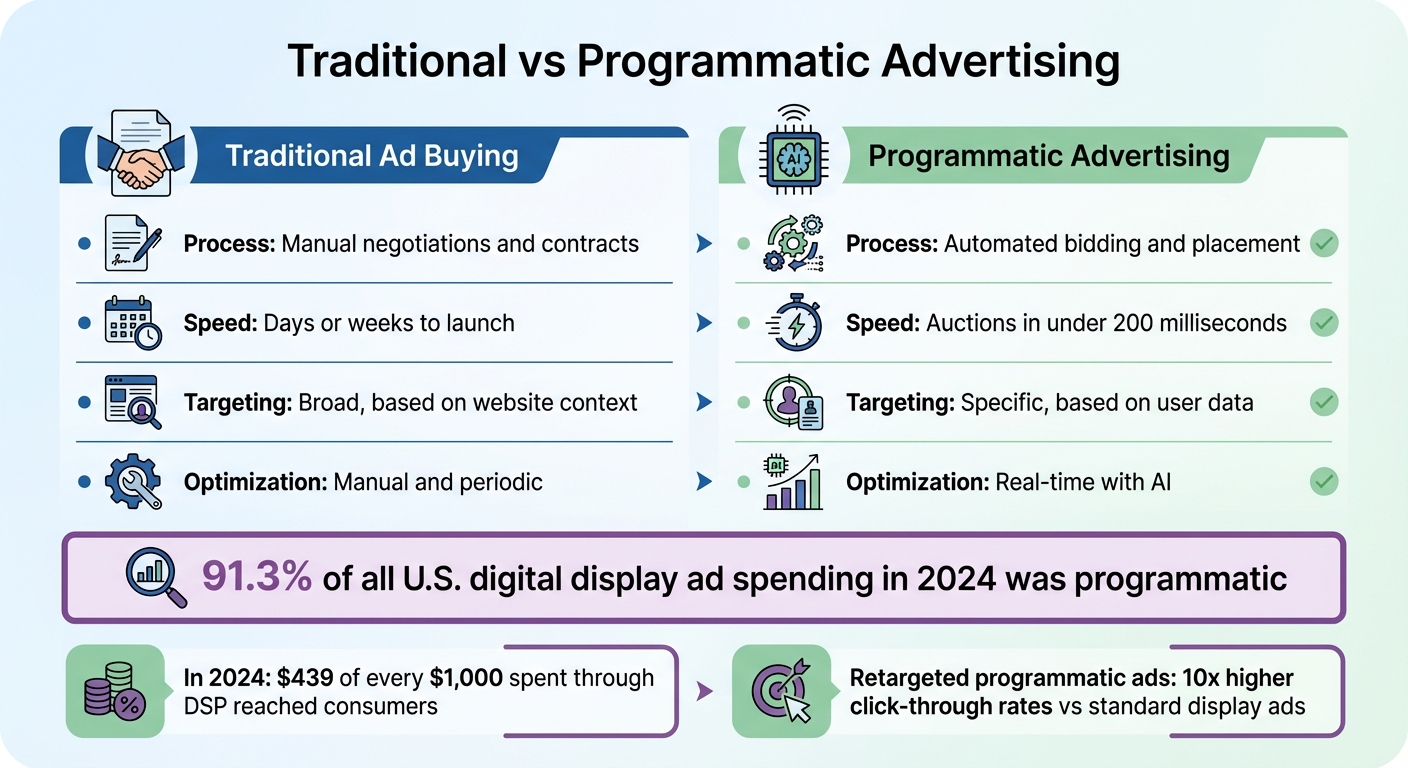
Traditional vs Programmatic Advertising for Nonprofits
Programmatic advertising is a way to buy and sell digital ad space automatically, using software, artificial intelligence, and algorithms to make the process faster and more efficient. Instead of relying on lengthy negotiations and proposals, this method uses real-time bidding to secure ad placements - often in under a second.
Here's how it works: When someone visits a website, a request is sent out with key details like their location, demographics, and browsing history. This data helps determine whether the ad opportunity aligns with the campaign’s goals. The request is then forwarded to an ad exchange, where Demand-Side Platforms (DSPs) evaluate the opportunity. If it’s a match, the DSP places a bid, and the highest bidder wins the auction, displaying their ad to the user. All of this happens in under 200 milliseconds.
The system relies on several key players working together. DSPs handle the bidding and targeting for advertisers, while publishers use Supply-Side Platforms (SSPs) to manage their available ad space. Real-Time Bidding (RTB) is the auction process where most programmatic transactions occur. By 2024, programmatic advertising made up 91.3% of all U.S. digital display ad spending.
Programmatic advertising also offers advanced targeting. For example:
- Behavioral targeting focuses on users’ past actions, like frequent donations to charities.
- Contextual targeting places ads alongside related content, such as displaying a faith-based ad on a religious news site.
- Geotargeting narrows in on specific locations.
- Retargeting re-engages users who’ve already visited a website.
As Media Cause puts it:
"Programmatic advertising helps eliminate wasted spend by narrowing the focus to very specific audiences rather than targeting entire websites or sections of websites".
The efficiency gains are hard to ignore. In 2024, for every $1,000 spent through a DSP, $439 reached consumers - $79 more per $1,000 than the previous year.
How Programmatic Ads Differ From Traditional Advertising
Traditional advertising involves a lot of manual work - reaching out to publishers, negotiating prices, submitting proposals, and signing contracts. This process can take days or even weeks, and the targeting is often broad, with little control over who actually sees the ad.
Programmatic advertising flips the script. It uses software to handle everything automatically, from bidding to ad placement. Campaigns can launch almost instantly, and advertisers can target individuals based on detailed data profiles rather than relying on broad website categories. Decisions about who sees an ad, where it appears, and when it’s shown happen at the impression level.
Here’s a quick comparison:
| Feature | Traditional Ad Buying | Programmatic Advertising |
|---|---|---|
| Process | Manual negotiations and contracts | Automated bidding and placement |
| Speed | Days or weeks to launch | Auctions in under 200 milliseconds |
| Targeting | Broad, based on website context | Specific, based on user data |
| Optimization | Manual and periodic | Real-time with AI |
One of programmatic advertising’s standout advantages is real-time optimization. If an ad or audience isn’t performing well, the system adjusts automatically - no need to renegotiate or wait for a review. As Landon Bennett from AdReform explains:
"By automating the repetitive tasks, marketers can invest their time in optimizing campaigns and improving ad performance, which directly impacts the bottom line".
This streamlined, data-driven approach is particularly useful for organizations looking to maximize their outreach efforts.
Why It Matters for Faith-Based Nonprofits
For faith-based nonprofits, programmatic advertising offers a way to stretch limited resources while improving outreach. Staff at these organizations often juggle multiple responsibilities, leaving little time for the manual work traditional ad campaigns require. Negotiating contracts, fine-tuning placements, and making adjustments can be time-consuming and costly - both in terms of money and manpower.
Programmatic advertising simplifies this process. The automation handles ad placements, freeing up staff to focus on their core mission. The precision targeting ensures that ads reach the right audience - whether it’s donors with a history of giving, people engaged with specific social causes, or those in a particular geographic area.
Cost efficiency is another major benefit. Programmatic campaigns typically operate on a Cost Per Mille (CPM) model, meaning you pay per 1,000 impressions. While some vendors require a minimum spend of $5,000 to $10,000 per month to see meaningful results, the reduced waste from precise targeting makes it worthwhile. Retargeted programmatic ads, for example, achieve click-through rates nearly 10 times higher than standard display ads.
This technology supports the entire donor journey. It can build awareness with Connected TV ads, maintain visibility through display ads, and convert potential donors with retargeting - all within a single automated system. Considering that 76% of donors research a cause online within a week of seeing an ad, programmatic advertising ensures nonprofits stay visible throughout this process without requiring constant manual effort.
Key Benefits of Programmatic Ads for Faith-Based Nonprofits
Efficient Use of Time and Resources
Faith-based nonprofits often operate with small teams that wear many hats. Traditional advertising can be time-consuming, requiring tasks like negotiating ad placements, managing campaigns manually, and tracking performance. Programmatic advertising simplifies this process by automating these tasks. This means your team can focus on running impactful campaigns across several channels without getting bogged down in the details, freeing up more time to focus on your mission. Plus, automation ensures donor outreach is handled with greater precision.
Better Donor Targeting
Finding the right donors isn’t just about reaching as many people as possible - it’s about reaching the right people. Programmatic advertising leverages detailed data to identify potential donors who are already engaging with content relevant to your cause, such as religious news or humanitarian topics, or who fit specific demographic profiles. It also uses lookalike modeling, analyzing your current donor data to find new supporters with similar traits. Once this precise targeting is in place, programmatic ads help expand your reach even further.
Multi-Channel Reach
Today’s donors interact with content across a wide range of platforms, from streaming TV and podcasts to websites and social media. Programmatic advertising allows you to run campaigns seamlessly across all these channels, ensuring your message stays visible as donors move between platforms. For example, a potential donor might first see a video ad on streaming TV, encounter a display ad while browsing online, and later be retargeted with another ad. This multi-channel approach keeps your organization top of mind throughout their journey.
Higher ROI and Donor Acquisition
With its precise targeting and ability to manage campaigns across multiple platforms, programmatic advertising helps maximize ROI by cutting down on wasted spending and optimizing bids in real time. On average, nonprofits spend just $0.06 on digital ads for every dollar raised online. When it comes to acquisition costs, the numbers vary: search ads average $46 per donation, social ads $86, and display ads $178. Programmatic platforms also track view-through conversions, which capture donors who see an ad and later visit your site to donate. This is especially useful since most donors take around two weeks to research before making a gift. By providing a clearer picture of ROI, programmatic advertising helps nonprofits make smarter investment decisions.
Getting Started with Programmatic Advertising
Setting Campaign Goals
Start by defining what you want to achieve: is it raising awareness, driving consideration, securing conversions, or building loyalty? Your specific goal might be something like raising $50,000 for a building project, recruiting 100 volunteers for a community event, or introducing your mission to 10,000 new people in your area. Each objective will shape your strategy and the way you approach your campaign.
Make sure your goal aligns with where your audience is in their journey. This alignment will help you choose the right ad formats and messaging for maximum impact.
"Calculate the true cost of donor acquisition and compare that to the lifetime value of that donor. You'll often find the cost to acquire a donor is greater than their first donation, which is why the funnel cannot stop at conversion." - Joe Frye, Digital Marketer
Once your goals are clear, focus on selecting the platforms that will best connect you with your intended audience.
Choosing the Right Platforms
Programmatic advertising relies on Demand-Side Platforms (DSPs) - software systems that automate the purchase of ad space across thousands of websites and apps. Popular options include Google DV360 and The Trade Desk. Google DV360, for example, gives access to over 80 ad exchange networks, covering about 90% of online ad spaces. This makes it a powerful choice for nonprofits aiming to reach a broad audience.
Keep in mind, most programmatic platforms require a minimum monthly spend between $5,000 and $10,000, with some, like Google DV360, potentially needing up to $50,000 per month. If your budget is below $10,000, you might find greater value in focusing on search or social media ads. Additionally, qualifying 501(c)(3) nonprofits can take advantage of Google Ad Grants, which provide up to $10,000 per month in free search advertising. This can complement your programmatic efforts and extend your reach.
After choosing your platforms, the next step is to leverage data to fine-tune your targeting strategy.
Using Data for Targeting
The true strength of programmatic advertising lies in its ability to use data for precise targeting. Start by tapping into your first-party data - information you already have about your donors, email subscribers, and website visitors. Use this data to create custom audience segments. From there, lookalike modeling can help you identify new people who share similar traits with your most engaged supporters.
You can also enhance your efforts by incorporating third-party data to reach individuals interested in topics like religious content, humanitarian causes, or charitable efforts. Another effective approach is contextual targeting, which places your ads on websites or pages that align with your mission - such as faith-based blogs, social issue news sites, or other relevant content hubs.
Don’t forget about retargeting. Serving ads to people who have already visited your website helps keep your organization top of mind. To do this effectively, install a tracking pixel on your site as soon as possible. Even if you're not ready to launch a full campaign, this will allow you to start gathering valuable data for future retargeting efforts.
sbb-itb-deea482
How Share Services Supports Programmatic Advertising for Nonprofits
Share Services helps nonprofits harness the power of precise, automated campaigns, making programmatic advertising accessible and effective.
Pricing and Plans Overview
Share Services caters to nonprofits with annual revenues between $1 million and $20 million, offering a straightforward pricing model divided into three components:
- Strategy Retainer: Starting at $3,500 per month, this includes strategist support, weekly planning sessions, project management, and tracking of key performance indicators (KPIs).
- Monthly Project Budget: Priced at $3,000 per month, this covers branding, graphic design, web design, copywriting, donation page improvements, and conversion rate optimization.
- Paid Media Spend: Beginning at $1,500 per month, this budget is allocated toward Meta ads, over-the-top (OTT) streaming services, Google Ad Grant management, analytics, and donor acquisition tracking.
This three-tiered pricing structure allows faith-based nonprofits to access professional programmatic advertising services at a lower entry cost compared to traditional platforms, which often require a minimum monthly spend of $5,000 to $10,000 for effective results.
| Plan Component | Monthly Investment | What's Included |
|---|---|---|
| Strategy Retainer | $3,500 | Strategist support, weekly sessions, project management, KPI tracking |
| Monthly Project Budget | $3,000 | Branding, design, copywriting, donation pages, conversion optimization |
| Paid Media Spend | $1,500 | Meta ads, OTT ads, Google Ad Grant management, analytics, donor acquisition |
This transparent pricing model ensures nonprofits can run campaigns that genuinely connect with faith-based audiences.
Benefits for Faith-Based Organizations
Share Services places a strong emphasis on trust, storytelling, and community engagement. Their campaigns go beyond simply running ads, employing a four-stage framework known as the Digital Discipleship Funnel: Attract, Engage, Convert, and Disciple. This method not only enhances efficiency but also ensures precise targeting of donors, offering an affordable and cohesive solution.
Faith-based donors often take time to develop trust before making financial commitments. Share Services respects this process by segmenting audiences based on giving history and interests, creating customized campaigns that align with the donor journey while optimizing ad spend. They handle the technical heavy lifting, such as setting up tracking pixels for view-through conversions and managing data platforms for precise audience targeting.
To protect your brand, Share Services ensures that ads are displayed only on vetted websites. This approach enables smaller nonprofits to leverage advanced programmatic advertising tools without needing in-house experts or grappling with complex demand-side platforms on their own.
Best Practices for Faith-Based Programmatic Campaigns
Prioritize Data Privacy and Compliance
For faith-based nonprofits, safeguarding donor trust means adhering to privacy regulations like GDPR and CCPA. Platforms such as Google emphasize that sensitive details - like religion, health, race, or sexual orientation - aren’t used to personalize ads. To stay compliant, consider using consent management tools to handle cookie and tracking permissions effectively. Privacy-safe frameworks like IAB Europe's TCF v2.0 can help ensure your ad systems honor user consent across different platforms. Also, completing advertiser identity verification programs provides transparency, allowing donors to see verified details like your organization’s name and location behind each ad. Instead of depending on third-party data, focus on creating custom first-party segments based on your existing supporters' behaviors.
Once privacy measures are in place, you can shift your attention to crafting campaigns that balance raising awareness with driving meaningful engagement.
Optimize Campaigns for Awareness and Action
To effectively connect with donors, your campaigns should aim to increase awareness while encouraging action. Strong campaigns guide donors through their entire journey, not just toward a single donation. Research shows that donors often spend time exploring causes online before making contributions, so staying visible during this decision-making period is critical. Use formats like CTV, audio streaming, and native ads to share your story and educate potential donors in a non-intrusive way. Since donors typically take about two weeks to research before giving, remarketing strategies are essential. These tactics keep your mission at the forefront and help you reach new prospects who exhibit similar behaviors.
Measure Key Performance Indicators (KPIs)
Measuring and analyzing campaign performance is essential for precision targeting. Track specific KPIs tailored to each stage of the donor journey. For awareness campaigns, focus on metrics like reach, frequency, and impressions. When targeting conversions, monitor cost per acquisition (CPA), return on ad spend (ROAS), and view-through conversions. View-through conversions are particularly useful in programmatic advertising, as they capture users who see your ad and later visit your site to donate without clicking directly. To ensure accurate data collection, use tracking pixels provided by vendors, as tools like Google Analytics may undercount the full impact of programmatic efforts. Additionally, keep an eye on ad frequency to avoid creative fatigue, which can hurt performance even when overall reach remains steady. Real-time optimization allows you to reallocate budgets quickly from high-CPA placements to better-performing ones.
| Funnel Stage | Primary Goal | Key Performance Indicators (KPIs) |
|---|---|---|
| Awareness | Reach new potential donors | Impressions, Reach, Frequency, View-Through Rate |
| Consideration | Engage interested users | Click-Through Rate, Time on Site, Bounce Rate |
| Conversion | Drive immediate action | Conversion Rate, Cost Per Acquisition, ROAS, View-Through Conversions |
| Loyalty | Retain existing supporters | Lifetime Donor Value, Repeat Engagement Frequency |
Regularly review campaign reports to spot signs of invalid traffic, which can drain your budget. Non-optimized campaigns can experience ad fraud rates as high as 10.9%, whereas protected campaigns typically see rates between 0.6% and 0.7%.
Conclusion
Programmatic advertising gives faith-based nonprofits a powerful way to connect with more people while keeping budgets in check. With AI-driven targeting, your organization can reach potential supporters across platforms like Connected TV, audio streaming, mobile apps, and trusted websites - meeting them where they already spend much of their time online.
Here's a key stat: 75% of donors research causes online, and 76% of them do so within a week of seeing an ad. With over 60% of nonprofits already using advertising and 50% planning to increase their budgets this year, this is the perfect moment to embrace these tools.
What’s great about this technology is that it supports every stage of the donor journey - from building awareness to driving conversions. As Don Dodds, Chief Marketing Strategist at M16 Marketing, explains:
"Digital marketing isn't just a channel - it's a mission multiplier. The right strategies can amplify reach, deepen community engagement, and significantly boost donations without bloated budgets".
To make the most of these benefits, start by setting clear goals for your campaigns. Whether you're aiming to raise awareness about your ministry, bring in new monthly donors, or reconnect with past supporters, clarity is key. Use privacy-compliant targeting strategies, leveraging first-party data from your current community. Keep in mind, most programmatic vendors require a minimum spend of $5,000 to $10,000 per month. However, eligible 501(c)(3) organizations can take advantage of up to $10,000 monthly in free search advertising through Google Ad Grants.
FAQs
What are the benefits of programmatic advertising for faith-based nonprofits?
Programmatic advertising uses AI-powered technology to automate the buying of digital ad space, making it easier for nonprofits to target specific audiences with incredible accuracy. By analyzing data like demographics, interests, and online behavior, faith-based organizations can connect with people who are more likely to resonate with their mission and values. The result? Every ad dollar works harder and smarter.
For faith-based nonprofits, this approach is especially valuable. It enables them to reach younger and more diverse audiences while staying true to the trust and storytelling that are core to their mission. Plus, real-time analytics provide a clear window into donor behavior - tracking actions like clicks, donations, and overall engagement. This means organizations can tweak campaigns on the fly to improve outcomes, ensuring their efforts deliver maximum results. Whether it’s acquiring new donors, keeping current supporters engaged, or stretching a tight budget, programmatic ads make a measurable difference.
Working with a partner like Share Services can make this process even easier. They offer tailored solutions specifically designed for faith-based groups, including programmatic media buying, donor-centered messaging, and digital fundraising strategies. With this kind of support, ministries can expand their reach, deepen donor relationships, and amplify their mission with greater effectiveness.
How is programmatic advertising different from traditional advertising?
Programmatic advertising relies on automated technology to buy and sell ad space in real-time. This method uses data-driven targeting and flexible pricing, making it an efficient way to reach audiences. Tools like real-time bidding and audience segmentation allow organizations to tailor their campaigns and optimize their reach.
On the other hand, traditional advertising depends on manual processes for ad placement. It often involves fixed-price agreements within specific publisher networks. While this approach can work for certain campaigns, it generally lacks the flexibility and precise targeting capabilities that programmatic advertising offers.
For faith-based nonprofits, programmatic advertising presents an opportunity to connect with donors and supporters more effectively. By ensuring your message reaches the right audience at the right moment, you can make a greater impact.
How can programmatic advertising help faith-based nonprofits reach the right donors?
Programmatic advertising leverages AI-powered tools to automate the process of buying digital ad space in real time. For faith-based nonprofits, this means reaching specific donor profiles by analyzing factors like browsing habits, interests, demographics, and even location. Instead of manually choosing websites to advertise on, your ads are shown to people who are most likely to resonate with your mission - like those exploring community service opportunities or consuming faith-related content.
This level of precision ensures that every advertising dollar works harder, connecting nonprofits with the right audience at the right moment. Plus, programmatic campaigns offer the ability to continuously test and refine strategies, which can boost donor engagement and increase conversions. Share Services partners with faith-based organizations to design and manage these campaigns, helping them strengthen connections with supporters and expand their reach effectively.
Related Blog Posts
Get helpful resources, straight to your inbox
We love sharing tools, ideas, and stories that make nonprofit work a little lighter and a lot more effective. Sign up below and we’ll send you practical tips, free resources, and a bit of encouragement—because the work you’re doing matters.
No spam. Just good stuff for good people.