

Dec 14, 2025
Case Study: Faith-Based Ad Campaigns That Worked
Faith-based nonprofits often face challenges like limited resources, misconceptions about their mission, and skepticism toward marketing. However, strategic digital advertising can help these organizations grow their reach, engage new audiences, and boost donations.
Key takeaways from successful campaigns include:
- Summit Ministries: Increased student registrations by 55% using targeted Facebook ads and retargeting strategies.
- Pushpay: Generated over 130,000 content leads for church leaders through Google Ads, Facebook videos, and email campaigns.
- The Life Book: Achieved 78,000 actions via Google Ad Grants by focusing on high-intent keywords and refining ad performance.
What worked? Clear goals, precise audience targeting, and multi-channel strategies like combining Google Ads, social media, and email campaigns. These examples show how nonprofits can maximize their impact by investing in well-planned digital marketing efforts.
I Tested 1,000+ Church Ads…Here's 10 That Actually Work
3 Faith-Based Ad Campaigns That Delivered Results
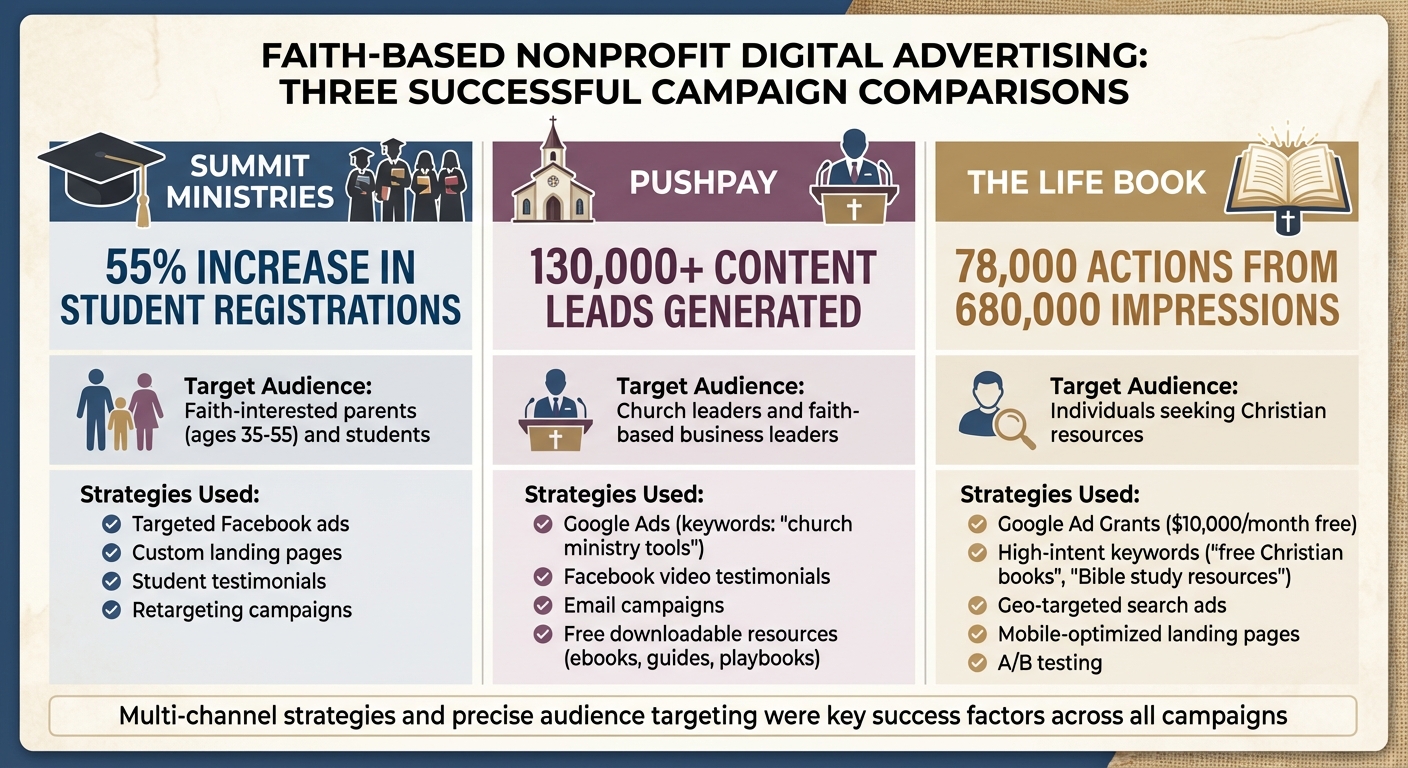
3 Faith-Based Digital Ad Campaign Results: Summit Ministries, Pushpay, and The Life Book
These campaigns highlight how setting clear objectives and using smart digital strategies can lead to measurable success. Each example illustrates a unique approach that helped further their mission.
Summit Ministries: 55% Growth in Student Registrations
Summit Ministries initially faced challenges due to broad targeting in a competitive keyword environment. To address this, they refined their focus to reach faith-interested parents (ages 35–55) and students exploring faith-based education. They launched targeted Facebook ads complemented by custom landing pages featuring compelling calls-to-action and testimonials. By testing various creatives - including student testimonials - and leveraging retargeting, they achieved a 55% increase in registrations, advancing their educational mission.
Pushpay: Over 130,000 Content Leads for Church Leaders
Pushpay built meaningful connections with a niche audience of faith-based business leaders by running sustained, multi-channel campaigns. They utilized Google Ads targeting keywords like "church ministry tools", Facebook video testimonials, and follow-up email campaigns. A standout tactic was offering free downloadable resources, such as ebooks on donor management, giving guides, and ministry playbooks, which resonated with church leaders seeking practical insights and strategies.
By guiding these leads through personalized content funnels - combining search ads, social media, and email sequences - Pushpay generated more than 130,000 content leads.
The Life Book: 78,000 Actions Through Google Ad Grants
The Life Book made the most of Google Ad Grants, which provides nonprofits up to $10,000 per month in free search advertising. Their campaigns focused on high-intent keywords like "free Christian books" and "Bible study resources." Using geo-targeted search ads, they directed users to mobile-optimized landing pages with clear conversion paths.
Despite strict compliance rules, such as maintaining a 5% click-through rate, The Life Book continuously refined their ad copy and landing pages through A/B testing. This disciplined approach resulted in 78,000 actions, including resource distributions, sign-ups, and donations, from 680,000 impressions - helping them effectively distribute Christian resources.
What Made These Campaigns Work
When analyzing these case studies, three standout elements emerged as the backbone of success: clear, audience-focused goals, precise targeting, and data-driven refinement. Each organization set a specific goal - whether it was increasing student registrations, driving content downloads, or maximizing the impact of a Google Ad Grant. From there, they aligned their creative strategies, channels, and calls to action to ensure every piece worked toward achieving that objective. These components worked together seamlessly to build effective campaigns.
Better Audience Targeting
The standout campaigns excelled at aligning their message, timing, and offer with specific subgroups within the broader faith community. Summit Ministries, for example, directed their efforts toward faith-driven parents and students exploring Christian education. Pushpay honed in on church leaders searching for practical ministry tools, while The Life Book connected with individuals actively seeking free Christian resources. By segmenting their audiences based on life stage, behaviors, or interests, these organizations were able to craft messaging that resonated deeply. This tailored approach consistently led to higher engagement and conversion rates.
Using Multiple Channels Together
A multi-channel approach proved to be a game-changer, creating more touchpoints and smoother paths to conversion. Pushpay, for instance, didn’t just rely on Google Ads. They paired search campaigns with Facebook video testimonials and follow-up email sequences. This cohesive strategy guided church leaders from initial awareness to final sign-up. Data consistently shows that multi-channel strategies outperform single-channel efforts by providing a more comprehensive user experience. When combined with targeted messaging, this approach amplified overall campaign results.
Measuring and Improving Campaign Performance
Success didn’t stop at launching the campaigns - ongoing measurement and refinement played a critical role. Each campaign closely monitored engagement, conversion, and revenue metrics to identify what worked and what didn’t. Metrics like click-through rates helped gauge message relevance, cost per lead evaluated efficiency, and landing page conversion rates revealed the strength of the offer. For example, The Life Book used A/B testing to refine their ad copy and landing page designs, ensuring they continually improved user engagement.
"It costs less to reactivate a lapsed donor than to acquire a new one. Email can be effective, but multi-channel approaches are even better. We did this with Focus and saw great results for them." - Eddie Laing, Paid Media Specialist
sbb-itb-deea482
How to Apply These Strategies with Share Services
Share Services' Support for Faith-Based Campaigns
Take inspiration from campaigns like Summit Ministries, which achieved a 55% boost in registrations, or The Life Book, which generated 78,000 opportunities. Share Services focuses on helping ministries with annual revenues between $1M and $20M design and implement digital strategies that align their spiritual mission with measurable results. Their process begins by identifying your ministry's core message, unique traits, and donor motivations. These insights are then transformed into campaigns with clear objectives, a strong visual identity, and messaging that aligns closely with your mission.
This approach mirrors the methods used in the case studies: setting specific goals such as email signups, event registrations, or recurring donations, and creating landing pages and ad materials that drive both spiritual and tangible outcomes. Share Services integrates these ad campaigns with email workflows, content plans, and donor retention strategies to nurture long-term relationships. Their services include digital fundraising, brand and messaging development, donor retention strategies, new donor acquisition, and digital marketing and advertising on platforms like Meta and Google.
Expanding Reach with Paid Media Spend Plans
On top of campaign strategies, targeted ad spending can help broaden your ministry's reach. Share Services offers a Paid Media Spend plan starting at $1,500 per month, allocating budgets strategically between Meta and Google ads (e.g., a 60/40 split) based on your goals. For example, Meta lead generation ads could promote devotionals or webinars, while Google search ads might target intent-driven queries like "Christian youth programs" or "church leadership training."
During the first two months, Share Services focuses on building a solid campaign foundation. This includes defining target audiences (such as church leaders, Christian parents, or mission-driven donors), refining landing pages, setting up tracking tools, and testing multiple ad variations through A/B testing. From months three to six, the focus shifts to optimization - adjusting ad creative, audience targeting, and bidding strategies based on performance metrics like click-through rates, cost per lead, and return on ad spend.
This approach often leads to a noticeable increase in qualified leads, such as resource downloads and email signups, as well as early signs of donor growth. Over time, as leads progress through follow-up campaigns, the return on investment becomes even clearer. Additionally, the plan includes management of Google Ad Grants, offering up to $10,000 per month in free search advertising for eligible nonprofits, ensuring you make the most of this resource alongside your paid campaigns.
Getting Expert Guidance Through Strategy Retainers
While targeted ad spending can deliver quick wins, long-term success requires a more comprehensive approach. For sustained growth, consider a strategy retainer that aligns digital advertising, email outreach, and donor engagement into one cohesive plan. Share Services offers a Strategy Retainer starting at $3,500 per month, which provides access to a dedicated nonprofit strategist, weekly strategy sessions, project management, and detailed KPI reporting. This ensures your efforts across fundraising, events, and donor communications are fully coordinated.
This type of retainer is particularly valuable for ministries seeking expert guidance across multiple channels. Instead of relying on isolated tactics, Share Services brings everything together into an integrated strategy, much like successful nonprofit campaigns often do. They help refine your ministry and fundraising objectives, align them with specific audience segments, and develop a unified plan where ads, emails, landing pages, and follow-ups all work together to deepen engagement with your mission.
What Faith-Based Nonprofits Can Learn
Why Marketing Investment Matters
The campaigns highlighted in this article all share a crucial takeaway: consistent and strategic marketing investment drives measurable ministry growth. For organizations that see marketing as a tool to amplify their mission rather than a competing expense, the results can be transformative.
For faith-based nonprofits with revenues between $1 million and $20 million, dedicating 5–10% of donations to marketing creates a framework for testing and growth. Start with a clear budget - say $1,500–$3,000 per month - and track metrics like cost per lead and cost per new donor. Expand your efforts only when the data confirms success. The key is tying specific marketing expenses to tangible ministry outcomes. When leadership sees a direct connection between ad spend and results like student registrations, prayer requests, or digital Bible study signups, marketing shifts from being seen as optional to an essential part of stewardship. By monitoring clicks, signups, and donations, organizations can quickly identify underperforming ads, reallocate funds to what works, and build momentum over time. This approach underscores the importance of a structured, goal-driven strategy for digital campaigns.
Getting Started with Your Ad Campaigns
Begin by setting a clear and measurable goal, such as gaining 500 email subscribers within 90 days. Focus on 2–3 key audience groups - like parents of teenagers, young adults aged 18–30, or current donors - and craft messaging tailored to each group. Offer something valuable to draw people in, such as a free devotional series or a downloadable guide that ties directly to your mission.
Establish a starter budget in U.S. dollars and define a test period, such as 90 days, to evaluate your campaign's performance. Choose one or two platforms to begin - Google Ads or Google Ad Grants paired with Facebook/Instagram are great starting points - and set up conversion tracking from the outset. Create dedicated landing pages and email follow-up sequences to ensure every click leads to meaningful engagement. Plan biweekly reviews to pause ads that aren’t delivering and double down on the ones that are.
For ministries accustomed to relying on word-of-mouth or in-person events, digital ads don’t replace personal outreach - they enhance it. Share Services provides structured support tailored to faith-based nonprofits, offering help with digital fundraising, branding, donor retention strategies, and paid media management. Their process begins with discovery and audience analysis, translating those insights into campaigns with clear goals, compelling visuals, and mission-aligned messaging. Whether you’re considering a Paid Media Spend plan starting at $1,500 per month or a more comprehensive Strategy Retainer starting at $3,500 per month, expert guidance ensures every dollar contributes to expanding your ministry’s reach and impact.
FAQs
How can faith-based nonprofits use digital advertising to make the most of limited resources?
Faith-based nonprofits have a powerful opportunity to expand their reach and strengthen their mission through digital advertising with a multi-channel approach. This means tapping into tools like email campaigns, display ads, retargeting, text messages, and even voicemail to connect meaningfully with both loyal donors and potential new supporters.
The key lies in crafting clear and concise messages that resonate. By incorporating paid retargeting ads, organizations can increase conversion rates and maintain donor loyalty - all while staying within budget. These tactics help nonprofits make the most of their resources, ensuring they can grow their mission and make a bigger impact in their communities.
What makes a multi-channel ad strategy effective for faith-based organizations?
An effective multi-channel advertising strategy for faith-based organizations brings together several communication methods, such as email, voicemail, text messaging, paid ads, and retargeting. When used together, these channels can help connect with supporters, re-engage donors who may have drifted away, and reach entirely new audiences.
The key to success lies in clear and concise messaging that resonates with your audience. Retargeting ads, in particular, are a great way to reconnect with past supporters, encouraging them to take meaningful action. By weaving these strategies together, organizations can strengthen donor acquisition, improve retention, and drive deeper engagement.
What are the best ways for faith-based organizations to evaluate and improve their ad campaigns?
Faith-based organizations can fine-tune their ad campaigns by keeping a close eye on essential performance metrics like conversion rates, donor retention, and acquisition costs. Tools for digital analytics and retargeting can provide insights into what’s effective and where improvements are needed.
To get better results, it's important to experiment with different messaging, visuals, and platforms. A multi-channel strategy - mixing email, text, voicemail, and paid ads - can boost donor engagement and broaden outreach efforts. Regularly analyzing performance data and making adjustments ensures campaigns stay on track for long-term success.
Related Blog Posts
Get helpful resources, straight to your inbox
We love sharing tools, ideas, and stories that make nonprofit work a little lighter and a lot more effective. Sign up below and we’ll send you practical tips, free resources, and a bit of encouragement—because the work you’re doing matters.
No spam. Just good stuff for good people.