
Dec 18, 2025
Case Study: Facebook Ads for Church Fundraising Success
Churches are turning to Facebook ads to connect with their communities, reduce costs, and increase donations. Traditional methods like newspaper ads are expensive and less effective, while targeted Facebook campaigns deliver measurable results at a fraction of the cost.
Key Takeaways From Grace Central Coast's Campaign:
- Budget: $5,000 spent on ads raised $45,000, achieving a 9x return on ad spend.
- Reach: Over 25,000 people reached, with 400 new donors acquired.
- Engagement: 83 event responses for campus launches and 25% of new donors contributing again within 30 days.
- Targeting: Custom and Lookalike Audiences helped focus on local supporters and past donors.
- Ad Formats: Testimonial videos and carousel ads led to 2x higher engagement and 25% more clicks.
Challenges and Solutions:
- Ad Fatigue: Introduced 5 new creatives weekly to maintain engagement.
- Tracking Issues: Used server-side event tracking to counter iOS privacy changes.
This success shows that even a modest budget, paired with focused targeting and compelling content, can significantly boost fundraising efforts. Churches can also improve results by combining Facebook ads with email campaigns, timing efforts around peak donation seasons, and leveraging recurring donor programs.
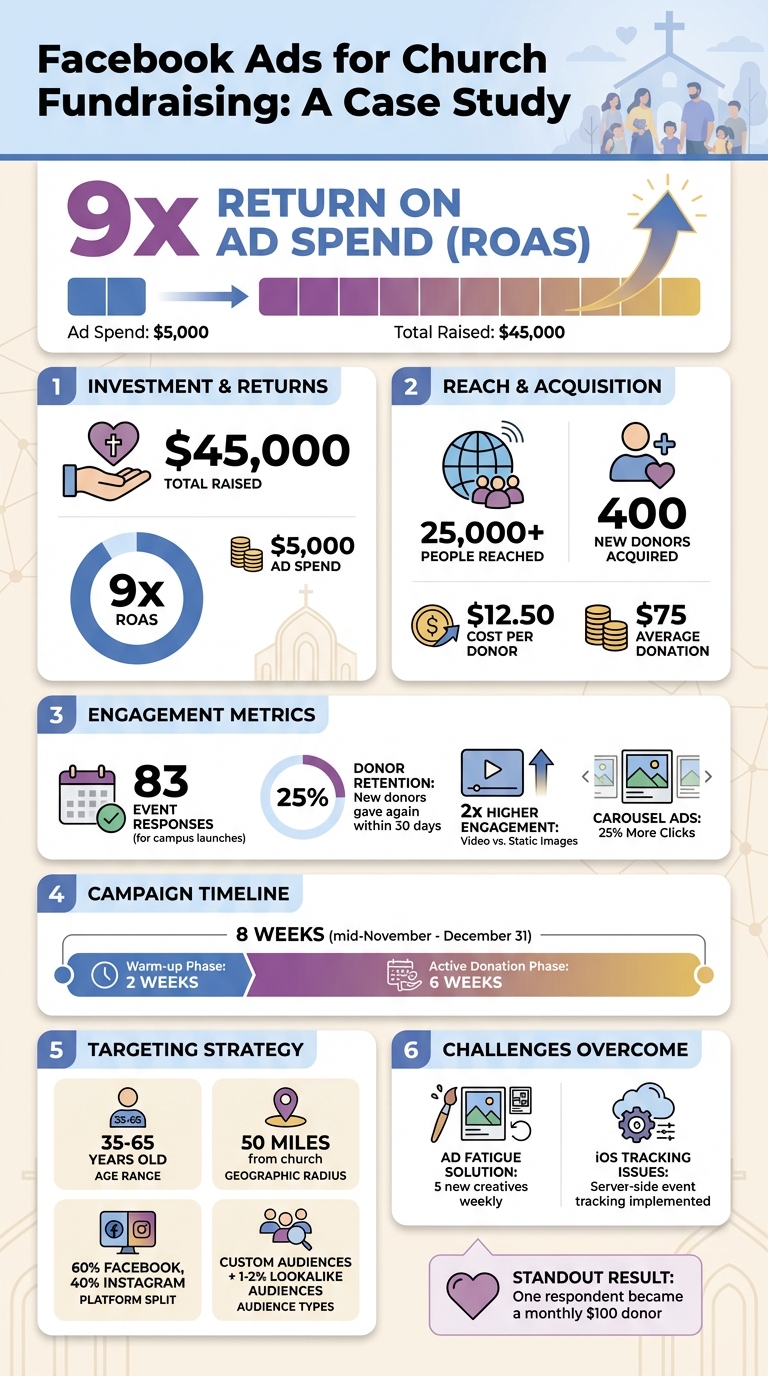
Grace Central Coast Facebook Ads Campaign Results: $5K Investment Generated $45K in Donations
Campaign Planning and Setup
Setting Fundraising Goals and KPIs
Grace Central Coast established a clear financial target aimed at supporting new campus launches. They measured success through event responses and overall campaign reach. To ensure the ads performed effectively, they focused on specific metrics tied to community engagement and outreach impact.
The team outlined both primary and secondary fundraising goals. For example, the primary objective was to "Raise $30,000 in four weeks for our outreach center." Secondary goals included acquiring 150 first-time donors, reactivating lapsed contributors, and growing their email list by 400 local contacts. To fine-tune their strategy, they monitored key metrics like cost per donor, return on ad spend (ROAS), and landing page conversion rates. These insights helped them adjust their approach as needed.
Identifying the Target Audience
Once the goals and metrics were set, the next step was identifying the right audience. Grace Central Coast used a layered targeting strategy to connect with supporters most likely to engage. They started by leveraging their internal data - such as email lists, past donation records, and volunteer rosters - to build Custom Audiences. This allowed them to retarget their warmest supporters effectively.
They also created Lookalike Audiences with 1–2% similarity, focusing on individuals in their local area who shared traits with their most active members. For broader outreach, they targeted people living within a 5–15 mile radius of their campuses. Interests related to faith, family, and community involvement were layered into this targeting to ensure relevance. By segmenting current donors and new prospects into separate ad sets, the church tailored messaging to each group and compared performance metrics to optimize results.
Creating Ad Content and Messaging
One standout ad featured a heartfelt story of someone reconnecting with the church community and becoming a volunteer. The messaging was simple yet impactful, with calls to action like "Join us for our launch Sunday" and details about what attendees could expect.
To find the most effective combinations, the church tested various elements, including photos, videos, headlines, and calls to action. Recognizing that most users access Facebook on their phones, they ensured that their landing pages were mobile-friendly. Facebook pixel tracking played a key role in capturing clicks, event responses, and donations, allowing real-time adjustments to the campaign strategy.
Campaign Execution and Results
Campaign Timeline and Phases
Grace Central Coast planned their campaign to run over 8 weeks, from mid-November through December 31, aligning with the peak donation period in the U.S., when 30–40% of annual charitable contributions are typically made. The first 2 weeks were dedicated to a warm-up phase, aimed at building awareness. During this time, testimonial videos were used to engage the audience and create retargeting opportunities.
For the remaining 6 weeks, the focus shifted to driving donations. This phase was timed to coincide with Giving Tuesday and the December donation rush, ensuring the campaign took full advantage of the heightened generosity during this season. The phased approach allowed for a mix of ad formats and placements to maintain engagement and drive conversions effectively.
Ad Formats and Placement Choices
The campaign utilized a variety of ad formats, including 15–30 second testimonial videos, carousel ads showcasing building renovations and ministry projects, and single-image static ads with direct calls-to-action for donations. The videos proved particularly effective, generating 2x higher engagement rates compared to static images. Meanwhile, carousel ads boosted click-through rates by 25%, as they allowed multiple stories to be shared within a single ad.
Ads were primarily shown on the Facebook News Feed and Stories, with 40% of the budget allocated to Instagram Feed and Reels. This allocation helped reach younger audiences while maintaining a broad appeal. The campaign targeted U.S. users aged 35–65 within 50 miles of the church, focusing on individuals interested in Christianity, nonprofits, and community service. Additionally, lookalike audiences based on past donors were used to expand the reach, ultimately connecting with over 25,000 potential supporters.
Performance Data and Outcomes
With a modest ad spend of $5,000, the campaign raised an impressive $45,000, achieving a 9x return on ad spend (ROAS) - far exceeding the typical range of 4–6x. The cost per donor was $12.50, and the average donation amounted to $75.
The campaign brought in 400 new donors, marking a 15–20% increase in their donor base. Notably, 25% of these new donors made additional contributions within 30 days, indicating strong retention potential. One standout example was a respondent who became a monthly $100 donor, highlighting the potential for long-term donor relationships.
However, the team encountered some challenges. By week 4, ad fatigue set in, causing click-through rates to drop by 15%. To address this, they introduced 5 new creatives each week and conducted A/B testing with different headlines to refresh engagement. Additionally, iOS privacy updates impacted tracking accuracy, but the team countered this issue by implementing server-side event tracking alongside the Facebook pixel.
Lessons Learned and Best Practices
What Delivered the Best Results
Grace Central Coast's campaign showed that video testimonials can make a big difference. Short clips featuring real church members and ministry beneficiaries resonated deeply, creating emotional connections that generic appeals simply couldn't match. These personal stories highlighted the real-world impact of the church’s work, leading to higher engagement.
Local targeting also played a key role in the campaign’s success. By focusing on audiences interested in Christianity and nonprofit initiatives within their community, the church reached people who were already inclined to support faith-based efforts.
Another standout strategy was clear, project-specific messaging. By tying donations to visible outcomes - like funding building renovations, youth programs, or community outreach - the church made it easy for donors to see the direct impact of their contributions. This clarity not only increased click-through rates but also encouraged larger donations.
Problems Encountered and Solutions Applied
While the campaign achieved plenty of wins, it wasn’t without its challenges. These hurdles offered valuable insights for future efforts.
One issue was ad fatigue, which set in by the fourth week of the campaign. To address this, the team introduced five new creative variations each week and tested headlines through A/B testing to keep the content fresh and engaging.
Another challenge came from iOS privacy updates, which disrupted tracking accuracy. To overcome this, the team implemented server-side event tracking alongside the Facebook pixel, ensuring better data collection and analysis.
Additionally, limited digital marketing experience among staff initially slowed the campaign’s setup and optimization. However, with support from experts, the team simplified their messaging and fine-tuned their approach. As Jasmine Morse from a nonprofit’s Advancement Department shared:
"Share helped us test simplified + focused messaging that improved our conversion rates. Additionally, paid display ad retargeting was successful, and the recurring giving pop-up brought us almost 100 new monthly gifts."
These experiences highlight the importance of flexibility and strategic adjustments when challenges arise.
Practical Tips for Churches
Drawing from these lessons, here are some actionable strategies for churches looking to improve their Facebook ad campaigns:
- Start small and scale up. Even a modest budget can yield great results. For example, Fellowship Baptist Panama City reached over 3,000 people with just $45 in ad spend.
- Coordinate across multiple channels. Amplify your Facebook ads by pairing them with email campaigns, in-service announcements, website updates, and printed materials. This multi-channel approach ensures your message reaches a broader audience.
- Time your campaigns wisely. Focus on periods when giving naturally peaks - such as Giving Tuesday, the December donation season, Easter, or other key ministry events. Timing your ads strategically can significantly boost their effectiveness.
-
Retarget past donors. Don’t overlook the value of re-engaging those who have already supported your mission. As Eddie Laing, a Paid Media Specialist, puts it:
"Reactivation is cheaper than acquisition."
sbb-itb-deea482
Conclusion
Next Steps and Growth Opportunities
Grace Central Coast's success with Facebook ads highlights how strategic digital campaigns can lead to measurable fundraising achievements. This case study sheds light on several ways churches can continue to enhance their digital fundraising efforts.
One key opportunity lies in developing recurring donor programs. By turning one-time contributors into monthly supporters, churches can build a stable and predictable funding base. Collecting contact information through ad-driven campaigns also opens the door to automated email sequences, which can nurture relationships and encourage ongoing support.
Expanding into other digital platforms is another smart move. Instagram ads, for example, are great for visual storytelling, while email campaigns excel at building deeper connections with donors. A multi-channel strategy not only broadens reach but also reduces reliance on any single platform, creating multiple opportunities to engage potential supporters.
With expert guidance, these efforts can gain even more momentum.
How Share Services Can Help
Share Services specializes in helping faith-based nonprofits with revenues between $1–$20 million craft and execute comprehensive digital fundraising strategies. Their expertise spans digital marketing, donor retention, and acquiring new supporters.
Kyle Birch, Director of Communications, shared his experience working with Share Services:
"Share completed the project in months - a task that would have taken our small staff half a year."
Their offerings include a Strategy Retainer for $3,500 per month, which provides a dedicated nonprofit strategist and weekly planning sessions. Additionally, their Paid Media Spend service, priced at $1,500 per month, handles Meta Ads, analytics, and donor acquisition. This structured approach ensures churches can replicate the strategies that fueled Grace Central Coast's success - from initial planning to campaign execution and optimization.
The BEST Facebook Ads for Churches in 2026 (examples + scripts)
FAQs
What can churches do to prevent ad fatigue in their Facebook fundraising campaigns?
To keep Facebook fundraising campaigns effective and avoid ad fatigue, churches should focus on keeping their ads dynamic and appealing. Regularly refreshing visuals, headlines, and messages can help maintain interest and engagement. Experiment with targeting different demographics or interests to expand your reach while staying aligned with your mission.
It’s also a good idea to rotate your messaging to showcase different aspects of your cause. For example, highlight specific projects, share impactful success stories, or provide updates on ongoing initiatives. When using retargeting, do so carefully - re-engage those who’ve shown interest, but avoid overwhelming them with too many ads.
For a more engaging approach, combine Facebook ads with other outreach methods like email campaigns or community events. This multi-channel strategy can create a richer experience for your supporters and strengthen their connection to your mission.
What are the best strategies to get the most out of Facebook ads for church fundraising?
To get the most out of Facebook ads for church fundraising, prioritize retargeting previous donors while also reaching out to new supporters with clear and engaging messages. Experiment with various ad formats and messages to discover what connects best with your audience.
Combining Facebook ads with other digital tools can amplify results. This multi-channel strategy not only boosts conversions but can also inspire recurring donations. Keep your messaging straightforward, emphasize the impact of your mission, and make sure your ads direct donors toward taking meaningful action.
How have iOS privacy updates affected Facebook ad tracking for nonprofits?
Recent updates to iOS privacy settings have created challenges for Facebook ads, particularly when it comes to tracking user behavior. These changes restrict the data collected through tracking pixels, which means nonprofits may struggle with less precise targeting and fewer insights into how their campaigns are performing.
This shift can drive up ad costs and reduce the overall effectiveness of campaigns. To navigate these challenges, nonprofits should prioritize multi-channel strategies and emphasize retargeting to keep audiences engaged and optimize their fundraising efforts.
Related Blog Posts
Get helpful resources, straight to your inbox
We love sharing tools, ideas, and stories that make nonprofit work a little lighter and a lot more effective. Sign up below and we’ll send you practical tips, free resources, and a bit of encouragement—because the work you’re doing matters.
No spam. Just good stuff for good people.