

Jan 23, 2026
Social Proof Tips for Faith-Based Nonprofits
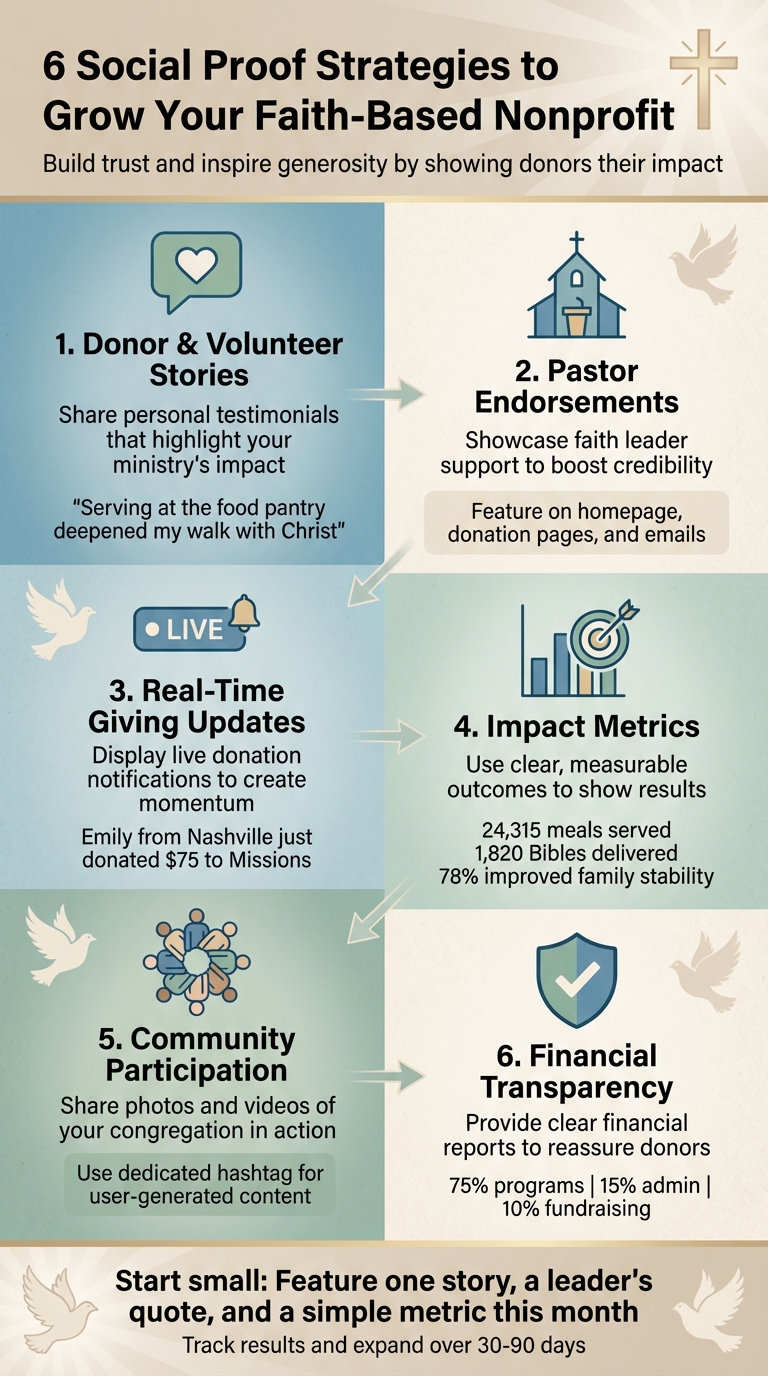
Want to grow your faith-based nonprofit? Social proof can help. It’s all about showing potential donors that others are already supporting your mission. By using real stories, pastor endorsements, giving updates, and impact data, you can build trust and inspire generosity. Here's how:
- Donor and Volunteer Stories: Share personal testimonials that highlight your ministry’s impact.
- Pastor Endorsements: Showcase faith leader support to boost credibility.
- Real-Time Giving Updates: Display live notifications of donations to create momentum.
- Impact Metrics: Use clear, measurable outcomes to show how contributions make a difference.
- Community Participation: Share photos and videos of your congregation in action.
- Financial Transparency: Provide clear financial reports to reassure donors.
Start small: feature one story, a leader’s quote, and a simple metric on your website or social media. Over time, collect more stories and data to strengthen your efforts. Tools like real-time donation notifications and progress bars can amplify your impact. For larger ministries, working with experts like Share Services can streamline your strategy and maximize results. The key? Show donors that their gifts are making a difference.
6 Social Proof Strategies for Faith-Based Nonprofits
1. Use Donor and Volunteer Testimonies
Stories from supporters build trust. When potential donors hear from real people - fellow community members rather than just staff - it adds authenticity and credibility. These personal accounts demonstrate that others in the faith community are already committed, making it easier for those on the fence to take that first step.
Focus on short, meaningful stories that tie a supporter's experience to God's work. Avoid general statements like "This ministry is amazing." Instead, aim for testimonies that reflect the tangible impact of your ministry. For instance:
"Serving at the food pantry deepened my walk with Christ and helped me see our neighbors the way Jesus does".
To make the most of these stories, streamline how you collect them. Use donation thank-you pages or volunteer surveys to invite supporters to share their experiences. Offer simple options for video or written responses with guided prompts. Encourage staff to gather stories during conversations and follow up with a quick form. Providing prompts and brief recording tools makes it easier for supporters to share, and always let them review their story before it’s published.
Always get written consent before sharing personal details. Use a release form specifying where the testimony will appear, such as your website, social media, or printed materials. Allow individuals to choose how they’re identified - full name, first name with last initial, or simply as a "long-time supporter." This not only respects privacy but also upholds your ministry’s reputation for integrity, which is an essential part of your Christian witness.
Feature one to three short quotes near your donation form, paired with a photo and location, like "Mark, donor from Dallas, TX". Use rotating carousels on your homepage and short vertical video clips on social media to showcase a variety of voices. These testimonials act as digital word-of-mouth, reinforcing your mission's credibility and showing potential supporters that a vibrant, active community stands behind your work.
2. Feature Pastor and Faith Leader Endorsements
Endorsements from faith leaders carry weight - they reflect shared values and provide a sense of trust, often inspiring congregants to contribute.
To build these connections, invite pastors and faith leaders to engage with your ministry. This could be through your website, events, or regular updates about your impact. Once a relationship is established, consider asking for a short endorsement, whether it’s a quick video or a concise quote. Using a customizable template can make this process easier for everyone involved.
Make sure these endorsements take center stage. Feature them prominently on your homepage, donation pages, and emails. Include the leader's photo, name, and church affiliation (with their permission) to add a personal and credible touch. Pair these endorsements with other elements, like donor testimonials or real-time giving updates, to weave a compelling story of trust and community participation.
Keep endorsements fresh by updating them periodically, especially during key fundraising seasons. This ensures your message stays relevant and continues to resonate with your audience.
3. Show Real-Time Giving Activity
Real-time giving updates can build trust and encourage others to take part. Imagine visiting a donation page and seeing a message like, "Emily from Nashville just donated $75 to Missions." It instantly reassures visitors that others are actively supporting your ministry, creating a ripple effect of generosity and involvement.
To make this even more effective, consider tools designed for this purpose. Platforms like Fundraise Up offer features such as live notifications - "James from Texas donated $250 to General Fund" - to highlight ongoing contributions. Similarly, WP Charitable's DonorTrust provides instant popups, such as "Sarah just donated $50," which not only build urgency but also foster a sense of community. These tools often allow donors to control how their information is displayed, whether they want their full name shown, just their initials, or to remain anonymous. This flexibility helps maintain trust while encouraging participation.
Strategically place these notifications on high-traffic areas like your homepage or donation pages. During live or virtual events, you can amplify this effect by showing a live giving thermometer on screens. As donations roll in - whether from mobile or online sources - it visually demonstrates collective progress, inspiring others to contribute. Many nonprofits have seen noticeable increases in donations shortly after implementing these features, as each new gift motivates others to join in.
Beyond dollar amounts, showcasing donor counts, such as "247 families have given so far," can emphasize the shared effort of the community. This approach resonates deeply, especially within congregational settings. Just make sure to use accurate, donor-approved data to keep the process transparent and trustworthy.
4. Share Impact Metrics and Ministry Results
When donors see clear, measurable outcomes - like meals served or Bibles delivered - they feel confident their contributions are making a difference. The trick is to focus on metrics that directly align with your ministry’s mission: think pastoral care provided, scholarships awarded, or youth completing leadership programs.
Start by identifying three to seven key outcomes that truly represent your work. Track both immediate outputs and long-term results. For instance, instead of just reporting the number of participants, share something like, "78% of program graduates reported improved family stability three months after completing the program." This kind of data shows the deeper, lasting impact of your efforts. Use headline numbers for public updates, but include detailed breakdowns in your annual report for those who want a closer look. Then, bring these numbers to life with visuals that tell your story.
Infographics are a fantastic way to make your data pop. Combine simple icons with short, bold phrases, such as a plate icon paired with "24,315 meals served in 2024" or a Bible icon labeled "1,820 Bibles delivered." Graphics showing growth - like "Partner churches: 5 → 19 since 2020" - help illustrate your ministry’s expansion. Keep the text concise, use large fonts for readability on mobile devices, and pair each number with real photos (with permission) to add a personal touch.
Connect donations to specific results. For example, explain that "$35 provides a spiritual care box for a family of four", or use progress bars to show collective achievements, such as "Goal: $50,000 for 200 campers; $37,500 raised for 150 campers." This approach not only highlights progress but also encourages others to contribute.
Transparency is key, especially for younger donors. Be clear about how you calculate your numbers, avoid exaggerations, and provide context. For example, you might say, "We served 612 families this year, a 22% increase from last year, as economic pressures grew in our community." Link to your annual report and audited financials, and pair big numbers with a personal story to show the human side of your work.
For ministries with budgets between $1–$20M, Share Services can help turn program outcomes into clear, donor-focused messaging that highlights your impact effectively.
sbb-itb-deea482
5. Display Community and Congregational Participation
Showcasing your ministry's community involvement can be a powerful way to highlight its impact. When people visit your website or social media, they’re not just looking for words - they want to see the life and energy of your congregation. Photos and videos of people worshiping, serving, and connecting bring your ministry’s work to life in a way that written descriptions simply can’t.
Capture moments that tell a story: volunteers organizing hygiene kits, youth groups mentoring children, small groups praying together, or members serving meals at a food pantry. These genuine, people-focused images show that your ministry is active, relational, and making a difference. Assign volunteers to take clear photos and short video clips, focusing on close-ups of faces, small groups in action, and meaningful before-and-after shots. Avoid wide, empty spaces - your goal is to reflect the vibrancy of your community.
Use these visuals strategically across your website - on your homepage, About page, Get Involved section, and donation pages. Pair each image or video with a short caption that connects the activity to its impact. For instance: "This Saturday, over 120 members from three congregations packed 500 hygiene kits - your support made this possible. Join us next month to make an even bigger difference!" These captions turn visuals into compelling stories that invite others to get involved.
To extend this sense of connection, encourage your community to share their own photos using a dedicated hashtag. User-generated content feels authentic and demonstrates that your ministry’s story is told not just by staff but by participants themselves. With permission, feature these posts in your Stories, website galleries, or newsletters. This peer-to-peer sharing resonates particularly well with younger supporters who value seeing real people like themselves engaged in meaningful work.
It’s also important to handle images responsibly. Develop a simple photo and video consent policy, including written parental consent for minors, and avoid sharing identifying details like full names or school information for children. For vulnerable groups, use group shots or symbolic imagery to respect their dignity and privacy. Make sure there’s an easy process for anyone to request the removal of their image from your platforms. This thoughtful approach ensures your visuals build trust while safeguarding the well-being of your community.
6. Demonstrate Financial Stewardship and Transparency
Faith-based donors place a high value on financial accountability and visible results. When someone visits your website or considers donating, one of the first things they’ll wonder is: Will my money be used wisely? And, just as importantly, Will my gift make a real difference? Clear and accessible financial reporting can answer those questions, build trust, and turn hesitant visitors into loyal supporters.
Start by creating a dedicated "Financial Accountability" or "Stewardship" page on your website. Use this space to share simple and clear financial summaries. For example, include a pie chart that breaks down how funds are allocated - such as 75% to programs, 15% to administration, and 10% to fundraising. Make your audited financial statements and IRS Form 990 easily downloadable, so donors can verify your claims themselves. To make it even easier, add links to these reports directly on your donation page. This transparency eliminates a common hesitation for donors and reassures them that their contributions are in good hands.
Numbers alone, however, aren’t enough. Pair your financial data with stories of impact to show how donations create real change. For instance, instead of simply stating, "$50,000 raised for youth ministry", explain that "$50 provides three counseling sessions for teens" or "$100 sends 10 Bibles to prisoners." After a campaign wraps up, send follow-up impact reports featuring photos, testimonials, and key results. A simple note like "This was made possible by the generosity of our congregation in 2024" helps donors see the direct connection between their giving and transformed lives.
To take transparency a step further, consider integrating real-time features into your website and donation pages. Progress bars showing fundraising goals (e.g., "80% funded - help us reach $25,000 by 12/31/2025") or donor count displays ("1,247 supporters this year") can create a sense of momentum. These tools not only encourage others to give but also demonstrate that your ministry is actively using funds and trusted by the community. For nonprofits managing $1–$20 million in annual revenue, partnering with organizations like Share Services can help streamline financial transparency, storytelling, and digital fundraising into a seamless donor experience.
Consistency is key to building trust. Don’t wait for an annual report to share updates. Post regular progress updates and impact stories in your email newsletters and on social media. When donors see ongoing evidence that their gifts are being put to work quickly and effectively, they’re far more likely to give again. By showing that your ministry operates with integrity and delivers results, you’ll inspire confidence and deepen donor relationships.
7. Partner with Share Services for Social Proof Strategy
Creating a strong social proof strategy requires careful coordination at every step of the donor journey. For faith-based nonprofits with annual revenues between $1 million and $20 million, teaming up with a specialized partner like Share Services can transform scattered efforts into a well-organized plan that builds trust and encourages consistent giving.
Share Services works with ministries to craft and execute social proof strategies across multiple channels. Their process begins by mapping out the donor journey to identify where social proof will have the most impact - whether it’s on donation pages, email welcome sequences, year-end campaigns, or digital ads. For example, they boosted monthly gifts by nearly 100 by simplifying messaging and adding a recurring donation pop-up. This integrated approach ensures that social proof becomes a lasting part of your outreach, reinforcing trust and deepening engagement within your congregation.
To achieve this, Share Services employs tools like real-time donor notifications, progress bars, and testimonial carousels. They also handle branding and messaging to ensure every story, statistic, and endorsement aligns with your mission and theology. As Kyle Birch, Director of Communications for one ministry partner, shared:
If I had managed this project personally, it would have taken me half a year; Share Services completed it in just two months.
But their work doesn’t stop at website tools. Share Services integrates social proof into broader digital campaigns, including donor acquisition efforts. They use platforms like Meta Ads, Google Ad Grant, and OTT advertising to showcase donor testimonials, impact stories, and pastor endorsements in highly targeted campaigns. One notable success was helping ECM meet its full ticket sales goal for an event through a multi-channel approach that combined voicemail, text, email, and paid ads.
To make these services accessible, Share Services offers flexible pricing options tailored to maximize your ministry’s reach. Their strategy retainers start at $3,500 per month and include a dedicated nonprofit strategist, weekly strategy sessions, project management, and KPI reporting. Additional project budgets begin at $3,000 per month for services like donation page optimization, email marketing, content creation, and branding. Paid media campaigns are available starting at $1,500 per month. For ministries seeking expert support without the cost of hiring full-time staff, this model provides access to specialists in fundraising, design, copywriting, and analytics - ensuring your strategy is both impactful and aligned with your mission.
Conclusion
Social proof serves as a guiding tool, showing believers where God is moving and inviting them to join in His work. By sharing donor stories, endorsements from pastors, real-time giving updates, impact data, and clear financial practices, you answer key questions every U.S. donor considers: "Is this ministry faithful to Scripture? Do they manage resources wisely? Will my contribution have a meaningful impact?"
These approaches build trust by connecting with both emotions and logic. Features like live notifications and visible community involvement highlight an active Body of Christ, inspiring confidence among donors. This creates a ripple effect: visible support encourages more giving, which generates further social proof, attracting even more supporters and broadening your ministry's influence.
Now is the time to put these ideas into motion. Start small but remain consistent. This month, share a single compelling story, a leader’s endorsement, and one straightforward metric across your website, social media, and email. Consider adding a donor wall or live giving notifications to your donation page to show others are already contributing. Over the next 30 to 90 days, collect more testimonies, experiment with social proof tools, and track which messages resonate most with your audience. Make social proof an ongoing part of your ministry’s communication.
For organizations seeking a more in-depth approach, partnering with Share Services could be a game-changer. Their team specializes in helping U.S.-based faith nonprofits with annual revenues between $1 million and $20 million integrate social proof into every aspect of their digital strategy. From donation pages and email campaigns to paid media and branding, they provide tailored solutions to build trust, strengthen donor relationships, and amplify your mission. With flexible pricing, you’ll have access to experts in fundraising, design, copywriting, and analytics.
Take the next step today. Start implementing social proof and show your supporters that God is working through your ministry - and that their gifts are truly making a difference.
FAQs
What’s the best way to gather and share impactful donor stories for my nonprofit?
Start by connecting with donors through interviews, surveys, or even social media. Gather their personal stories and experiences that reflect how your mission has made a difference. These firsthand accounts can provide a genuine glimpse into the impact of your work.
Once you’ve collected these stories, share them widely - on your website, through social media posts, in newsletters, or during events. These narratives don’t just inspire; they help build trust and strengthen your community’s connection to your cause.
To take it a step further, develop a more focused storytelling strategy. Tailor your messaging to resonate with your audience and amplify your mission. Real, heartfelt testimonials are one of the most effective ways to highlight the change your nonprofit is driving.
What are the best ways to showcase real-time donation updates?
Using tools that offer real-time donation updates can be a game-changer for faith-based nonprofits aiming to inspire generosity and build a stronger sense of community. For example, live donation dashboards provide a visual representation of contributions as they roll in, creating an engaging and transparent experience for supporters. Similarly, crowdfunding platforms with live update features allow organizations to showcase progress toward their fundraising goals, keeping donors informed and motivated.
On top of that, digital advertising tools can be used to retarget potential donors by sharing updates on campaign milestones. These updates serve as gentle reminders and encourage individuals to take action by contributing to the cause.
By leveraging these tools, nonprofits can not only emphasize the immediate impact of giving but also generate excitement and momentum, showing supporters how their generosity is making a difference in real time.
How can I build donor trust through financial transparency?
Building trust with donors begins with clear financial transparency. Provide straightforward reports that break down your income, expenses, and how donations are actively fueling your mission. Make sure these reports are easy to understand and include real-life examples or stories that highlight the direct impact of their contributions.
Consistent updates and open communication go a long way in showing supporters the difference their generosity makes. This approach not only strengthens connections but also encourages long-term commitment to your cause.
Related Blog Posts
Get helpful resources, straight to your inbox
We love sharing tools, ideas, and stories that make nonprofit work a little lighter and a lot more effective. Sign up below and we’ll send you practical tips, free resources, and a bit of encouragement—because the work you’re doing matters.
No spam. Just good stuff for good people.