

Dec 15, 2025
How Faith-Based Nonprofits Build Trust Through Branding
Faith-based nonprofits rely on trust to secure support and grow their mission. Building this trust goes beyond faith alone - it requires clear, consistent branding that reflects your values and mission at every touchpoint. Here’s how to achieve it:
- Define Your Mission and Values: Clearly articulate what you do, who you serve, and why it matters. Use accessible language that resonates with both devoted supporters and new audiences.
- Create a Visual Identity: Develop a professional logo, color palette, and typography that align with your mission. Consistency across all platforms (website, social media, emails, and print) helps reinforce recognition.
- Craft Unified Messaging: Use concise, honest taglines and emotional storytelling to connect with your audience. Share real-life examples of your impact to inspire trust and action.
- Ensure Consistency Across Channels: Align your branding across digital and offline materials to avoid confusion and maintain credibility.
- Track Performance: Monitor engagement metrics like email open rates, donor retention, and social media interactions to measure trust and refine your strategy.
How A Nonprofit's Branding Increases Fundraising!
Define Your Core Mission and Values
Your mission and values lay the groundwork for building a brand that people can trust. For faith-based nonprofits, this means clearly stating what you do and how it reflects your beliefs. When supporters see a genuine connection between your mission and your faith, they’re more likely to trust and support your organization.
Faith-based organizations should tie their mission to their spiritual principles and the impact they aim to have on the community. This doesn’t mean using insider language that might exclude those unfamiliar with your tradition. Instead, explain your beliefs in a way that’s clear and inviting - something both devoted supporters and curious neighbors can connect with.
Clarify Your Purpose and Vision
Start by crafting a concise mission statement - just one or two sentences - that answers three key questions: Who do you serve? What do you do? Why does it matter? For example, a mission statement could be: "We equip urban churches to mentor at-risk youth so that young people encounter Christ and pursue hopeful futures." This kind of statement identifies your audience, describes your work, and highlights both the spiritual and practical outcomes you aim to achieve.
Next, create a vision statement that describes the future you’re working toward. Imagine what your community - or even the world - might look like 10 to 15 years from now if your mission succeeds. Will there be stronger families, fewer children in foster care, or healthier local churches? Your vision should promise both spiritual renewal and measurable improvements in the community. Once you’ve written these statements, evaluate your current programs. If something doesn’t align with your mission and vision, it might be time to reframe, refocus, or phase it out.
Align Messaging with Faith-Based Principles
Your faith identity should come through in language that appeals to a broad audience. Identify three to five core values that reflect both your ministry’s principles and your faith commitments. For example, values like integrity, stewardship, and compassion can be paired with faith-driven ideals such as prayer, Christlike service, or biblical justice. For each value, include specific actions that demonstrate it. If "integrity" is one of your values, you might explain it like this: "We publish annual impact reports, our leaders are accountable to a board, and we maintain transparency in financial reporting."
Steer clear of overly complex theological terms; instead, use accessible language like "spiritual growth." Combine clear expressions of faith with universal values. For instance, you might say: "Because we believe every person is made in the image of God, we treat each neighbor with dignity and respect." This approach resonates with committed Christians while also appealing to broader American ideals of fairness and human dignity. By showing how your ministry benefits both the community and the world, you build trust and welcome a wide range of supporters.
Once your mission and values are clearly defined, translate them into a visual identity that reflects your brand’s promise and purpose.
Build a Consistent Visual Identity
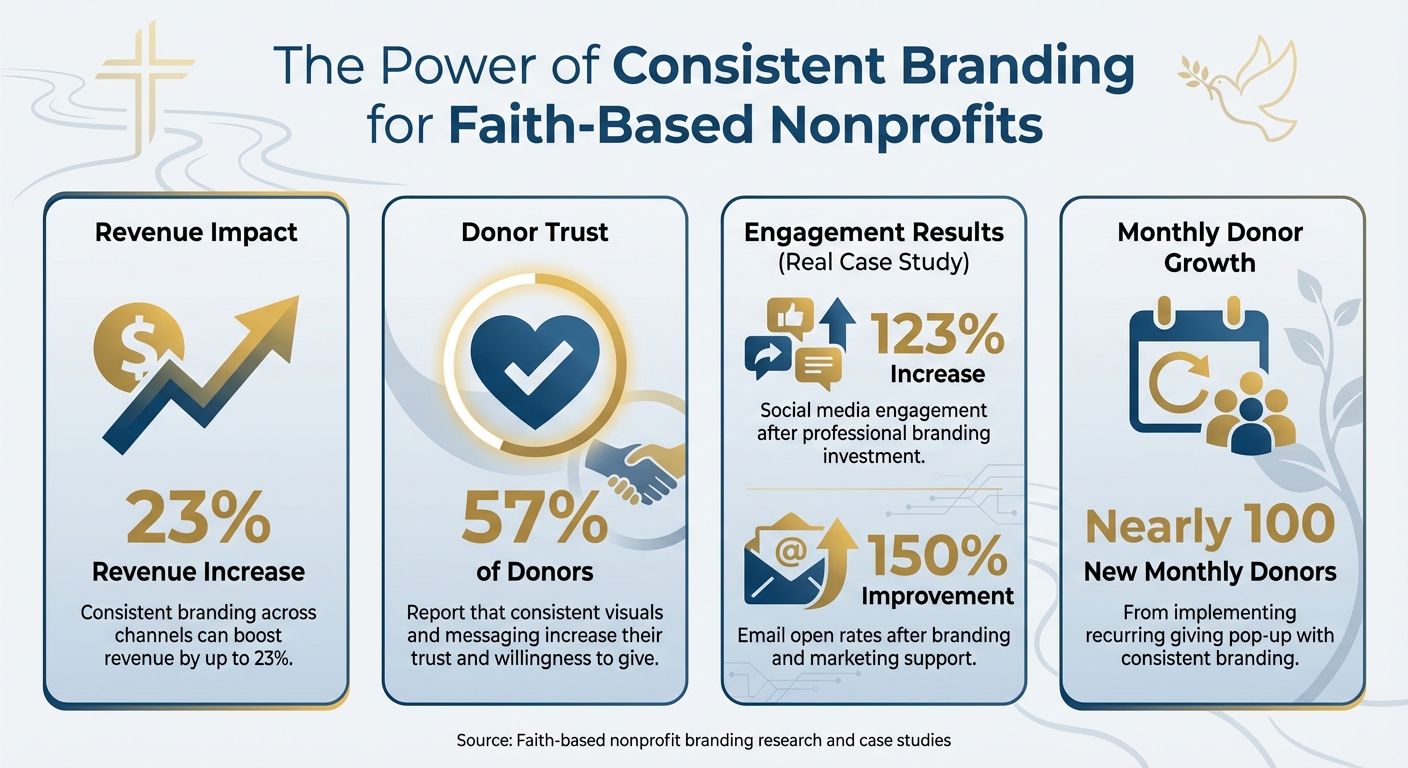
Impact of Consistent Branding on Faith-Based Nonprofit Trust and Revenue
A well-defined mission and values are the foundation for building a strong visual identity that reinforces donor trust. Once you’ve clarified what your organization stands for, it’s time to translate those principles into a cohesive and recognizable visual style. Your logo, color choices, and design elements should work together to create a consistent, professional appearance that reflects your faith-based mission. When supporters encounter the same visual style across your website, social media, donation forms, and printed materials, they’ll immediately know it’s you - avoiding any confusion caused by mixed or inconsistent messages.
But this isn’t just about appearances. Research shows that consistent branding across channels can boost revenue by up to 23%, as familiarity builds trust. For faith-based nonprofits, this is especially critical - 57% of donors report that consistent visuals and messaging increase their trust and willingness to give. By presenting a reliable and unified image, you’re creating a foundation of trust and professionalism that encourages long-term support.
Design Logos and Visual Elements
Your logo is the visual cornerstone of your organization - it’s often the first thing people see and associate with your work. Start with a simple, scalable design that looks great everywhere, whether it’s on a mobile screen, a printed flyer, or a large event banner. If you include faith symbols like a cross, dove, or flame, combine them with distinctive shapes or letterforms to make your logo unique. Avoid overly intricate designs that may feel outdated or cluttered. Instead, aim for a clean, modern look that communicates both professionalism and spiritual authenticity.
Next, choose a color palette that aligns with your mission and evokes the right emotions. For example, blues and greens can convey peace and trust, golds and whites suggest hope and purity, and warm earth tones reflect a sense of community. Stick to one or two primary colors and a few secondary or neutral tones to maintain visual harmony. Ensure your colors have enough contrast for accessibility, especially on digital platforms where readability is essential. Document the exact color codes (HEX, RGB, CMYK) so your colors appear consistently everywhere.
Typography is another key component. Select one primary font for headings and another complementary font for body text, and use them consistently across all materials - whether they’re digital or printed. The fonts should be easy to read and widely available, ensuring they work well for websites, social media, flyers, and more. These design choices lay the groundwork for creating detailed brand guidelines that will help you maintain consistency over time.
Create Brand Guidelines for Consistency
A brand guide acts as your roadmap for keeping everything visually aligned. It should detail logo variations (such as full color, black-and-white, horizontal, or stacked), minimum size requirements, and spacing rules to avoid distortion or crowding. Include exact color codes, font names and weights, and usage instructions so that everyone - whether they’re staff, volunteers, or external vendors - stays on the same page. Providing examples of correct and incorrect applications, like how a social media post or donor letter should look, can help prevent mistakes.
Make your brand guide accessible by saving it as a PDF and sharing it with everyone involved in creating materials for your organization. Include templates for common formats like PowerPoint or ProPresenter slides, social media posts sized at 1920×1080 pixels, 8.5×11 inch letters, 4×6 inch pledge cards, and annual reports. Review all materials regularly to ensure they align with your brand guidelines. One faith-based nonprofit saw a 123% increase in social media engagement and a 150% improvement in email open rates after investing in professional branding and marketing support - proof that clear, cohesive visuals can drive measurable results.
For faith-based nonprofits with annual revenues between $1 million and $20 million, working with experts who understand the specific needs of ministry work can simplify the process. Share Services specializes in helping organizations like yours develop comprehensive brand guidelines and maintain consistency across all channels. As Share Services explains:
We help you tell your story so clearly that people instantly understand why your work matters.
When your visuals and messaging align seamlessly, it reassures supporters that your organization is trustworthy, professional, and deeply committed to its mission.
Craft a Unified Messaging and Storytelling Strategy
Once you’ve nailed down your visual identity, it’s time to focus on your words. Your messaging should align seamlessly with your visuals, creating a cohesive brand experience that feels genuine and reliable. When your taglines, stories, and communications consistently reflect your core values, your audience will recognize and trust your organization. This trust is critical, especially when it comes to how supporters perceive the use of their donations. By tying your messaging strategy to your visual identity, you reinforce your mission at every interaction.
Develop Key Messaging and Taglines
Think of your tagline as a promise - a concise way to encapsulate what your organization stands for. Keep it short (under 10 words) and centered on the inspiration or transformation you deliver, rather than just describing your daily operations.
Focus on values like trust, community, transparency, and faith-driven honesty. Brainstorm phrases that reflect these principles, and test them with a small group of supporters to see what resonates. However, avoid using religious language as a mere marketing tool. If it doesn’t genuinely reflect your mission, it can backfire and diminish trust.
Use Storytelling to Build Emotional Connections
Stories are powerful tools for building trust. Sharing honest testimonials from beneficiaries, donors, or volunteers can showcase the real impact of your work and foster a sense of belonging. For example, Parable Communications helps faith-based organizations create shareable content from sermon highlights and success stories, strengthening connections and inspiring action.
World Relief took this approach further by developing a devotional series that intertwined personal stories with their fundraising campaigns, leading to a significant boost in engagement. When you share authentic stories through social media, email, or events, you’re doing more than just asking for support - you’re inviting people to join something meaningful. As Share Services puts it:
When your story is told clearly and reaches the right hearts, amazing things happen. More support. More impact. More lives changed.
For faith-based nonprofits with annual revenues between $1 million and $20 million, working with experts who understand ministry work can be a game-changer. Share Services specializes in crafting brand and messaging strategies tailored to organizations like yours, ensuring your story connects deeply and consistently across every platform.
sbb-itb-deea482
Maintain Brand Consistency Across Channels
Your supporters encounter your ministry through various touchpoints - websites, social media, emails, and events. Keeping these interactions consistent builds recognition and trust. When branding feels disconnected, donors may question the reliability of your ministry. A unified approach ensures clear and connected communication, reinforcing the mission you aim to share.
Studies reveal that nonprofits with consistent branding not only stand out but also foster trust and encourage giving. These elements signal reliability and transparency - qualities highly valued by U.S. donors. To achieve this, apply consistent branding across both online and offline platforms.
Implement Branding on Digital Platforms
Website and social media: Make your website feel cohesive by using the same header and footer on every page, featuring your logo, brand colors, and navigation. Maintain consistent fonts, layouts, and styles to create a seamless experience for donors. On social media, standardize profile pictures, cover photos, and bio descriptions across platforms like Facebook, Instagram, and YouTube. Use the same brand colors, fonts, and logo placement in graphics, Stories, and Reels to reinforce your identity.
Email: Create a branded email template tailored to each audience. Include your logo, color palette, and footer in every email. Ensure uniformity in typography and button designs across newsletters, appeals, and devotionals. Use consistent call-to-action phrases like "Give", "Pray with Us", or "Register." Match the sender name, reply-to address, tax language, suggested gift amounts (e.g., $50, $100, $250), and impact statements with those on your website and printed materials.
Apply Consistency in Events and Offline Materials
Events: Whether you're hosting worship nights, conferences, or fundraising banquets, events offer a chance to reinforce your brand. Start by incorporating your core brand elements - logo, colors, tagline, and key message - into all event materials. Use these elements on invitations, registration pages, stage slides, programs, banners, podium signs, badges, and directional signs. This ensures attendees feel connected to the same trusted ministry they’ve seen online. For stage visuals, stick to your chosen fonts and imagery, and if applicable, include Scripture or faith symbols that align with your broader communications.
Printed materials: Brochures, donor packets, and annual reports should reflect your digital branding. Maintain consistent logo placement, color hierarchy, and typography. Use recurring faith-based language, such as a core Scripture theme or mission statement, to tie messaging together across channels. Ensure program names, currency formatting (e.g., $1,500 instead of 1.500), and testimonial layouts match what donors see online. This alignment helps supporters easily connect print stories with your digital presence.
Many faith-based nonprofits with annual revenues between $1 million and $20 million find that working with experts who understand ministry needs makes achieving brand consistency easier. Share Services provides support in brand and messaging development, graphic design, web design, and content creation. Their expertise ensures your ministry maintains a unified presence across websites, emails, social media, and print. This cohesive branding strengthens trust while helping you track engagement over time.
Measure and Sustain Brand Trust
Building brand trust is not a one-and-done effort - it requires consistent monitoring and refinement. Keeping your branding cohesive across all channels ensures your metrics reflect meaningful data.
Track Engagement and Feedback Metrics
To gauge how well your message resonates, focus on key engagement metrics. Pay attention to email performance by tracking open rates, click-through rates, and unsubscribe rates on a monthly basis. For instance, a faith-based nonprofit working with Parable Communications saw a 150% increase in email open rates after improving their storytelling and digital presence. This highlights how consistent branding can directly enhance engagement.
Social media metrics - such as likes, shares, comments, and follower growth - offer another window into audience connection. World Relief, for example, monitored engagement for their "Change That Lasts" Christmas Devotional series by tracking weekly email opens and social shares on platforms like Facebook and Instagram. They tied these metrics to their fundraising goals, demonstrating how engagement can reflect trust.
Donor behavior is perhaps the clearest indicator of trust. Keep an eye on donor retention rates, recurring gift sign-ups, average gift sizes, and the number of returning lapsed donors. Share Services helped one organization implement a recurring giving pop-up, resulting in nearly 100 new monthly donors - a clear sign of increased trust and commitment.
"Share helped us test simplified + focused messaging that improved our conversion rates. Additionally, paid display ad retargeting was successful, and the recurring giving pop-up brought us almost 100 new monthly gifts. We've continued to see success with both of these strategies in other campaign efforts."
- Jasmine Morse, Advancement Department
Beyond numbers, qualitative insights are equally valuable. Conduct quarterly surveys using tools like Google Forms or SurveyMonkey to measure whether your communications come across as transparent, Christ-centered, and aligned with your values. Pay attention to recurring themes in social media comments, prayer requests, and post-event feedback, especially around topics like financial transparency and leadership communication. These efforts reinforce the importance of unified branding and help you fine-tune your approach.
These metrics and insights form the foundation for building strategic partnerships.
Partner with Experts for Long-Term Success
For faith-based nonprofits with annual revenues between $1 million and $20 million, maintaining brand trust often requires expertise that goes beyond in-house capabilities.
"If I was actually doing this project, it would have taken me half a year, and Share was able to do it in a couple of months. And that's something we wouldn't have been able to do with our small staff."
- Kyle Birch, Director of Communications
Share Services specializes in supporting nonprofits in this revenue range, offering a range of services like digital fundraising, brand and messaging development, donor retention strategies, new donor acquisition, and digital marketing. Their team of dedicated strategists manages all aspects of marketing - websites, emails, social media, and paid campaigns - while providing detailed KPI reporting to show how branding efforts impact engagement and donations. This partnership ensures your brand doesn’t just launch effectively but continues to grow trust over time.
| Services | Price | Inclusions |
|---|---|---|
| Strategy Retainer (Required) | $3,500/month | Dedicated Nonprofit Strategist, Weekly Strategy Session, Project Management and KPI Reporting |
| Monthly Project Budget (Add-on) | $3,000/month | Monthly Donor Programs, New Donor Journeys, Email Marketing, Branding, Graphic Design, Web Design, Copywriting, Content Creation, Donation Pages, Conversion Rate Optimization |
| Paid Media Spend (Add-on) | $1,500/month | Meta Ads, OTT Ads, Direct Deal Ads, Google Ad Grant, Analytics, Donor Acquisition Campaigns, Email List Building |
Expert partners can address common challenges like inconsistent messaging, donor churn, and unclear impact reporting. They bring specialized skills in areas like multi-channel donor reactivation, conversion rate optimization, and analytics tracking to identify which faith-based content resonates most deeply. By collaborating with a team that understands both nonprofit fundraising and faith-based principles, you’ll gain the tools and insights needed to measure, maintain, and grow trust over the long haul.
Conclusion
Building trust in your brand means ensuring that your mission aligns with every interaction your audience has with your organization. When your brand consistently reflects your faith-based values across all platforms, it shows supporters that your promises and actions are in harmony with your mission. This alignment can turn one-time donors into lifelong advocates for your ministry.
Here’s the key: focus on the essentials. Define your mission and values clearly, establish a unified visual identity, create stories that resonate emotionally, and stay consistent across all touchpoints. Track your progress, adjust your strategy as needed, and remember what experts emphasize: trust is built when a ministry’s promises, visuals, and actions consistently align over time. It’s about demonstrating integrity and staying true to your calling.
Take a close look at your materials. Does your website, email communication, and social media presence consistently reflect your story? Are your colors, fonts, and tone cohesive? If not, it’s time to update your brand guidelines. Even small changes - like refining your tagline or standardizing how your logo is used - can improve recognition and build credibility. When your materials align, they reinforce the message you’ve worked so hard to craft.
For ministries with revenue between $1–$20M, working with experts like Share Services can simplify the process of aligning your branding and fundraising efforts.
FAQs
How can faith-based nonprofits clearly share their mission and values with a diverse audience?
Faith-based nonprofits can communicate their mission and values effectively by prioritizing consistent and sincere messaging that genuinely reflects their core principles. By using straightforward language that connects with their audience, organizations can ensure their message aligns seamlessly with their purpose.
Reaching people on a deeper level often comes down to sharing powerful stories that showcase the tangible impact of their efforts. These narratives help create emotional bonds, allowing supporters to understand and appreciate the importance of the organization’s work.
To expand their reach, nonprofits can embrace a multi-channel strategy that leverages email campaigns, social media platforms, and digital ads. Crafting content that fits the style and audience of each channel while maintaining a cohesive brand voice is key to building trust and strengthening relationships with their supporters.
What are the key elements of a strong and consistent visual identity for faith-based nonprofits?
A strong visual identity is essential for faith-based nonprofits, helping them communicate their mission effectively while fostering trust and connection. Key elements of this identity include:
- A well-thought-out color palette: Choose colors that reflect the organization's core values and evoke the emotions tied to its mission.
- A meaningful logo: A logo should be simple, recognizable, and representative of the nonprofit's purpose.
- Consistent typography: Using the same fonts across all materials creates a polished and unified appearance.
- Thoughtful imagery: Select visuals that align with the organization's faith-based mission and resonate emotionally with the audience.
When these elements come together cohesively, they help nonprofits amplify their message and deepen relationships with their supporters.
Why is it important for faith-based nonprofits to track engagement metrics?
Tracking engagement metrics plays a key role for faith-based nonprofits, offering a clear window into how supporters interact and connect with their mission. By analyzing these patterns, organizations can gauge how well they’re cultivating trust and meaningful relationships with their audience.
This information allows nonprofits to fine-tune their approach, ensuring their messaging stays aligned with their mission while deeply resonating with supporters. In the long run, tracking engagement not only boosts transparency but also strengthens donor loyalty and solidifies credibility within the community.
Related Blog Posts
Get helpful resources, straight to your inbox
We love sharing tools, ideas, and stories that make nonprofit work a little lighter and a lot more effective. Sign up below and we’ll send you practical tips, free resources, and a bit of encouragement—because the work you’re doing matters.
No spam. Just good stuff for good people.