
Mar 16, 2026
How Paid Ads Boost Year-End Fundraising
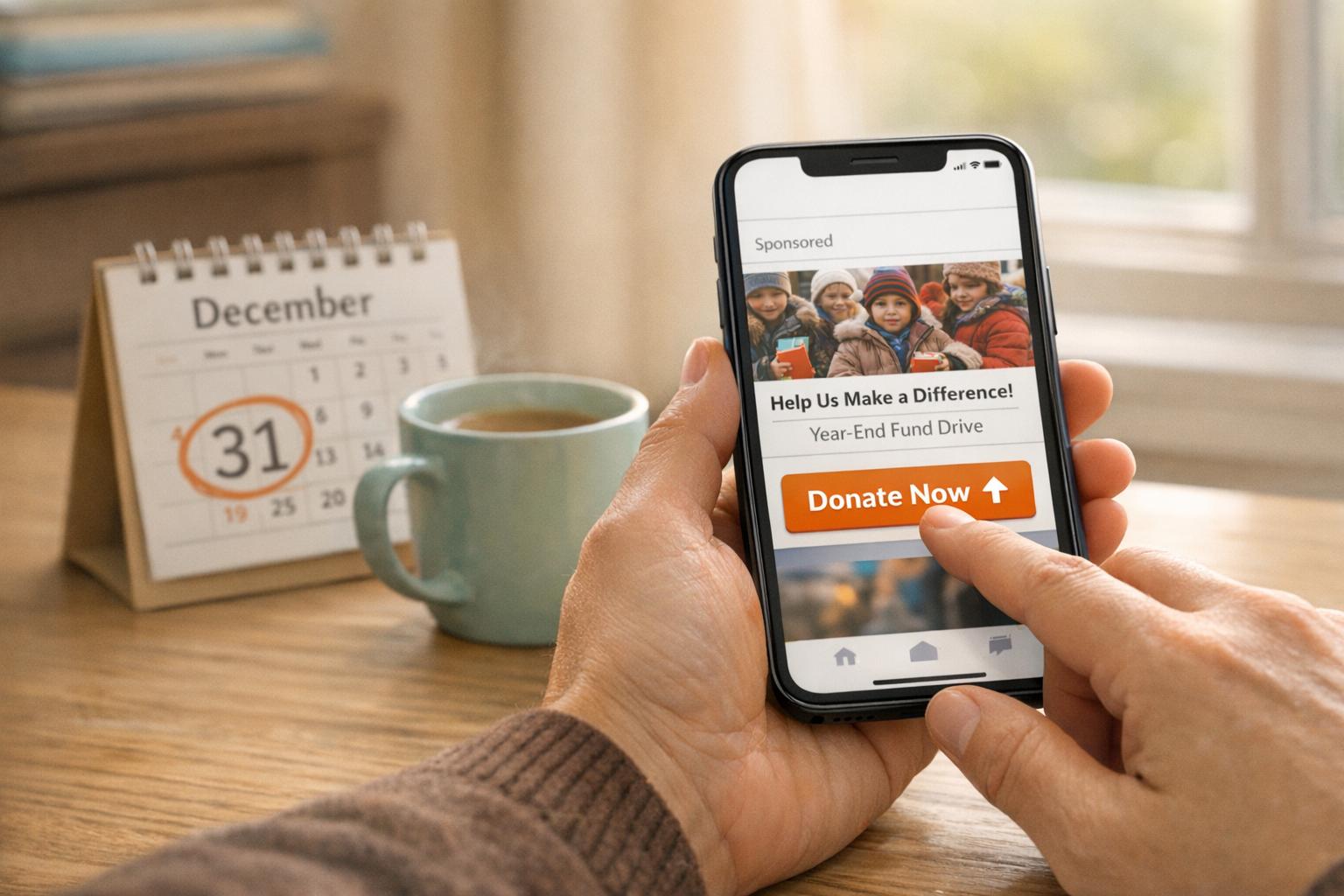
Paid ads can supercharge nonprofit fundraising during the year-end season, when nearly 26% of annual donations are made. With tax deadlines and the holiday spirit driving urgency, nonprofits can use targeted digital campaigns to reach new donors, increase visibility, and amplify their efforts.
Key Takeaways:
- Why it Works: Paid ads extend reach beyond email lists and social media followers, especially as organic reach declines.
- Proven Results: In 2025, nonprofits saw a 41% revenue increase from paid ads in the final week of December, with a 44% donation boost on December 31 alone.
- Platform Insights:
- Search Ads: High-intent donors, but costs spike during peak times.
- Social Media: Cost-efficient and effective for remarketing past donors.
- Programmatic Ads & Connected TV: Emerging channels with strong returns.
- Best Practices: Start early, allocate budgets wisely, and focus on precise targeting and impactful messaging.
Nonprofits like The Salvation Army and Christian Relief Fund have achieved returns on ad spend as high as 30x, proving that paid ads are a powerful tool for year-end campaigns. Success hinges on careful planning, clear messaging, and strategic use of platforms.
How Different Paid Ad Platforms Perform
Paid Search Campaign Results
Paid search campaigns are a powerful tool for reaching high-intent donors, especially during the year-end giving season. A great example comes from The Salvation Army Western Territory, which ran a campaign from October through December 2024 under the leadership of Director of Digital Strategy Brenda Jones. By combining Performance Max (PMAX) with traditional search, they managed to achieve a 70% year-over-year revenue increase despite a 144% jump in cost-per-click (CPC). On Giving Tuesday alone, they saw a staggering 2,245% revenue surge.
However, the challenge of managing cost fluctuations is very real. Blood Cancer United encountered a 384% CPC increase in the final week of December 2024. Even with this spike, they implemented value-based bidding strategies and achieved a 7% year-over-year revenue boost. To avoid running into budget constraints during high-demand periods like Giving Tuesday, it's recommended to allocate an extra 30% budget headroom.
While search ads are effective, social media ads offer another avenue to engage donors.
Using Social Media Ads to Drive Donations
Platforms like Facebook and Instagram excel at engaging audiences through precise targeting. For example, the American Lung Association worked with X Agency in December 2022 to fine-tune their Facebook strategy. They shifted focus from finding new donors to remarketing to website visitors and past donors. With just an additional $1,500 in spending, the campaign brought in 132 more attributed donors and achieved 118% year-over-year growth in donation revenue.
Social media ads also tend to be more cost-efficient than search during year-end campaigns. Blood Cancer United's December 2024 campaign is a case in point - they reduced social media spending by 25%, yet still achieved a 69% higher return on ad spend (ROAS) thanks to targeting and creative optimization. If you're investing in social ads, prioritize Facebook Newsfeed placement, which consistently drives the highest donation volumes. Target "warm" audiences, such as people who abandoned the donation process or previously interacted with your content, instead of focusing solely on broad prospecting.
For even broader reach, consider exploring newer ad channels.
New Channels: Programmatic Ads and Connected TV
As competition heats up during the year-end period, diversifying your paid media strategy can help tap into new donor segments. Programmatic advertising platforms like The Trade Desk, Amazon, and Quantcast are particularly effective for this. Blood Cancer United, for instance, implemented a programmatic strategy between December 5 and December 31, making real-time daily budget adjustments. The result? A 2X return on ad spend and a 29% overall increase in blended revenue.
The trend toward multi-channel ad formats is also growing. Last year, nonprofits increased their spending on these formats by 86%, moving away from managing search and social separately. These integrated platforms, which use machine learning to optimize budgets, are delivering $1.49 in return for every dollar spent. If you're new to programmatic or multi-channel platforms, consider allocating 10-15% of your advertising budget to test them before the peak December period.
sbb-itb-deea482
How to Maximize Paid Ad ROI
Improving Ad Targeting and Messaging
To get the most out of your paid ads, focus on reaching the right audience and delivering messages that highlight the impact of donations. Use CRM data to create lookalike audiences on platforms like Facebook. Start with a 1% similarity to your existing donors, and as you scale, expand to 3–7%. This method helps you find new donors who share similar traits with your current supporters. Also, make use of exclusion targeting to avoid asking for donations from individuals who’ve already contributed. Instead, shift the focus for these audiences to messages about the impact of their contributions or updates on your work.
A great example of this approach comes from the Christian Relief Fund. Between July and December 2024, they worked with digital strategist Naomi James to run a highly focused campaign. They used affinity targeting to connect with religious audiences and geo-fencing to engage attendees at mega-churches. With just $4,486 in ad spend, they generated $134,936 in donations, achieving an impressive 30× return on ad spend.
Your messaging should always put the donor at the center. Highlight the direct impact of their support with clear, specific language. For instance, instead of vague appeals, say something like, "$35 provides education for one child." This transparency helps donors understand exactly how their money will be used. Behavioral science can also play a role here. Use loss aversion to show what might be lost without their support, and the bandwagon effect to emphasize how many others are already contributing. For matching gift campaigns, adding urgency with countdowns or limited-time multipliers can encourage immediate action.
Once your audience and messaging are dialed in, it’s time to focus on crafting ads that drive results.
Designing Effective Ad Creatives
Great ad creatives are crucial for inspiring action. Stories about individuals can create a stronger emotional connection with donors. Make sure your call-to-action buttons grab attention by using contrasting colors and placing them strategically in your ads. Tangible examples - like "$5 provides clean water for one week" - help build trust and encourage larger donations.
Before committing to a full ad spend, test your creatives. Use organic posts to gauge which stories and visuals resonate most, then scale up the successful ones. Also, ensure that all your ads lead to mobile-optimized landing pages and donation flows. Many donors, especially during year-end campaigns, will engage with your ads on their phones.
How to Allocate Your Budget
With well-targeted ads and compelling creatives, the next step is to allocate your budget strategically to maximize your campaign’s ROI. Divide your budget into three phases:
- Pre-Peak (August–October): Focus on building awareness and testing strategies.
- Peak (November–December): Prioritize high-intent conversions.
- Post-Year-End (January–February): Invest in retaining donors.
During the peak season, keep about 30% of your budget as headroom to avoid hitting spending caps too early and to capture last-minute donations. For instance, The Salvation Army’s Performance Max campaign in October 2024 maintained a 30% headroom despite a 144% increase in cost-per-clicks (CPC), which contributed to their strong revenue growth.
Additionally, set aside 10–15% of your budget to test machine learning-driven multi-channel platforms. These platforms are currently delivering an average return of $1.49 for every dollar spent, making them a worthwhile investment.
Google Ads for Nonprofits: Real Case Study with $10K Grant + Funnel Breakdown
Case Studies: Year-End Campaign Results

Nonprofit Year-End Paid Ad Campaign Results and ROI Comparison
Faith-Based Nonprofit Campaign Examples
These case studies highlight how well-planned paid media campaigns can lead to impressive donation increases during crucial fundraising periods. Faith-based nonprofits, in particular, demonstrate how advertising efforts can drive year-end donation growth.
Take International Justice Mission (IJM), for example. During a seven-week Holiday Gift Catalog campaign from mid-November to December 2020, the team, led by Jared Arango, Regional Lead for Paid Media, used programmatic display ads, search campaigns targeting keywords like "charitable gifts", and email mapping to connect with their existing audience. With just $7,000 in ad spend, IJM raised an astounding $109,500 - resulting in a return on ad spend (ROAS) of 1,563%.
"What's nice about Feathr is that you can aggregate everything in one platform and have a unified approach... having it all in one place to see overall results is really useful." - Jared Arango, Regional Lead for Paid Media, IJM
Similarly, Hope & A Future, a foster care nonprofit based in Arizona, launched its first digital campaign just days before Giving Tuesday in late 2020. President Michael Brewer utilized tactics like geofencing, email mapping, and retargeting campaigns to re-engage visitors who abandoned donation forms. With an ad spend of $4,410, the campaign raised $32,282, achieving a 7.3× return and reaching over 84,000 potential new donors.
"Working with Feathr is highly cost effective. We spent $4,410 and got $32,282 back." - Michael Brewer, President, Hope & A Future
These examples provide a glimpse into broader trends observed across various campaigns.
What the Data Shows
The numbers reveal some clear strategies for success. Campaigns that started as early as July saw better results during the year-end giving season. For instance, Christian Relief Fund kicked off its awareness efforts in the summer and later implemented affinity targeting and geofencing around mega-churches. According to Marketing Strategist Caleb Dansby, this approach turned a $4,486 ad spend into $134,936 in donations - a staggering 30× return.
Using multiple channels also proved to be more effective than relying on a single platform. Metropolitan Ministries in Tampa Bay revamped their paid media strategy across search, social, and programmatic channels, resulting in a 437% increase in new donors and a 140% jump in online donations.
Remarketing and re-engaging past donors were particularly impactful. The American Lung Association shifted its 2022 year-end campaign to focus on remarketing to website visitors and reaching out to previous donors. This adjustment brought in 132 additional donors and led to a 118% increase in year-over-year donation revenue, despite only adding $1,500 to their ad budget.
Here’s a snapshot of the results from these campaigns:
| Organization | Ad Spend | Funds Raised | ROAS / Result |
|---|---|---|---|
| International Justice Mission | $7,000 | $109,500 | 1,563% |
| Christian Relief Fund | $4,486 | $134,936 | 30× |
| Hope & A Future | $4,410 | $32,282 | 7.3× |
| Blood Cancer United | –5% (YoY) | +29% (YoY) | 102% CVR Increase |
| Salvation Army West | Optimized | +70% (YoY) | 2,245% Giving Tuesday Surge |
How Share Services Supports Paid Media Campaigns
Share Services builds on its proven track record to offer nonprofits a robust set of tools designed to amplify year-end fundraising efforts.
Custom Paid Media Campaigns
For nonprofits with revenues between $1–$20 million, Share Services crafts paid media strategies tailored to their specific needs. These campaigns blend Meta ads and Google Ad Grants to expand donor outreach.
Their team uses precise targeting to engage active faith-based audiences, launching campaigns as early as July or August to create momentum for year-end giving.
The messaging focuses on tangible outcomes, highlighting what donor contributions achieve. For instance, ads might emphasize that "$50 provides meals" or "$100 supports education", making the impact of donations clear and relatable. This donor-focused strategy, paired with consistent messaging across paid ads, direct mail, and email, ensures a unified and compelling narrative.
Additional Marketing Support
Share Services doesn’t stop at paid media. They also deliver strategies for donor retention, branding, and messaging development to strengthen overall fundraising efforts. Their technical expertise includes setting up tools like Google Tag Manager, Google Analytics, and Search Console for accurate donation tracking.
They also implement features designed to boost conversions, such as recurring giving pop-ups. One client reported gaining nearly 100 new monthly donors from this feature alone.
"Share helped us test simplified + focused messaging that improved our conversion rates. Additionally, display ad retargeting drove strong results, and the recurring giving pop-up brought us almost 100 new monthly gifts."
- Jasmine Morse, Advancement Department
Pricing for Nonprofits
Share Services offers a Paid Media Spend plan starting at $1,500/month. This includes Meta Ads, Connected TV, Google Ad Grant management, and YouTube campaigns. To access these services, nonprofits must also invest in a Strategy Retainer, starting at $3,500/month, which provides a dedicated nonprofit strategist and weekly strategy sessions.
For additional creative needs - such as branding, web design, or copywriting - a Monthly Project Budget is available starting at $3,000/month.
"It costs less to reactivate a lapsed donor than to acquire a new one. Email can be effective, but multi-channel approaches are even better."
- Eddie Laing, Paid Media Specialist, Share Services
With transparent pricing and hands-on support, Share Services equips nonprofits with the tools they need to maximize year-end donations effectively.
Conclusion
Year-end fundraising demands careful planning and execution. As seen in case studies, paid ads provide measurable outcomes, especially when nonprofits grapple with rising costs and shrinking organic reach. With search costs surging by as much as 384% during the last week of December, having skilled campaign management is more important than ever.
Early preparation, seamless coordination across channels, and real-time adjustments are key to success. These examples highlight the importance of having experts guide the process.
"Digital advertising became our fishnet. It allowed us to reach beyond our day-to-day interactions and get in front of people who may never have heard of us otherwise."
- Caleb Dansby, Marketing Strategist, Christian Relief Fund
Nonprofit leaders can tap into these strategies with the help of experienced partners. Share Services offers nonprofits with annual revenues between $1–$20 million the expertise and tools to make the most of their year-end campaigns. Their Paid Media Spend plan starts at $1,500/month and includes Meta ads, Connected TV, and Google Ad Grant management. For deeper strategic guidance, their Strategy Retainer begins at $3,500/month.
The takeaway is clear: well-executed paid ad campaigns drive results. Nonprofits looking to boost their year-end fundraising can start laying the groundwork now for their next big push.
FAQs
How much should we budget for year-end paid ads?
Your year-end paid ads budget should generally account for 5–10% of your total marketing budget. To make the most of it, use a data-driven strategy that allows for flexibility. Monitor performance closely and make adjustments as needed to optimize results. This way, you can achieve maximum impact while keeping your spending in check.
Which paid ad channel works best for donations?
Social media platforms such as Facebook and Instagram are powerful tools for encouraging donations, especially among younger generations. In fact, 59% of Gen Z donors report being inspired to give through these channels. Additionally, Google Ads provides an excellent opportunity for targeted outreach, enabling nonprofits to connect with specific audiences and make their campaigns more effective.
How do we track donations from ads accurately?
To keep tabs on donations effectively, tools like Facebook Pixel and Google Analytics are invaluable. These platforms let you track how your campaigns are performing, pinpoint which ads are driving donations, and gain insights into donor behavior. Setting them up correctly ensures you can measure conversions accurately and refine your campaigns for improved outcomes.
Related Blog Posts
Get helpful resources, straight to your inbox
We love sharing tools, ideas, and stories that make nonprofit work a little lighter and a lot more effective. Sign up below and we’ll send you practical tips, free resources, and a bit of encouragement—because the work you’re doing matters.
No spam. Just good stuff for good people.