
Jan 14, 2026
Geo-Targeting Trends for Nonprofits 2025
Geo-targeting is reshaping nonprofit fundraising by tailoring outreach based on location, like city or ZIP code. This approach helps organizations connect with donors by highlighting local impact, boosting engagement, and driving mobile donations.
Key takeaways:
- Why it works: Donors respond more to local causes. Personalized appeals tied to familiar places increase trust and urgency.
- Mobile trends: Mobile traffic is 57% of nonprofit site visits, yet desktops bring 75% of revenue. Optimizing mobile giving with geo-targeting can close this gap.
- Tools: Platforms like Google and Meta enable ZIP code targeting, geofencing, and location-based SMS for precise campaigns.
- Privacy: Compliance with laws like CCPA and clear consent practices are essential to maintain donor trust.
- Future: AI will enhance geo-targeting by predicting donor preferences and fine-tuning campaigns.
Faith-based nonprofits using geo-targeting can maximize ad budgets, build stronger community ties, and improve donor retention while navigating rising digital ad costs and privacy challenges.
Current Research on Geo-Targeted Fundraising
What Geo-Targeting Means for Fundraising
Geo-targeting in fundraising involves tailoring your outreach based on a donor's physical location. Tools like radius and ZIP code targeting on platforms such as Google, Meta, and YouTube allow campaigns to show ads to users within specific cities, ZIP codes, or a defined distance from a location. Meanwhile, geofencing creates virtual boundaries around specific places - like churches or events - to deliver ads to devices that enter those areas. By combining these location-based techniques with behavioral and demographic data - like age, interests, and past donation habits - fundraisers can craft segmented audiences. This approach helps attract new donors, retain current supporters, and promote events, forming the basis for research into their effectiveness.
Research Sources and Methods
Recent research has explored how these geo-targeting strategies perform in real-world fundraising efforts. Between 2022 and 2025, several key resources have helped nonprofits better understand and refine these techniques:
- Nonprofit digital and fundraising trend reports track changes in paid media performance, privacy regulations, and channel effectiveness, breaking down metrics like click-through rates, conversion trends, and cost per acquisition by platform.
- Digital strategy and SEO guides for nonprofits study how donors use local search terms, such as "homeless shelter Austin" or "food pantry Denver", to find causes nearby.
- Platform-specific insights from tools like Google Ads and Meta reveal the benefits of geo-targeted campaigns, showing improved cost efficiency when budgets focus on local audiences rather than national ones.
- Cross-sector geo-targeting and mobile marketing analyses offer benchmarks for engagement improvements through geofencing and hyperlocal campaigns.
These resources give faith-based leaders actionable data to evaluate response rates, navigate privacy-related limitations on location data, and determine which geo-targeting strategies yield the best return on investment.
Why Geo-Targeting Matters for Faith-Based Nonprofits
Geo-targeting provides a clearer understanding of donor behavior, particularly for faith-based nonprofits. Research from 2022 to 2025 highlights that donors prefer supporting local causes, with campaigns framed around community impact often achieving higher engagement. Digital marketing advice for nonprofits stresses the importance of using local keywords, as donors frequently search for causes they can see making a difference in their own neighborhoods. Broader nonprofit trends through 2025 show a growing focus on hyperlocal and community-centered outreach, with donors responding more positively to campaigns that connect directly to familiar places - like specific neighborhoods, school districts, or cities.
For faith-based organizations, this connection is even more critical. Their missions are deeply tied to community settings - whether through congregations, campus ministries, or local service programs. Research from 2023 to 2025 shows that geo-targeted campaigns that highlight these local ties often achieve higher click-through and response rates, especially when they emphasize shared spiritual values and visible community impact. This approach resonates strongly with donors who want to see their contributions making a tangible difference in areas they know and care about.
How to Reach Your Target Audience with Geotargeting
How Location Affects Donor Behavior
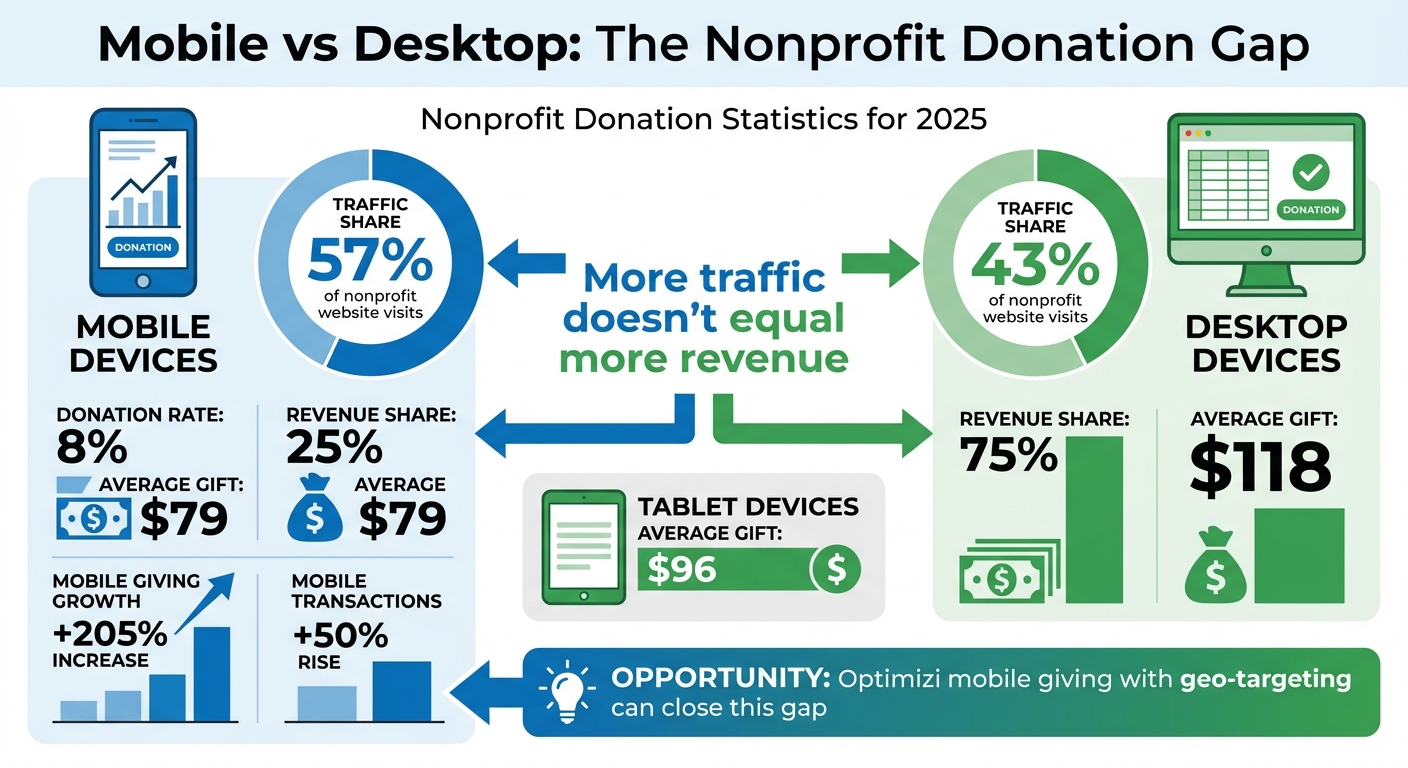
Mobile vs Desktop Nonprofit Donation Statistics 2025
Why Donors Support Local Organizations
People are naturally drawn to causes that impact their own communities. When appeals mention familiar street names, school districts, or landmarks, it creates a sense of trust - donors feel assured their contributions are making a difference close to home.
For faith-based nonprofits, this connection is even more profound. Congregations, campus ministries, and local service programs are deeply rooted in the communities they serve. When someone searches for terms like "homeless shelter Austin" or "literacy programs Miami", they’re not just looking for a cause - they’re seeking a way to make a visible impact. Geo-targeted campaigns, such as "Support San Diego Kids This School Year", make giving feel personal and immediate. These localized appeals not only strengthen trust but also allow digital platforms to spotlight causes that are just around the corner.
Finding Causes Through Location-Based Digital Channels
Digital platforms have made it easier than ever for donors to connect with nearby causes. Tools like Google, Facebook, and YouTube allow nonprofits to target ads based on radius, city, or ZIP code, delivering messages that resonate with people in specific areas. Social media is also a game-changer. In 2023, more than half of nonprofits collaborated with influencers to engage local audiences, particularly younger donors like Millennials and Gen Z. These partnerships help bridge personal values with community-focused causes, making it easier for individuals to find and support organizations that align with both.
Mobile Devices and Location-Based Campaigns
Mobile devices play a central role in location-driven fundraising efforts. Mobile giving has surged by 205%, with the average donation through mobile channels reaching $79. While 57% of nonprofit website traffic comes from mobile devices, these users donate at an 8% rate and have contributed to a 50% rise in mobile transactions. This shows how comfortable people have become with donating on the go.
| Device Type | Average Gift | Traffic Share | Revenue Share |
|---|---|---|---|
| Mobile | $79 | 57% | 25% |
| Desktop | $118 | 43% | 75% |
| Tablet | $96 | - | - |
Text messaging is particularly effective for location-based appeals, offering high engagement rates for event notifications and fundraising campaigns. For example, nonprofits can send geo-targeted texts to supporters near an event or within a specific community, turning proximity into prompt action. Faith-based organizations can use these messages to promote local service projects, fundraisers, or campus ministry events. Mobile-optimized donation pages - featuring simple designs, large buttons, and payment options like Apple Pay and Google Pay - help reduce barriers and encourage immediate contributions.
Geo-Targeting Technologies and Data Methods
Let’s dive deeper into the technologies and data that power effective geo-targeting campaigns, building on our earlier discussion of its impact.
Common Geo-Targeting Tools for Nonprofits
In 2025, nonprofits are leveraging three primary geo-targeting tools - geofencing, location-based SMS, and dynamic content - to connect with their supporters in meaningful ways.
- Geofencing creates a virtual boundary, typically 1–5 miles, around a specific location like a church, shelter, or event venue. For instance, a ministry might geofence a 3-mile area around its food pantry and display ads encouraging nearby supporters to "Give $50 to feed local families" when they enter the boundary. It’s a simple yet effective way to engage with people in the right place at the right time.
- Location-based SMS allows nonprofits to send tailored messages to supporters in specific ZIP codes or within a set radius. For example, after a local storm, a church could use this tool to notify nearby volunteers about a relief effort or invite donors to a fundraising breakfast via opt-in text messages.
- Dynamic geographic content adjusts website or ad messaging based on the visitor’s location. A visitor in Phoenix might see "Support students in Phoenix this semester", while someone in Dallas would see "Support students in Dallas this semester." This type of personalization, powered by IP address or GPS data, can significantly improve engagement and response rates.
These tools rely heavily on accurate, first-party data to deliver results, forming the backbone of successful geo-targeted campaigns.
Data Sources and Quality
The success of geo-targeting hinges on the quality of the data being used. Nonprofits prioritize first-party data - information collected directly from supporters through donations, event registrations, email signups, or surveys. This includes details like home addresses, ZIP codes, and campus preferences stored in a CRM. With third-party data becoming less dependable due to stricter privacy rules and cookie restrictions, first-party data has become the gold standard.
Additional location data comes from GPS, Wi-Fi, and cellular towers. When users consent to share their location, ad platforms can use this data to target individuals who have been near partner locations or live within a specific radius of program sites.
Three factors ensure data quality:
- Accuracy: This is maintained by validating addresses with USPS formats.
- Recency: Supporters are encouraged to update their information during online checkouts or event signups.
- Granularity: Depending on the campaign’s scope, data precision can range from state-level targeting for broad efforts to ZIP+4 or even latitude-longitude for highly localized outreach.
With reliable data in place, nonprofits can turn these insights into powerful, targeted outreach strategies.
How Share Services Supports Geo-Targeting Implementation
Share Services plays a key role in helping nonprofits design and execute geo-targeting campaigns through its digital marketing and fundraising expertise. The process begins with a consultation to align geo-targeting strategies with the organization’s mission and the needs of its community. A dedicated account strategist collaborates with the nonprofit’s team to define location-based segments in their CRM. This could involve setting up radius tags around important sites or identifying "home campus" preferences for multi-site churches. These segments are then integrated across email, SMS, and ad platforms for seamless execution.
Share Services offers paid media campaigns starting at $1,500 per month, covering Meta ads, Google Ad Grant management, and analytics designed to drive donor acquisition through geo-targeting. For a more comprehensive approach, a $3,000 monthly project budget includes donation page optimization, email marketing, and content tailored to specific geographic audiences. For example, a new donor in Chicago might receive an email highlighting Chicago-specific impact stories, join a local SMS list, and see retargeting ads focused on Chicago programs. All of this is managed by a team with deep nonprofit fundraising expertise, ensuring every campaign is both strategic and effective.
sbb-itb-deea482
Privacy Laws and Ethical Considerations
Geo-targeting blends cutting-edge fundraising tools with serious privacy challenges. Location data, even when linked only to a device ID, is classified as personal information under most modern privacy laws because it can reveal an individual's movements and behaviors.
U.S. Privacy Laws Affecting Geo-Targeting
Nonprofits face a maze of federal and state privacy regulations when using location data. At the federal level, the Federal Trade Commission's Section 5 prohibits deceptive practices, requiring organizations to clearly disclose any location tracking in geo-targeted campaigns. Likewise, the Children's Online Privacy Protection Act (COPPA) mandates parental consent for collecting location data from children under 13.
State policies add another layer of complexity. California's Consumer Privacy Act (CCPA), now amended by the CPRA, gives residents the right to know, delete, and opt out of the sale or sharing of their location data. States like Colorado, Connecticut, and Virginia classify precise geolocation as sensitive data, requiring explicit opt-in consent. Violations can result in fines of up to $7,500 per incident.
Platform rules are even stricter. For instance, Google and Meta require organizations to meet their opt-in standards, and Apple's iOS App Tracking Transparency framework has led to 62% of users opting out of tracking. Noncompliance with these platform policies can lead to account suspensions, even if the organization meets legal requirements.
Maintaining Donor Trust with Location Data
Trust is the cornerstone of donor relationships. According to the 2023 Cisco Consumer Privacy Survey, 81% of consumers believe how an organization handles personal data reflects its respect for them as supporters. Furthermore, 76% said they would switch to another organization if they lost trust in its data practices. For nonprofits, this means transparency is non-negotiable.
Clear communication is key. Instead of vague legal jargon, use straightforward language like, "We use your ZIP code to share local impact stories", or, "Get event updates within 10 miles." Always provide easy ways for donors to opt out, such as an unsubscribe link, a preference center, or a simple reply-STOP option for SMS campaigns.
Faith-based nonprofits face additional ethical concerns. For example, tracking visits to religious events could unintentionally expose sensitive beliefs. Regulatory actions, such as the FTC's enforcement of the 2024 Health Breach Notification Rule and its 2023 case against data broker Kochava, show that using location data to monitor visits to sensitive places - like churches, health clinics, or shelters - can lead to serious consequences. A safer approach is to invite supporters to opt in for updates from their congregation or region, rather than relying on geofencing strategies that might infer religious practices.
By prioritizing transparency and ethical practices, nonprofits can build trust while leveraging geo-targeting effectively.
Weighing Benefits Against Risks
Geo-targeting offers the potential to boost donor engagement and campaign efficiency, but it comes with risks that demand careful handling. Here's a closer look:
| Aspect | Benefits | Risks |
|---|---|---|
| Engagement | Locally relevant appeals can increase response rates by 20–50% | Messaging that tracks detailed movements may feel invasive |
| Donor Experience | Tailored messaging reduces inbox clutter | Donors may feel monitored if tracking isn't clearly disclosed |
| Compliance | Using first-party data like ZIP codes simplifies privacy management | Noncompliance risks fines (up to $7,500 per violation) and potential account suspensions |
| Mission Alignment | Localized messaging strengthens community connections | Overly invasive tracking could conflict with nonprofit values and alienate communities |
To maximize the benefits while minimizing risks, nonprofits should focus on using coarse location data, like ZIP codes or city-level information, rather than exact GPS coordinates. Always secure clear opt-in consent before launching location-based campaigns, and retain data only as long as necessary. By treating location data with the same care as donor relationships, nonprofits can turn geo-targeting into a tool for meaningful connections instead of a source of concern.
Applying Geo-Targeting in Faith-Based Nonprofits
Connecting with Local Giving Preferences
Faith-based nonprofits can create more impactful fundraising appeals by tailoring their messages to local communities. By focusing on city-specific or neighborhood-specific content, they can highlight ministry work happening close to home. For instance, an email to supporters in South Phoenix might showcase photos from a local church pantry and include a message like, "This month, 73 families in South Phoenix received groceries at our church pantry." Similarly, geo-targeted ads on platforms like Meta and Google could promote events with localized copy such as, "Help families in Dallas stay warm this winter." When donors see familiar landmarks, schools, or community partners in these stories, it reinforces the idea that their contributions are making a tangible difference in their own backyard. To consistently deliver these personalized messages, nonprofits must first establish strong internal data systems.
Building Internal Capacity for Geo-Targeting
Effective geo-targeting starts with clean, organized data and the right tools. Begin by standardizing your CRM data collection - make sure mailing addresses and ZIP codes are included on all forms. Then, create geographic segments by grouping donors based on factors like campus location, city, ZIP code clusters (e.g., "East Cincinnati"), or even drive-time distances around ministry sites (e.g., 0–5 miles, 5–15 miles). For mid-sized nonprofits, this typically involves having a dedicated digital lead, a CRM administrator, and a budget of $1,500–$5,000 per month for each key market.
If managing this internally feels overwhelming, partnering with services like Share Services can simplify the process. Share Services specializes in designing geo-targeted digital fundraising campaigns tailored to specific congregations or mission sites. They ensure messaging aligns with local community needs and help nonprofits optimize their CRM systems to capture and use geographic data effectively. With these systems in place, organizations can then explore advanced technologies to further refine their geo-targeting strategies.
What's Next for Geo-Targeting
Geo-targeting is advancing at a rapid pace. AI-driven personalization is already transforming nonprofit fundraising. Tools like Meta's Advantage+ can automatically customize ads for local micro-segments, improving engagement. Soon, AI will integrate location data with giving history and engagement patterns to deliver dynamic messages such as, "Since you're in Nashville and support youth ministry, here's how teens in your neighborhood are being mentored this month." Predictive models will also help nonprofits identify which ZIP codes are most likely to respond to specific appeals - such as global missions versus local outreach - and adjust ad spending accordingly.
However, as technology evolves, so do privacy standards. With reduced third-party tracking and stricter consent requirements, nonprofits will need to rely more on first-party data - like emails, CRM profiles, and event registrations. To adapt, organizations should use clear consent language when collecting data (e.g., "We may use your information to share updates about local ministry opportunities") and maintain meticulous CRM hygiene to build reliable geographic segments without depending on ad platform cookies. Privacy-aware measurement techniques, such as modeled conversions and aggregated reporting, will also become essential.
Conclusion: Main Points on Geo-Targeting for Nonprofits
Geo-targeting has become a game-changer for digital fundraising, especially for U.S. faith-based nonprofits navigating 2025. By zeroing in on specific ZIP codes, cities, or areas where they already have a ministry presence, these organizations are seeing higher engagement and response rates compared to broad, nationwide campaigns. With the continued rise of mobile usage, location-focused campaigns seamlessly fit how donors now discover and connect with causes through their smartphones.
For nonprofits with annual revenues between $1–$20 million, geo-targeting offers a smart way to stretch limited ad budgets. Tailoring messages to address local concerns not only resonates more with donors but also makes the impact of their contributions feel more tangible. People want to know how their gifts are transforming their own neighborhoods, schools, and church communities. Pairing geo-targeted ads with mobile-friendly donation pages, SMS reminders, and compelling local success stories creates a streamlined path from awareness to action.
What’s more, the tools needed for geo-targeting are now within reach for mid-sized nonprofits. Platforms like Google and Meta make it easy to target by ZIP code or radius, while AI tools simplify the creation and testing of localized ad content. With third-party tracking becoming less reliable, nonprofits must prioritize first-party data - clean, consented, and well-organized. This data not only supports effective targeting but also builds trust with donors in an era of heightened privacy concerns.
For many faith-based nonprofits, managing digital campaigns in-house can be daunting. That’s where specialized partners like Share Services come in. They help organizations integrate geo-targeting into broader strategies, including donor retention, acquisition, and digital fundraising. Their expertise in audience segmentation, creative testing, and multi-channel coordination ensures nonprofits can maximize their efforts without overextending their resources.
Looking ahead, geo-targeting is set to become even more precise and predictive. By combining donor history, real-time location data, and AI-driven insights, nonprofits will be able to anticipate when and where supporters are most likely to engage. Organizations that treat geo-targeting as part of a larger strategy - investing in data, analytics, and staff development - will be better equipped to expand their reach, inspire local giving, and amplify their missions in 2025 and beyond.
FAQs
How can nonprofits use geo-targeting while staying compliant with privacy laws?
To ensure compliance with privacy laws while using geo-targeting, nonprofits need to create well-defined data collection policies and secure clear consent from their supporters. Adhering to regulations like GDPR or CCPA is essential, along with offering transparent privacy notices that detail how collected data will be utilized.
Keeping privacy practices up-to-date and giving supporters control over their data are also important measures. Partnering with legal experts and using tools designed with privacy in mind can help your organization meet legal requirements while building and maintaining trust with your audience.
What are the best geo-targeting strategies for faith-based nonprofits?
Geo-targeting offers a powerful way for faith-based nonprofits to connect with supporters in specific regions. Strategies like location-based digital advertising, paid retargeting ads, and multi-channel marketing campaigns focused on local engagement can make a big difference.
Using location data allows nonprofits to craft messages that speak directly to the unique needs and interests of particular communities. This personalized approach helps not only in drawing in new donors but also in building stronger connections with current supporters within those areas.
How can nonprofits use AI to improve geo-targeted fundraising strategies?
AI has the power to transform geo-targeted fundraising by using location-based data to identify areas with the greatest donor potential. With machine learning, nonprofits can uncover patterns, segment their audience, and craft personalized messages that resonate with supporters in specific regions.
This method not only increases engagement but also ensures resources are directed where they’ll have the most impact. By tapping into AI, nonprofits can strengthen donor relationships, achieve better campaign results, and amplify the reach of their mission.
Related Blog Posts
Get helpful resources, straight to your inbox
We love sharing tools, ideas, and stories that make nonprofit work a little lighter and a lot more effective. Sign up below and we’ll send you practical tips, free resources, and a bit of encouragement—because the work you’re doing matters.
No spam. Just good stuff for good people.