

Jan 17, 2026
Faith-Based Fundraising: Ethics vs. Cultural Sensitivity
Faith-based fundraising requires a delicate balance: staying true to ethical principles while respecting the diverse values of donors. Here’s the challenge: public trust in religious organizations is declining, with only 47% of Americans reporting house of worship affiliation by 2020. Meanwhile, younger generations, like Millennials and Gen Z, still contribute significantly to faith-based causes - 27% and 26% of their donations, respectively.
To succeed, nonprofits must focus on two key areas:
-
Ethical Standards
- Financial transparency (e.g., sharing Form 990s).
- Honoring donor intent.
- Avoiding exploitative practices like commission-based fundraising.
- Respectful messaging that upholds dignity.
-
Cultural Sensitivity
- Tailoring campaigns to generational and demographic preferences.
- Using inclusive, respectful language and visuals.
- Avoiding alienation through faith-specific language or imagery.
Both approaches build trust, but they serve different purposes. Ethics ensures accountability and transparency, while sensitivity fosters connection and belonging. Together, they create campaigns that resonate with diverse donors and reflect the organization’s values.
Religion & the Shifting Demand for Philanthropy
Ethical Standards in Faith-Based Fundraising
Faith-based organizations shoulder a distinct responsibility: ensuring their fundraising efforts align with their core spiritual values. These ethical standards go beyond mere legal compliance - they form the foundation of trust between the organization and its donors. When individuals contribute in the name of faith, every dollar must be handled with care and integrity, reflecting both the donor's generosity and the organization’s mission.
Transparency and Accountability
At the heart of ethical fundraising lies financial transparency. Tax-exempt nonprofits are required to provide copies of their three most recent IRS Form 990s upon request. However, many take it a step further by posting these documents, along with audited financial statements and annual reports, directly on their websites. This level of openness fosters deeper trust with donors.
Honoring donor intent is non-negotiable. If a donation is given for a specific purpose, the organization must ensure it is used accordingly. Should circumstances change, it becomes essential to seek the donor’s agreement before reallocating funds. Annual reports should not only present financial data but also highlight the mission-driven work accomplished during the year.
Strong oversight practices are another pillar of ethical fundraising. Boards should review financial reports and Form 990s before they are filed. Policies addressing conflicts of interest, combined with annual disclosure requirements, help maintain organizational integrity. Additionally, whistleblower policies provide staff with a safe avenue to voice concerns without fear of retaliation. These measures protect both the organization and the trust donors place in it.
By committing to transparency, organizations can also address and avoid practices that could exploit or manipulate donors.
Avoiding Exploitation and Manipulation
One critical ethical guideline is to avoid commission-based compensation for fundraisers. Paying fundraisers a percentage of the money raised can lead to undue pressure and a focus on revenue over relationships. Instead, organizations should offer salaries or set fees, ensuring fundraisers remain committed to serving donors and advancing the mission.
The portrayal of beneficiaries in fundraising materials also carries significant ethical implications. Using exploitative imagery that undermines a person’s dignity is unacceptable. The Association of Fundraising Professionals underscores this principle:
"Fundraisers will always be respectful of our beneficiaries and donors, following their choices and wishes, wherever possible".
Ethical campaigns emphasize strengths-based messaging, which highlights the resilience and humanity of those being helped, rather than reducing them to their struggles. This approach not only respects the dignity of individuals but also aligns with the values taught by faith traditions.
By upholding these practices, faith-based organizations ensure their fundraising efforts remain respectful and mission-driven.
Alignment with Faith Values
Every fundraising appeal must be rooted in theological integrity. A guideline established by the United States Conference of Catholic Bishops on November 13, 2002, and enacted on August 15, 2007, states that appeals should be:
"truthful and forthright, theologically sound, and should strive to motivate the faithful to a greater love of God and neighbor".
This principle transcends specific faith traditions, emphasizing that fundraising should inspire spiritual growth while honoring donor intent.
Stewardship serves as the guiding model for faith-based fundraising. According to the Association of Christian Fundraisers, members:
"seek to serve Christ faithfully and hold His name as supreme... [and] strive to model and promote the concept of Christian stewardship among donors".
This means prioritizing the donor’s best interests, respecting their freedom to give, and ensuring that fundraising practices reflect the organization’s stated values. Whether through formal religious oversight or board governance, accountability structures help keep fundraising efforts firmly rooted in the organization’s spiritual mission. These principles also pave the way for outreach that respects and reflects the community’s faith-based values.
Cultural Sensitivity in Faith-Based Fundraising
Ethical fundraising principles are important, but when it comes to faith-based efforts, cultural sensitivity takes center stage. It’s about crafting messages that resonate with a diverse donor base, recognizing how America’s religious and cultural landscape has evolved. A one-size-fits-all approach just doesn’t cut it anymore. Nonprofits need to embrace this diversity to form genuine connections with donors.
Understanding Donor Diversity
Donor behavior varies widely across generations, shaped by their views on religion and giving. For instance, while 60% of donors over 75 support religious causes, only 32% of Millennials (ages 24–42) do the same. That said, younger generations are still contributing to faith-based organizations - 27% of Gen Z’s total donations and 26% of Millennials’ total donations go to these causes.
The motivations behind giving also differ. Baby Boomers often focus on trust and organizational reputation, while Millennials and Gen Z are drawn to a sense of belonging and the chance to make a tangible difference. Interestingly, next-generation donors are 38% more likely to make lifestyle sacrifices to give, and 39% of donors across all ages have cut back on daily expenses to continue supporting causes they care about.
Effective fundraising strategies should reflect these preferences. Boomers respond well to direct mail and clear financial transparency, while younger donors connect with storytelling on social media and peer-to-peer campaigns. Racial and ethnic diversity also calls for tailored approaches. For example, some donors might find home-based solicitations too personal, preferring public venues instead. Others may feel more included when materials are provided in their native language. By understanding these nuances, nonprofits can craft messages that honor each donor's faith and individuality.
Respectful Faith Messaging
When communicating faith-based values, balance is key. It’s essential to express these values without alienating donors from different backgrounds. A growing number of people have distanced themselves from organized religion, often because they don’t see it living out principles like helping those in need. Mark Neigh, Vice President of Digital at Masterworks, highlights this challenge:
"Many people leave the church because they don't see organized religion living out the core principles they believe in, like helping those in need. Nonprofits who figure out how to create relevant experiences for this audience - typically a younger audience - will have a chance to succeed".
Younger donors, in particular, want to feel like valued members of a community with shared goals - not just a source of funding. This means steering clear of "saviorism" and instead using strength-based language that emphasizes the potential and resilience of those being helped. For example, describing beneficiaries as "neighbors facing hunger" rather than "the hungry" creates a more respectful and empowering tone.
Visuals also matter. Inclusive imagery that reflects an organization’s commitment to diversity helps donors feel seen and respected, reinforcing their connection to the cause.
Adapting Campaigns to Local Contexts
Tailoring campaigns to regional and cultural contexts is another crucial step. For example, nonprofits should avoid scheduling fundraising efforts during major religious observances like Yom Kippur or Ramadan and ensure event planning accommodates dietary restrictions. Socioeconomic factors also play a role - using language that feels approachable rather than elitist can help engage donors from a range of class backgrounds.
Gender dynamics in financial decision-making, often influenced by culture and nationality, should also guide how organizations approach donors. Building cultural competence in these areas involves three core elements: knowledge (understanding languages and local customs), skills (practicing empathy and active listening), and attitudes (maintaining openness and humility).
When nonprofits invest in understanding their communities, they create opportunities for giving to become more than just a transaction. It becomes a shared act of respect and collaboration, rooted in mutual values and understanding.
Ethics vs. Cultural Sensitivity: Direct Comparison
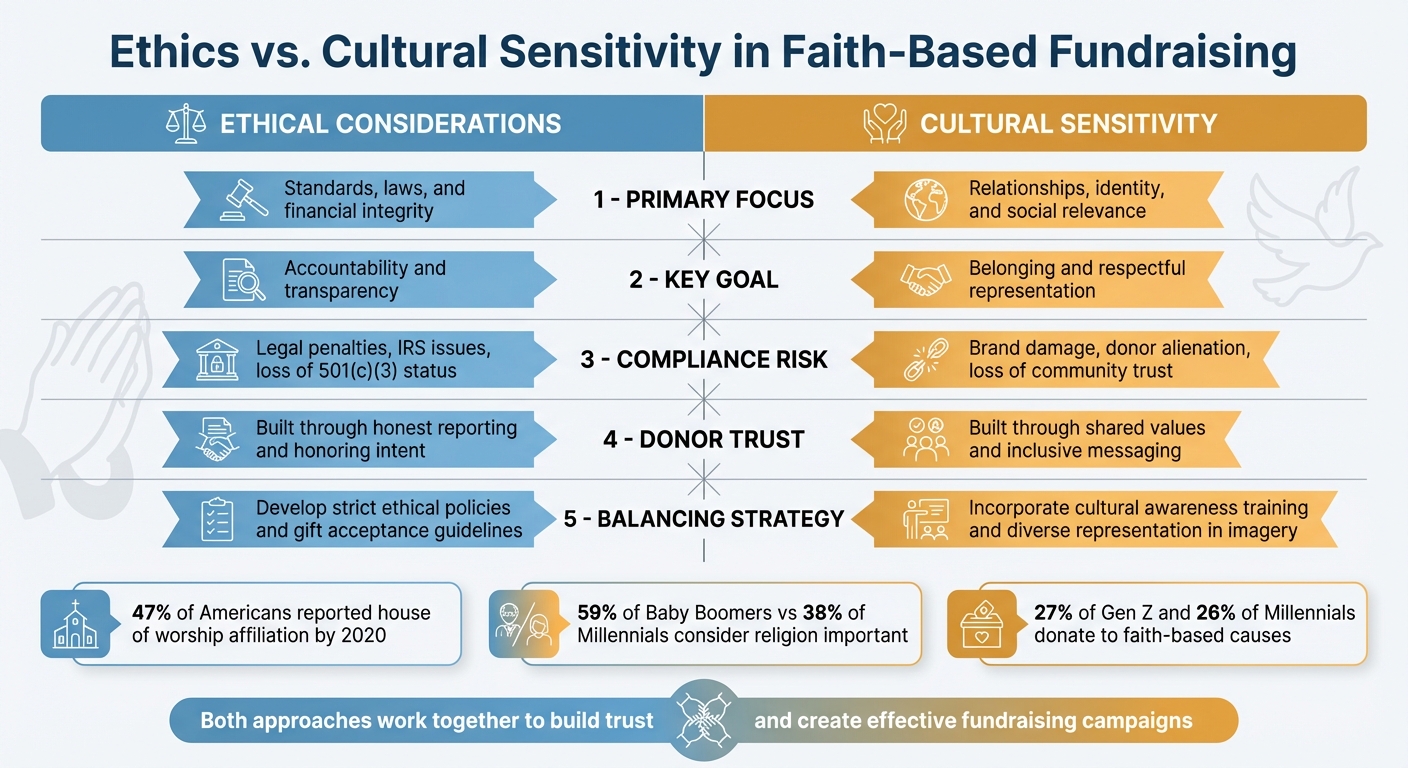
Ethics vs Cultural Sensitivity in Faith-Based Fundraising: Key Differences
Building on the earlier discussion of ethical standards and cultural sensitivity, let’s explore how these two elements play distinct yet complementary roles in earning donor trust.
Ethics and cultural sensitivity might seem like separate concepts, but both are essential for creating a trustworthy relationship with donors. Ethics lays the groundwork by establishing rules and accountability measures that ensure fundraising practices remain honest and legally compliant. On the other hand, cultural sensitivity focuses on building meaningful connections by shaping communication, fostering inclusivity, and making donors feel genuinely valued.
The focus of each is unique: ethical practices revolve around compliance, transparency, and financial integrity. This includes adhering to legal standards, maintaining clear communication, and respecting donor intent. Meanwhile, cultural sensitivity prioritizes identity, relevance, and respect. For instance, it’s worth noting that 59% of Baby Boomers consider religion a crucial part of their lives, compared to only 38% of younger Millennials.
Despite their differences, both contribute to building trust. Ethical missteps, such as hidden fees or misuse of funds, can erode credibility just as much as culturally insensitive messaging. Using exploitative imagery or ignoring generational differences in giving motivations can alienate donors. Both approaches demand honesty: ethics require truthful and transparent communication, while cultural sensitivity calls for messaging that highlights strengths and aspirations rather than deficits.
Comparison Table: Ethics and Cultural Sensitivity
Here’s a closer look at how ethics and cultural sensitivity differ while pursuing shared goals:
| Criteria | Ethical Considerations | Cultural Sensitivity |
|---|---|---|
| Primary Focus | Standards, laws, and financial integrity | Relationships, identity, and social relevance |
| Key Goal | Accountability and transparency | Belonging and respectful representation |
| Compliance Risk | Legal penalties, IRS issues, loss of 501(c)(3) status | Brand damage, donor alienation, loss of community trust |
| Donor Trust | Built through honest reporting and honoring intent | Built through shared values and inclusive messaging |
| Balancing Strategy | Develop strict ethical policies and gift acceptance guidelines | Incorporate cultural awareness training and diverse representation in imagery |
The best faith-based fundraising campaigns don’t pit ethics against cultural sensitivity - they blend the two seamlessly. This balanced approach involves transparent financial practices to build trust with donors who value accountability, while also creating messaging and experiences that resonate with diverse audiences, particularly younger generations seeking a sense of connection and belonging. By integrating both, organizations can meet the needs of a broad donor base while maintaining integrity and respect.
sbb-itb-deea482
Practical Strategies for Balancing Ethics and Cultural Sensitivity
Crafting fundraising campaigns that respect both ethical standards and cultural sensitivity requires careful planning and attention to detail. The good news? Nonprofits can establish systems that honor both principles without having to compromise one for the other.
Developing Ethical Policies
Start by documenting your ethical commitments. Resources like the Association of Fundraising Professionals' revised Code of Ethical Standards (December 2023) and the Donors' Bill of Rights are excellent benchmarks to guide your policies.
Make sure your gift acceptance policies are clear and well-defined. This helps set expectations and ensures your mission remains protected. Avoid commission-based compensation for fundraisers; instead, offer fixed salaries to emphasize authentic relationships over the size of donations.
Transparency is another cornerstone of ethical fundraising. Share key financial details with your donors. As the National Council of Nonprofits puts it:
"Transparency inspires confidence. Beyond what the law requires, nonprofits can demonstrate their commitment to ethical practices by being transparent regarding financial information and fundraising practices."
Finally, ensure your team is equipped to apply these ethical principles in a way that respects cultural diversity.
Incorporating Cultural Awareness Training
While strong policies lay the groundwork, a well-informed team ensures your approach resonates with diverse audiences. Train your staff and board members to engage effectively with a variety of cultural backgrounds. One useful tool is asset-framing, which focuses on highlighting beneficiaries' strengths and aspirations instead of their challenges - helping to avoid exploitative narratives.
Inclusive language training is another essential step. This ensures your communications reflect respect for different cultural perspectives. For example, consider generational differences: 59% of Baby Boomers view religion as important in their lives, compared to just 38% of younger Millennials.
If you're handling donor data across borders, make sure your team is trained on international data protection regulations like GDPR. This not only helps you avoid legal issues but also demonstrates respect for donor privacy. Similarly, when sharing personal stories from constituents, establish clear guidelines for obtaining informed consent and allow individuals to share their experiences in their own words.
Embedding Faith Values Respectfully
Incorporating faith values into your fundraising approach can guide your efforts while respecting the diverse beliefs of your donors. As 1 Peter 5:2 reminds us, leaders should be "eager to serve" rather than "greedy for money".
Consider adopting a "faith mission" approach to communicate your financial needs authentically. As Hudson Taylor famously said:
"God's work done in God's way will never lack God's supply".
This perspective allows you to share specific ministry needs with confidence, trusting the right supporters will respond.
Modular messaging is another effective tactic. Create faith-friendly versions of campaigns tailored to specific religious groups while maintaining a neutral baseline for broader audiences. Research shows that 91% to 100% of donors across various faiths first choose an issue to support before selecting an organization. Modular messaging lets you highlight moral accountability for faith-based donors while focusing on evidence-based outcomes for secular supporters - without straying from your core values.
Finally, take inspiration from historical guidelines like those of George Müller: avoid incurring debt, use funds strictly for their intended purpose, and measure success by the impact achieved rather than the total amount raised. These principles encourage responsible stewardship and ensure ethical fundraising remains central to your mission. By embedding faith values into your campaigns, you not only strengthen ethical accountability but also create meaningful connections with your donor community.
Using Share Services for Ethical and Culturally Sensitive Campaigns
Share Services provides tools tailored to help faith-based nonprofits integrate ethical principles with cultural awareness in their fundraising efforts. Designed for organizations with annual revenues between $1 million and $20 million, their approach moves away from divisive "Us vs. Them" narratives, instead fostering a "We" mindset. This perspective positions donors, nonprofits, and beneficiaries as equal members of a shared community. By translating ethical best practices into actionable campaigns, Share Services offers three specialized services to help nonprofits achieve this balance.
Customized Fundraising Strategies
The Strategy Retainer service ($3,500/month) gives nonprofits access to expert strategists who guide them in implementing ethical practices while monitoring performance metrics. This service emphasizes strength-based messaging, showcasing beneficiaries' goals and potential rather than focusing on their challenges. By avoiding exploitative portrayals, nonprofits can maintain dignity and respect in their messaging. Weekly strategy sessions ensure alignment with ethical standards, while project management and KPI tracking promote transparency, fostering trust with donors.
Culturally Tailored Branding and Messaging
The Monthly Project Budget ($3,000/month) helps nonprofits create content that connects with diverse donor groups. This service includes lifestyle branding strategies that appeal to both traditional supporters and newer, younger audiences. By leveraging generational segmentation, Share Services builds trust and transparency for older donors while emphasizing belonging and impact for younger ones. This is especially relevant as 27% of Gen Z and 26% of Millennials continue to support religious organizations. The package covers branding, graphic design, web design, and copywriting, all crafted with respectful, person-first language that upholds dignity and cultural sensitivity.
Targeted Donor Acquisition Campaigns
The Paid Media Spend ($1,500/month) focuses on reaching diverse audiences through customized digital campaigns on platforms like Meta, Google Ad Grants, and over-the-top (OTT) advertising. Rather than prioritizing immediate returns, this service emphasizes building long-term brand recognition. As Mark Neigh, Vice President of Digital at Masterworks, explains:
"Very few nonprofits think of the value of paid media outside of the direct return on ad spend. But well-placed media that focuses on brand recognition is often less expensive than conversion-optimized media and may have more lasting effects."
This approach is particularly effective for engaging next-generation donors, who are 38% more likely to make lifestyle changes to support causes they care about. Campaigns are designed with practical cultural awareness in mind, such as respecting dietary restrictions or understanding appropriate dress for donor meetings. At the same time, ethical standards are maintained, ensuring fundraising expenses remain below the recommended 35% threshold.
Conclusion
Faith-based nonprofits carry the responsibility of maintaining ethical practices and demonstrating cultural awareness to build trust and amplify their mission's reach. By prioritizing transparency in financial reporting, respecting donor intentions, and steering clear of exploitative messaging, these organizations stay true to the principles of their faith. At the same time, understanding generational shifts, tailoring communication styles, and embracing person-first language help ensure their campaigns connect meaningfully with diverse audiences.
This need for balance becomes even more critical in light of changing donor behaviors and expectations. Studies reveal a decline in traditional religious affiliations, with faith-based charities no longer holding the top spot as the most trusted in the U.S.. However, younger donors remain actively engaged when they see their values reflected in an organization’s actions. As Lord Rabbi Jonathan Sacks wisely observed, ethical fundraising not only upholds faith but also enhances its reputation, while unethical practices risk doing the opposite.
Achieving this balance requires deliberate strategies. Tools like a Donor Bill of Rights, clear gift acceptance policies, and a shift from deficit-focused narratives to strengths-based storytelling can guide these efforts. By moving away from framing donors as saviors and beneficiaries as victims, nonprofits can embrace a "We" narrative - one that positions donors, organizations, and the people they serve as equal contributors to community transformation.
Practical benchmarks also play a role. For instance, keeping fundraising expenses under the recommended 35% threshold is a tangible way to demonstrate accountability. Campaigns that honor both faith principles and donor diversity do more than raise money - they reinforce the organization’s mission and values.
FAQs
How can faith-based organizations ethically fundraise while respecting cultural differences?
Faith-based organizations can successfully navigate the balance between ethical fundraising and cultural sensitivity by focusing on three core principles: transparency, honesty, and respect for donor intent. Openly sharing financial practices and crafting truthful, respectful messaging are key to earning trust and building lasting donor relationships. Organizations can also look to ethical standards, like those outlined by the Association of Fundraising Professionals, which discourage exploitative imagery and stress the importance of aligning fundraising efforts with donor interests.
When it comes to cultural sensitivity, adapting fundraising strategies to reflect local customs can make a significant impact. At the same time, these efforts should stay rooted in universal values like accountability and transparency. For instance, tailoring messages to resonate with the values and traditions of the communities they serve helps foster stronger connections. By incorporating faith-based principles - such as stewardship and honoring donor restrictions - organizations can ensure their practices align with both ethical standards and cultural expectations. Tools and strategies from groups like Share Services can further support organizations in creating campaigns that resonate culturally, retain donor trust, and meet U.S. nonprofit regulations.
How can nonprofits create culturally sensitive and ethical fundraising campaigns?
To connect with a variety of donor groups, nonprofits should prioritize understanding the unique values, traditions, and motivations of each community. This means taking a closer look at the language, imagery, and outreach methods used to ensure they convey respect and inclusivity. For example, aligning campaigns with cultural celebrations - like incorporating symbols or themes from holidays such as Yalda, Dongzhi, or Lucia’s Day - can show a genuine effort to understand and build trust with these communities.
Leveraging segmentation tools to deliver personalized messages to the right donor groups is crucial. On top of that, providing clear and transparent reporting - such as detailed breakdowns of budgets and measurable impact - can strengthen ethical practices and boost donor confidence. Digital platforms that offer multilingual content and personalized messaging, like those from Share Services, make it easier for nonprofits to scale these culturally sensitive approaches while ensuring every donor feels appreciated and connected to the mission.
Why is transparency important for building trust in faith-based fundraising?
Transparency plays a crucial role in faith-based fundraising, as it assures donors that their contributions are handled with integrity and care. By openly sharing financial details - like budgets, funding sources, and how donations are spent - nonprofits show they are accountable and committed to ethical management. This not only meets legal standards but also upholds the moral responsibility of managing resources with honesty.
Today’s donors want more than just a thank-you note - they expect clear, straightforward information about where their money goes and updates that show the difference their gifts make. When organizations embrace transparency, they strengthen trust, encourage long-term support, and minimize potential misunderstandings. Collaborating with experts such as Share Services can help nonprofits craft strong communication strategies and donor retention plans that reflect these principles.
Related Blog Posts
Get helpful resources, straight to your inbox
We love sharing tools, ideas, and stories that make nonprofit work a little lighter and a lot more effective. Sign up below and we’ll send you practical tips, free resources, and a bit of encouragement—because the work you’re doing matters.
No spam. Just good stuff for good people.