
Jan 15, 2026
5 Donor Segmentation Tips for Faith-Based Nonprofits
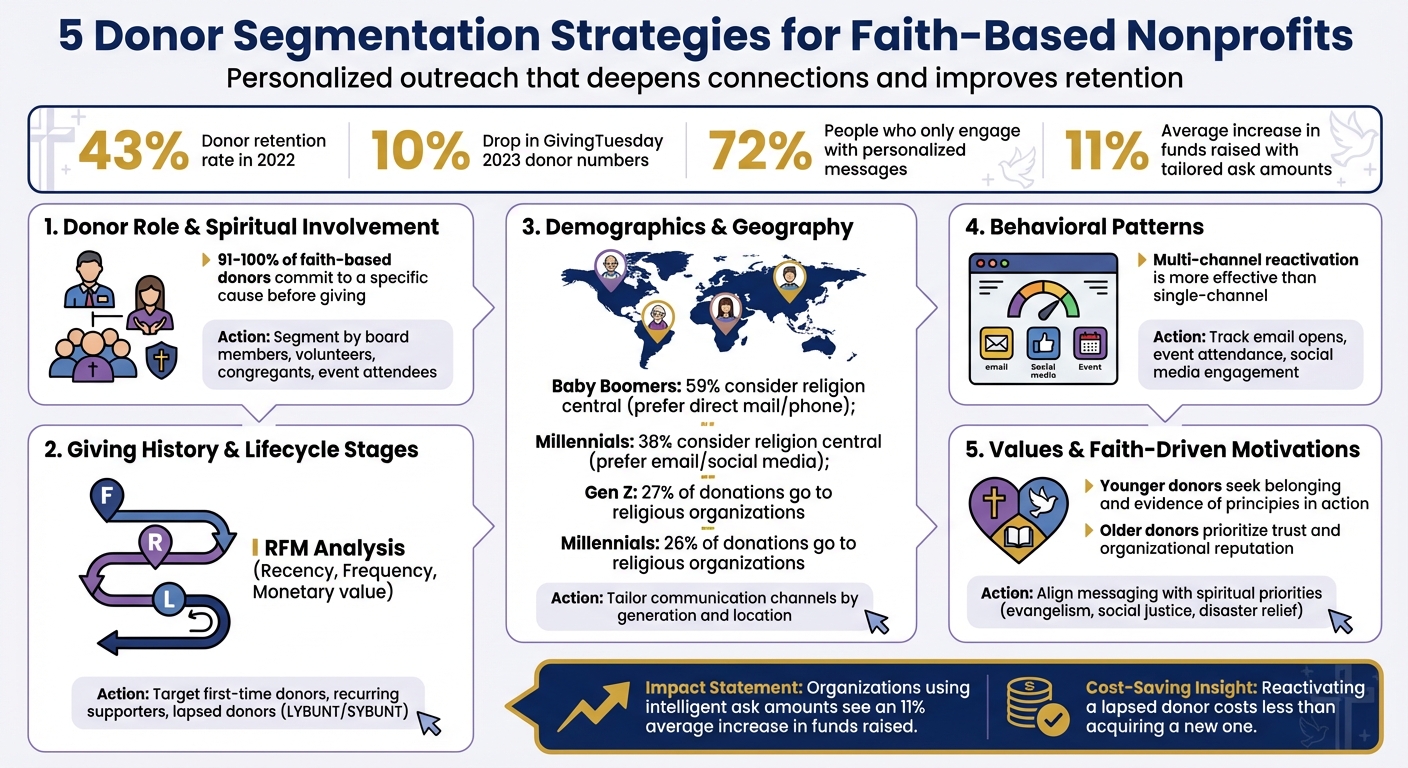
Donor segmentation helps faith-based nonprofits connect with supporters by grouping them based on shared traits like giving history, demographics, and spiritual engagement. Why does this matter? Retention rates are low - only 43% of donors stayed engaged in 2022, and GivingTuesday 2023 saw a 10% drop in donor numbers. People disengage when messaging feels irrelevant, but personalized outreach can improve retention and deepen connections.
Key Takeaways:
- Segment by donor role and spiritual involvement: Tailor communication to volunteers, board members, or congregants based on their level of engagement.
- Use giving history and donor lifecycle stages: Target first-time donors, recurring supporters, and lapsed donors with personalized asks.
- Apply demographic and geographic data: Adapt outreach to generational preferences and local needs.
- Track behavioral patterns: Identify engaged supporters and reengage those showing less activity.
- Segment by values and faith-driven motivations: Align messages with donors' spiritual priorities like evangelism or social justice.
Personalized messaging isn’t just effective - it’s necessary. Understanding your donors’ motivations and engagement levels is the key to retaining support and growing your mission.
5 Donor Segmentation Strategies for Faith-Based Nonprofits
Fundraising Expert Reveals BEST Donor Segmentation & Email Campaign Strategies for Nonprofits
sbb-itb-deea482
1. Segment by Donor Role and Spiritual Involvement
Not all donors connect with your mission in the same way. Congregants, social media followers, volunteers, and board members each bring a unique perspective, and your messaging should reflect that. To start, organize your donors based on their specific roles and level of involvement.
Group your donor base into categories like current or former board members, volunteers, event attendees, program alumni, or parents of participants. But don’t stop at basic details like giving history - dig deeper. Track their event attendance, peer fundraising efforts, advocacy work, or committee participation to get a full picture of their engagement.
Here’s an interesting insight: 91–100% of faith-based donors commit to a specific cause or issue before giving. For example, acknowledging a volunteer’s hands-on contributions shows you understand and value what drew them to your mission in the first place. Faith-based donors often follow structured, recurring giving patterns tied to their spiritual commitments. This differs from secular donors, whose giving tends to be more flexible and driven by specific causes.
To make your outreach even more effective, match the messenger to the donor’s role. For instance, have board members speak to fellow board members or alumni connect with other alumni. When approaching volunteers, start by recognizing the time they’ve already given, then explain how their financial support can amplify their impact. For faith-based organizations, segmenting by spiritual involvement means understanding what resonates with each donor’s faith journey and framing your request in a way that aligns with their beliefs.
"Fundraising becomes a spiritual practice when you discern how God invites others to join His mission through your ministry." - Zach Leighton, Principal Creative, Reliant
And here’s a compelling stat: Organizations that adjust their ask amounts based on individual donor characteristics see an average increase of 11% in funds raised compared to those using generic appeals. Tailored messaging isn’t just thoughtful - it’s effective.
2. Use Giving History and Donor Lifecycle Stages
Your donor database is like a map of each supporter's journey. By using RFM analysis - Recency, Frequency, Monetary value - you can pinpoint your most active donors and identify those who might need a little extra attention to stay engaged.
Nonprofits today face real challenges when it comes to donor retention. That’s why it’s crucial to create tailored approaches for supporters at different stages of their giving journey. For example, you can craft a warm welcome for first-time donors, keep recurring supporters in the loop with updates, and reconnect with lapsed donors (LYBUNT/SYBUNT) through personalized outreach that highlights their previous contributions.
But it doesn’t stop at lifecycle stages. Paying attention to seasonal and behavioral trends can make your segmentation even sharper. Faith-based donors, for instance, often give during specific times of the year or to particular causes, like mission trips or building projects. If a donor who typically gives in December skips their usual contribution, it’s a great opportunity to reach out. Automated triggers in your database can notify your team when a recurring donor’s payment method is about to expire or when someone misses their regular giving period.
"When you know how, when, and why your supporters feel motivated to give, you can create powerful, personal, and meaningful asks." - Doubleknot
Using this kind of data, you can also personalize donation requests based on each donor’s giving history. Nonprofits that use “Intelligent Ask Amounts” report an average increase of 11% in funds raised. It’s a simple yet effective way to make your appeals more impactful and relevant.
3. Apply Demographic and Geographic Data for Targeted Outreach
Understanding donor demographics and locations is key to creating messages that truly resonate. Factors like age, income, and location play a big role in shaping how you reach out and connect with your audience.
Let’s start with age. Different generations respond to different communication channels. For example, Baby Boomers are more likely to engage with direct mail and phone calls, while Millennials and Gen Z tend to prefer email, social media, and SMS updates. Interestingly, even though only 38% of younger Millennials feel religion is a central part of their lives (compared to 59% of Baby Boomers), a significant portion of their donations - 27% for Gen Z and 26% for Millennials - still goes to religious organizations. This highlights the importance of meeting younger donors where they are: on digital platforms. At the same time, it’s essential to maintain traditional outreach methods for older generations. Beyond age, financial capacity is another layer to consider.
Income data can help you tailor your donation requests. For instance, high-income donors might be approached for major gifts, while middle- and low-income donors receive appeals that align with their giving capacity. This ensures your asks are realistic and respectful of each donor’s financial situation.
Geographic data adds another layer of personalization. Knowing where your donors are located allows you to promote local events, invite nearby supporters to volunteer opportunities, and address specific community needs. For example, you might send personalized invitations to donors within a 20-mile radius of an event while offering virtual options for those farther away.
"Geographic segmentation ensures your appeals account for local connections and cultural nuances." - Jeremy Reis, Author
To make your outreach even more effective, consider creating donor personas like "Retired Boomer Bob" or "Millennial Parent Maya." These personas help you refine your messaging and connect on a deeper level. Combining demographic and geographic insights can also lead to highly specific segments, such as "Middle-Aged, Urban, Recurring Donors", which allow you to craft messages that align perfectly with a donor’s lifestyle and values. Keep in mind that 72% of people engage only with marketing messages tailored to their interests, so relevance is key to building strong connections.
Share Services offers digital fundraising tools designed to help you integrate demographic and geographic data, making it easier to engage donors in meaningful ways.
4. Track Behavioral Patterns to Identify Engaged Supporters
Understanding how donors interact with your organization - whether through donation habits, event participation, email engagement, or social media activity - offers a clear picture of their level of commitment. For faith-based nonprofits, this means looking beyond financial contributions to include involvement in spiritual programs, volunteer efforts, and faith-driven events.
Engaged donors often display consistent behaviors, like opening emails, attending events, and interacting with your social media content. These individuals are excellent candidates for increased giving opportunities or even leadership roles within your organization. On the other hand, a drop in engagement - fewer event RSVPs, declining email open rates, or reduced social media activity - could indicate a donor is at risk of disengaging. Recognizing these patterns allows you to create targeted outreach strategies to reengage them.
"It costs less to reactivate a lapsed donor than to acquire a new one. Email can be effective, but multi-channel approaches are even better." - Eddie Laing, Paid Media Specialist
By analyzing this behavioral data, you can craft personalized outreach efforts. For instance, a loyal monthly donor may appreciate tailored updates about the impact of their contributions, while someone who frequently attends events might respond well to invitations for exclusive gatherings or leadership roles in faith-based projects. Meanwhile, donors who engage primarily online may connect better with digital storytelling that highlights your ministry's achievements. Customizing your communication helps build stronger, more meaningful relationships with your supporters.
To make this process easier, digital tools can play a key role. Share Services offers solutions that help faith-based nonprofits track donor behavior across various channels, enabling you to identify and engage your most dedicated supporters effectively.
5. Segment by Values and Faith-Driven Motivations
Understanding why donors give is just as important as knowing how much they give. For faith-based nonprofits, it’s crucial to go beyond just tracking donations and delve into the beliefs, values, and spiritual motivations that influence giving decisions.
To uncover what truly resonates with your supporters, consider asking them about the ministry programs they care about most. Whether it’s evangelism, disaster relief, community education, or social justice, these preferences can reveal their core faith-driven priorities. Additionally, observing how donors interact with your website and social media - like downloading annual reports, visiting specific program pages, or engaging with particular posts - can provide valuable insights into what matters most to them.
Donor values add another layer to your segmentation strategy. Different generations and faith backgrounds often require distinct approaches. For example, 27% of Gen Z and 26% of Millennials donate to religious organizations, with many younger donors seeking a sense of belonging and tangible evidence of faith-based organizations living out principles like helping those in need. On the other hand, Baby Boomers - 59% of whom consider religion a central part of their lives, compared to 38% of younger Millennials - tend to prioritize trust and the reputation of the organization.
"Many people leave the church because they don't see organized religion living out the core principles they believe in, like helping those in need. Nonprofits who figure out how to create relevant experiences for this audience - typically a younger audience - will have a chance to succeed."
- Mark Neigh, Vice President of Digital, Masterworks
Once you’ve identified these value-based segments, tailor your messaging accordingly. Highlight community aid efforts for those passionate about social justice, or share stories of spiritual transformation for donors driven by evangelism. This approach helps create stronger connections, as 72% of people are more likely to engage with messages that align with their interests. Share Services specializes in helping faith-based nonprofits craft messaging and branding strategies that align with donors’ core values, making it easier to build lasting relationships with supporters who share your mission. By weaving these insights into your existing segmentation strategy, you can enhance engagement and deepen donor relationships.
Conclusion
For faith-based nonprofits, donor segmentation isn't just a helpful tool - it’s a game-changer. By categorizing donors based on spiritual involvement, giving history, demographics, behavior, and faith-based values, you can move beyond generic appeals and craft messages that truly resonate. When you understand what drives your donors and where they are in their giving journey, you can create personalized communications that inspire ongoing support and deepen their connection to your mission.
The importance of segmentation is backed by clear trends. Reactivating a lapsed donor through targeted efforts costs far less than acquiring a new one. Plus, loyal donors are twice as likely to maintain their contributions during tough financial times compared to less engaged supporters.
If you're just starting, focus on one method - like RFM analysis or developing donor personas - and build from there. Experiment with targeted messages, keep your donor database up-to-date, and establish clear paths to guide first-time donors into becoming regular supporters .
To make this process easier, Share Services offers tailored support for faith-based nonprofits. From email campaigns to paid media strategies, they handle the technical aspects so you can focus on your mission. For example, one organization grew its recurring donor base from 350 to over 1,500 supporters by adopting targeted messaging and a multi-channel approach. Share Services provides the expertise to turn segmentation insights into real, measurable growth.
FAQs
How does donor segmentation help faith-based nonprofits retain supporters?
Donor segmentation helps faith-based nonprofits connect with supporters on a personal level by grouping them based on shared traits like donation history, interests, or engagement. This approach ensures that donors receive messages that feel relevant and meaningful, building stronger bonds and a deeper sense of community.
When communication and outreach are tailored to specific groups, nonprofits can show genuine appreciation and align their messaging with what matters most to each donor. This not only encourages ongoing support but also improves donor retention year after year. Thoughtful segmentation is a key strategy for nurturing relationships and ensuring the long-term success of your mission.
How can demographic and geographic data improve donor segmentation for faith-based nonprofits?
Demographic and geographic data play a crucial role in shaping donor segments that truly connect with your audience. By diving into factors like age, income, marital status, and education level, nonprofits gain a clearer picture of a donor’s ability to give, their interests, and how they prefer to be reached.
Geographic details - like city, ZIP code, or state - add another layer of insight, emphasizing local connections and regional differences. This information is especially useful for tailoring outreach, such as promoting events or programs that resonate within a donor’s community.
When these data points come together, faith-based nonprofits can create messages that feel personal, set donation amounts that make sense, and time their outreach to align with a donor’s life. The result? Stronger relationships, more engaged donors, and fundraising efforts that hit the mark.
Why is it important for faith-based nonprofits to align donor messaging with spiritual values?
Connecting donor messaging to supporters' spiritual values creates a meaningful bond by addressing what they deeply care about. This strategy helps nurture trust and loyalty - key elements for faith-based nonprofits to sustain solid relationships with their donors. By aligning your communication with their beliefs, you ensure your message feels personal and impactful, inspiring ongoing support for your cause.
Related Blog Posts
Get helpful resources, straight to your inbox
We love sharing tools, ideas, and stories that make nonprofit work a little lighter and a lot more effective. Sign up below and we’ll send you practical tips, free resources, and a bit of encouragement—because the work you’re doing matters.
No spam. Just good stuff for good people.