
Feb 14, 2026
Top AI Tools for Donor Segmentation
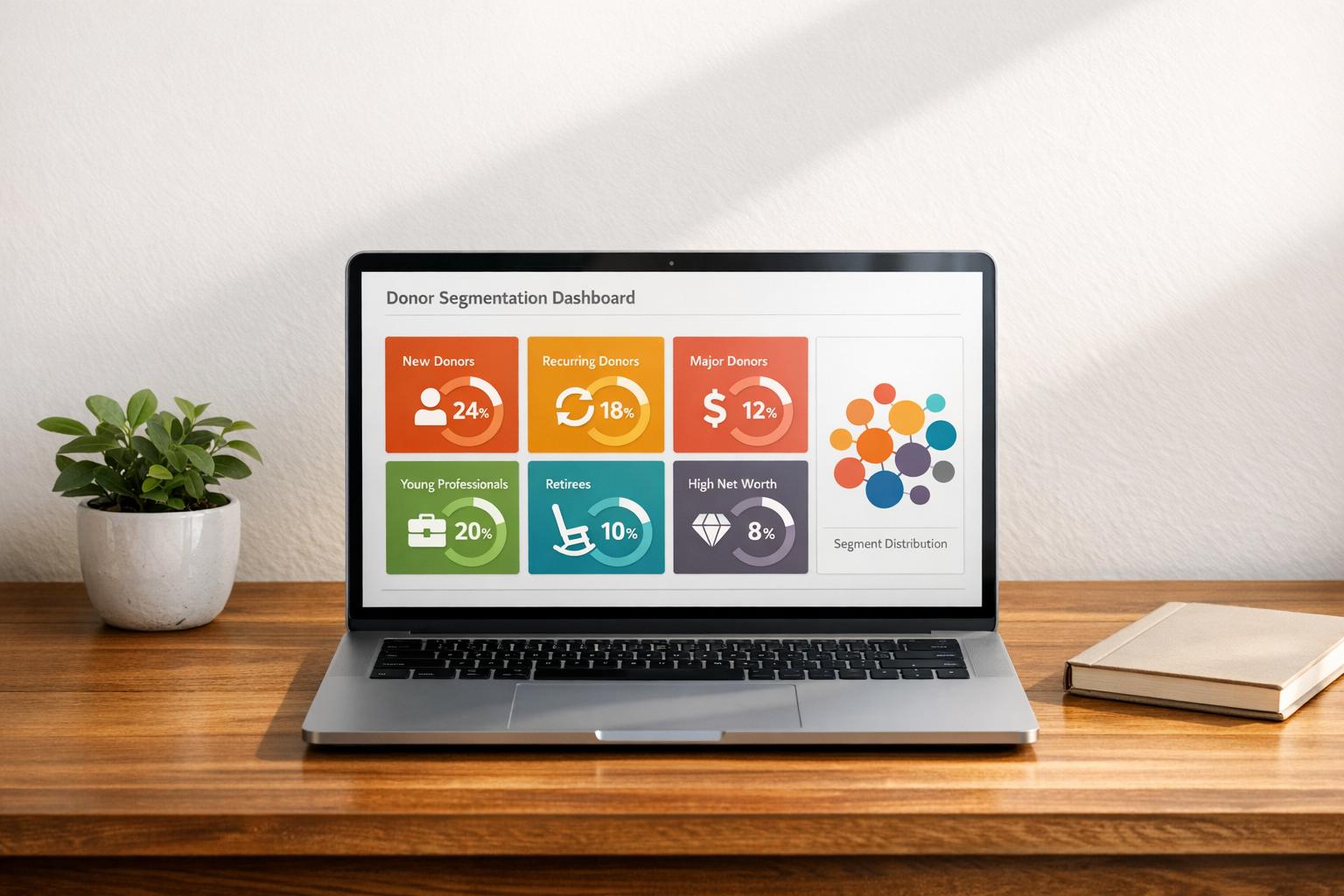
AI tools are transforming how nonprofits approach donor segmentation. Instead of relying on basic donor lists, these tools analyze donor behavior like email engagement, event participation, and giving trends to create dynamic groups. This helps nonprofits send tailored messages, improve donor retention, and increase monthly donations. For example, organizations using AI-driven segmentation have seen up to a 16% boost in retention rates and a 23% rise in monthly gift conversions.
Here’s a quick overview of the top AI tools for donor segmentation:
- DonorSearch AI: Predicts donor behavior with 81% accuracy and simplifies portfolio prioritization.
- Wisely: Focuses on identifying high-potential donors but lacks robust support.
- Donorbox Jay·AI: Automates donor analysis and personalizes outreach but is limited to specific subscription plans.
- Virtuous: Uses real-time donor signals to align communications with donor interests.
- Salesforce Einstein AI: Offers enterprise-level predictive modeling but requires significant investment.
- Dataro: Integrates with existing CRMs to predict donor behavior but needs a large dataset.
- Blackbaud Predictive Analytics: Combines wealth screening with predictive modeling for major gift campaigns.
- Keela: Affordable for smaller nonprofits, with tools like Smart Ask and Donor Readiness.
Quick Comparison
| Tool | Best For | Pricing | Key Features | Limitations |
|---|---|---|---|---|
| DonorSearch AI | Major gift prospecting | Custom pricing | Predicts donor behavior, simplifies portfolio management | Data quality impacts accuracy |
| Wisely | High-potential donor identification | Contact for quote | Lead management, behavioral analysis | Poor 24/7 support rating |
| Donorbox Jay·AI | Small to mid-sized nonprofits | Included in Pro plans | Automates analysis, visualizes donor data | Requires Pro, Premium, or CRM subscription |
| Virtuous | Relationship-focused nonprofits | Custom pricing | Predictive modeling, real-time donor signals | Best with clean, historical data |
| Salesforce Einstein AI | Large organizations | $60+/user/month | Predictive modeling, engagement scoring | High setup cost and steep learning curve |
| Dataro | Data-driven insights | Custom pricing | Propensity modeling, multi-channel optimization | Requires large donor database |
| Blackbaud Predictive Analytics | Blackbaud users | Custom pricing | Wealth screening, predictive models | Limited to Blackbaud ecosystem |
| Keela | Small nonprofits | Starts at $134/month | Smart Ask, Donor Readiness algorithm | Discounts only apply for the first year |
These tools help nonprofits save time, personalize outreach, and increase donor engagement. To choose the right one, consider your organization’s size, budget, and data quality.

AI Donor Segmentation Tools Comparison: Features, Pricing, and Best Use Cases
5 Ways Nonprofits Can Use AI to Get More Done (Without Losing Your Voice)
sbb-itb-deea482
1. DonorSearch AI
DonorSearch AI is a tool designed to help faith-based nonprofits identify loyal donors and understand their giving habits. By using machine learning, it predicts which supporters are likely to donate again or even increase their contributions over time.
Key Segmentation Features
DonorSearch AI uses its MLR Score and custom AI metrics to predict outcomes like outreach response rates, donor retention, and the likelihood of repeat contributions. These predictions boast an impressive 81% accuracy rate. The platform also provides Donor Lifetime Value (LTV) projections, which can identify prospects with up to 20 times greater lifetime giving potential compared to traditional methods. For major gift officers, the tool simplifies portfolio prioritization, a task that typically takes hours, by completing it in just minutes. These features make managing donor relationships and portfolios far more efficient.
Pricing
The cost of DonorSearch AI is customized based on your organization's size and specific needs, determined during a personalized demo. For nonprofits new to AI, the platform offers Enhanced CORE, a simplified version with standardized models and straightforward reporting. This option provides an easier entry point for organizations exploring AI for the first time. Matthew Cook, Executive Director of Blue13 Dance Company, shared his experience:
"You will make your money back. It will easily give you a return on investment in your first year".
Suitability for Faith-Based Nonprofits
DonorSearch AI goes beyond simple demographics, fostering deeper donor connections. Sarah Richards, Research Analyst at Dynamic Catholic, highlighted its impact:
"leveraged DonorSearch to drive a $25 million campaign".
Organizations using the platform have seen response rates improve by up to 85% and average gift amounts increase by 20%. Additionally, it integrates seamlessly with over 40 church management systems, making it a flexible choice for faith-based groups.
Limitations
While DonorSearch AI provides powerful insights, it depends on the quality of your existing donor data for accurate predictions. It's important to note that the tool is designed to complement, not replace, the human element in donor relationships and strategic decision-making.
2. Wisely
Wisely leverages AI to pinpoint high-potential donors by analyzing behavioral patterns. This approach to targeted lead management forms the backbone of its segmentation tools.
Key Segmentation Features
Wisely is equipped with tools that help create focused outreach programs, improving donor retention rates. Its lead management features are particularly beneficial for organizations in the "Causes and Charity" sector, simplifying how prospects are identified and followed up on. Additionally, the platform uses automated insights to help nonprofits expand their most successful fundraising strategies. Its analytics capabilities have been rated 4.45/5 for delivering actionable insights.
Pricing
Pricing details for Wisely aren’t publicly disclosed. Organizations interested in using the platform are encouraged to contact the vendor directly for a quote tailored to their specific needs and size.
Suitability for Faith-Based Nonprofits
Wisely has an overall rating of 4.36 out of 5, based on feedback from 42 users. Its AI-driven features earned a 4.27 out of 5, reflecting its ability to maintain consistent engagement and follow-ups with supporters. These qualities are especially valuable for faith-based nonprofits, where fostering long-term donor relationships is essential. Reviews highlight the platform’s effectiveness in driving results through well-organized operations and marketing efforts.
Limitations
One notable drawback is Wisely’s 24/7 support, which received a low rating of 1.58/5, meaning nonprofits may need to depend on their own technical expertise. Additionally, its data import and export tools scored a modest 3.42 out of 5. Some reviews also question the platform’s sustainability in the long run.
3. Donorbox Jay·AI
Donorbox Jay·AI is an AI-powered fundraising assistant designed to simplify donor analysis and create personalized communications. By leveraging donor behavior insights, it helps nonprofits identify patterns, interests, and motivations, enabling them to develop more effective engagement strategies.
Key Segmentation Features
Integrated into the Donorbox CRM, Jay·AI offers tools to create targeted contact lists and dynamic groups automatically. Its "Moments" feature streamlines milestone-driven outreach, while donor data is displayed in easy-to-read visual formats like bar, pie, and line charts, making performance tracking and campaign adjustments more manageable. By automating tasks like data analysis and email drafting, Jay·AI allows nonprofit teams to save time and focus on cultivating relationships with high-value donors and optimizing engagement channels.
Pricing
Jay·AI is included at no extra charge for organizations subscribed to Donorbox Pro, Premium, or Donorbox CRM plans. While the exact monthly subscription costs in USD for Pro and Premium tiers aren't publicly listed, nonprofits can directly contact Donorbox for the latest package details.
Suitability for Faith-Based Nonprofits
Jay·AI is tailored to each nonprofit's mission and donor audience, ensuring that all communications align with the organization's values. This makes it especially beneficial for faith-based nonprofits that prioritize highly personalized and mission-focused donor engagement. Lindsey Baker Bower from Donorbox highlights its role in campaign preparation:
"While it will never replace the personal touch necessary to maintain strong donor relationships, AI is a great tool for drafting your campaign materials".
In addition, Jay·AI is SOC 2 Type II certified and PCI DSS Level 1 compliant, ensuring donor data is secure while enhancing segmentation and personalization.
Limitations
Jay·AI is not available on the standard or free Donorbox plans, requiring nonprofits to subscribe to a Pro, Premium, or CRM plan. Additionally, the Donorbox CRM is undergoing updates, and interested users must join a waitlist to access its full features.
4. Virtuous
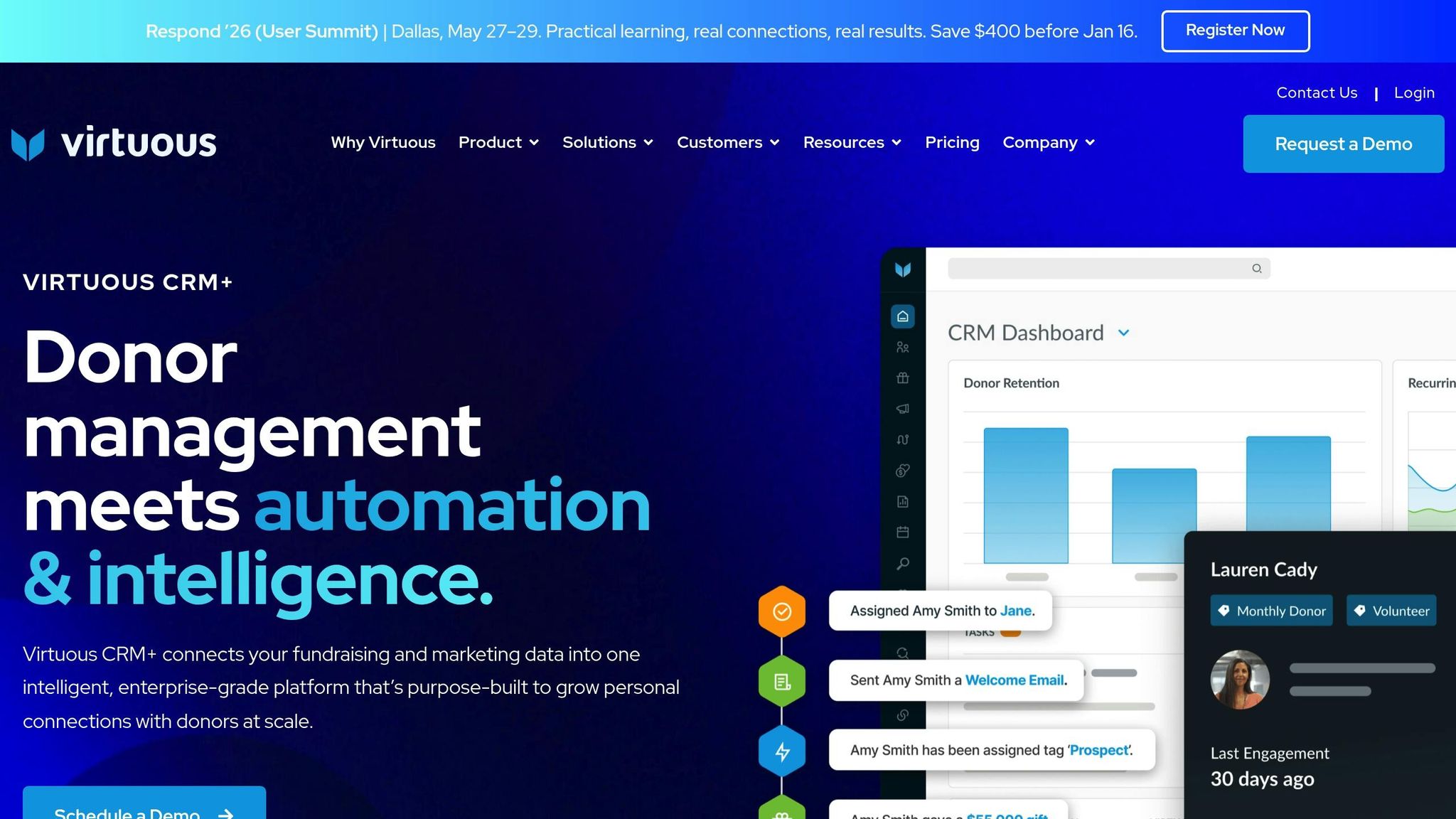
Virtuous stands out by aligning donor segmentation with ministry-specific values through its dynamic fundraising model. Unlike static donor lists, it uses real-time donor signals to create personalized communication pathways that strengthen supporter relationships.
Key Segmentation Features
Virtuous leverages AI-powered predictive modeling to analyze giving likelihood, churn risk, planned gift potential, and upgrade opportunities using machine learning. The platform also enriches donor profiles automatically with third-party data, making it easier for organizations to understand their supporters.
With natural language search, staff can find donor segments using simple, conversational commands instead of navigating complicated database queries. The system even suggests AI-recommended gift amounts tailored to each donor's financial capacity, helping organizations approach donors more strategically.
Other features include automated tagging, which categorizes donors based on their donation frequency, campaign engagement, or volunteer activities. Custom fields allow nonprofits to track mission-specific details, like cause preferences or employer matching programs. Additionally, the platform recommends 3–5 donor personas for more focused messaging. Organizations using Virtuous have reported impressive results, including a 12% increase in donor retention, a 10% boost in average gift size, and a 20% reduction in administrative tasks.
Pricing
Virtuous offers nonprofit-friendly pricing and discounts for verified organizations. Costs are customized based on the size and needs of your organization, with quotes provided in USD.
Suitability for Faith-Based Nonprofits
Virtuous includes relational giving tools designed to align donor interests with ministry-specific missions. It tracks media channels to measure which outreach efforts drive donations and automates stewardship paths that guide supporters through faith-centered journeys.
For example, Jewish Voice Ministries International transitioned from manual campaigns to Virtuous automation and achieved a 600% ROI increase. Charlotte Rescue Mission uses automated donor lifecycles to send three educational emails to new donors. Lea Love, Manager of Development Operations, shares:
"It's all about creating connections. Everyone that completes a first-time donation receives a series of three emails that helps educate them and gives us a chance to talk more about our programs".
Victory Mission also saw remarkable growth, with their monthly donor base increasing by 75% over two years after adopting Virtuous to enhance recurring giving. Mindy McDonald, Director of Advancement and Marketing, attributes this success to the platform's ability to strengthen donor relationships.
Limitations
While Virtuous offers powerful tools, creating too many donor personas - more than 20 - can overwhelm staff with content demands. Gabe Cooper, CEO of Virtuous, advises:
"We recommend starting with three to five personas if you haven't done this in the past. If you overthink it too much, you end up with 20 different personas. It gets hard gathering up the content that's specific to each one".
Additionally, the platform performs best with clean, historical data. Organizations with underdeveloped data practices may need time to fully benefit from its features. Proper integration with external platforms for email, social media, and events is also crucial for building a complete donor view.
5. Salesforce Einstein AI
Salesforce Einstein AI integrates with the Nonprofit Success Pack (NPSP) to deliver advanced donor segmentation through predictive modeling. By analyzing data from Contact, Opportunity, and Recurring Donation records, it identifies individuals most likely to become first-time donors, recurring contributors, or major gift prospects. This builds on earlier segmentation tools but offers a more advanced, enterprise-level solution.
Key Segmentation Features
Einstein uses engagement scoring personas to categorize donors based on their likelihood to open emails, click on links, or stay subscribed. It also flags donors who are either overwhelmed by communications or under-engaged, helping organizations adjust their outreach strategies.
The Einstein Prediction Builder creates custom models tailored to your organization's historical data, with updates provided monthly. The What-If Analyzer evaluates how changes in communication volume might impact donor saturation and opt-out rates. Additionally, Einstein's Natural Language Processing (NLP) capabilities analyze donor surveys, messages, and call transcripts to uncover donor intent and motivations - particularly useful for understanding the values driving faith-based supporters.
Pricing
Through the Power of Us Program, Salesforce provides 10 free Nonprofit Cloud licenses to eligible 501(c)(3) organizations, valued at $4,320 to $7,200 annually. Additional licenses cost $36–$60 per user per month. However, Einstein AI features require either the Enterprise Edition (around $150 per user per month) or the Unlimited Edition (around $300 per user per month), both offered at discounted nonprofit rates. Implementation costs can range from $7,000 to $30,000, with ongoing admin support priced between $500 and $5,000 monthly.
Suitability for Faith-Based Nonprofits
Large faith-based organizations stand to gain the most from Salesforce's comprehensive platform, which supports fundraising, grant management, and program tracking. Its ability to analyze qualitative data enables nonprofits to align their outreach with donors' spiritual motivations. However, a 2025 NCF Foundation survey revealed that only 14% of nonprofits currently use AI effectively. To maximize success, organizations should begin with focused use cases - such as predicting donor upgrades or analyzing survey feedback - before expanding their AI usage.
Limitations
The implementation process can take 3 to 6 months or longer, requires dedicated administrative support, and involves adapting generic CRM terms to nonprofit-specific concepts. For faith-based nonprofits with fewer than 10 users, the upfront investment may not align with their technical resources or budget. While Einstein excels at efficiency tasks, it cannot replace the personal connections that are key to building strong donor relationships.
6. Dataro
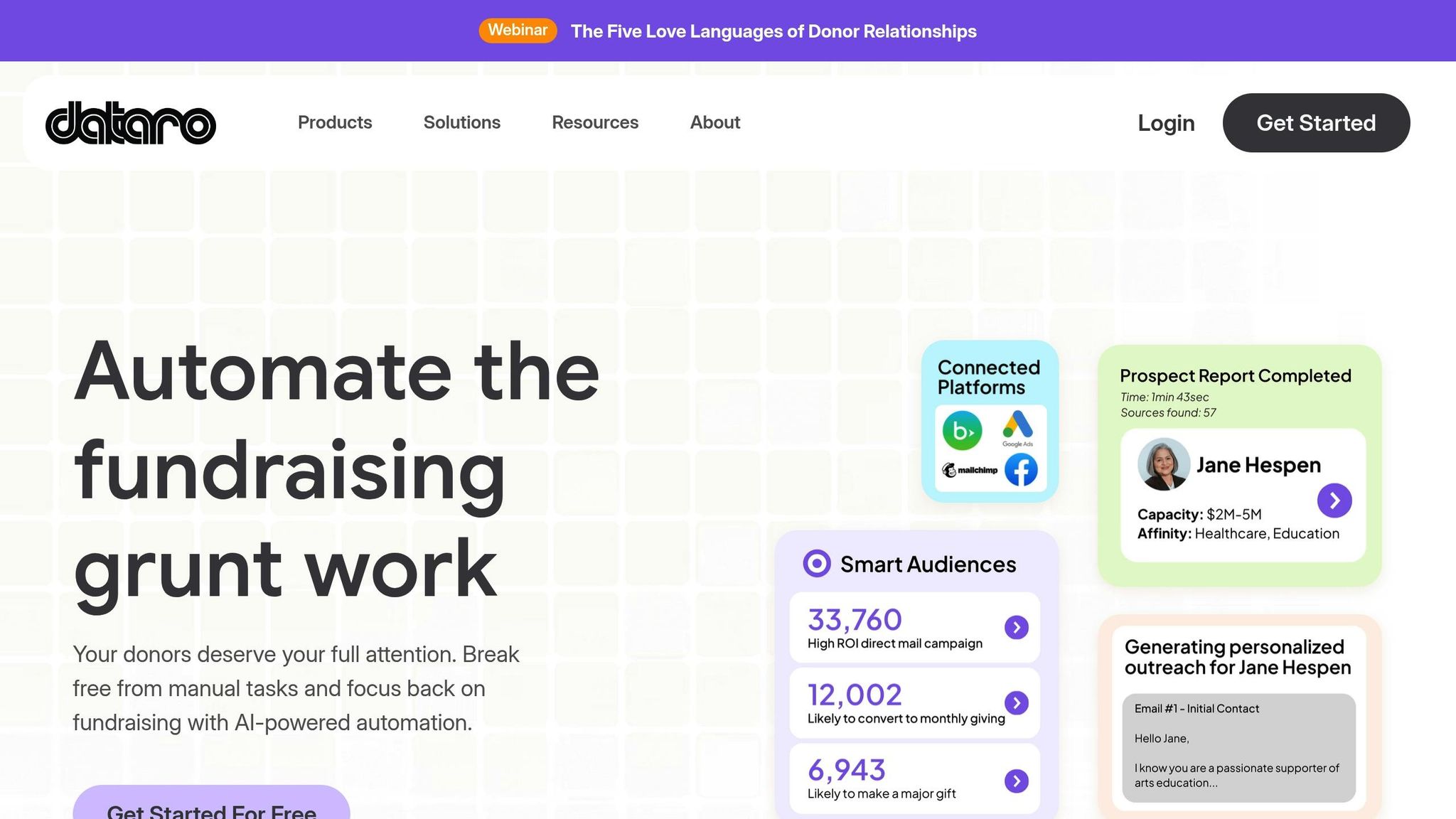
Dataro is a machine learning add-on tailored specifically for nonprofits, designed to overlay AI-driven predictions onto your existing CRM. It works seamlessly with platforms like Salesforce, Blackbaud (Raiser's Edge NXT, CRM, RE7), Microsoft Dynamics, and Donorfy. For accurate results, nonprofits need at least 10,000 donor records and a recommended history of 5 years (with a minimum of 2 years). These integrations ensure Dataro fits smoothly into existing donor management systems.
Key Segmentation Features
Dataro uses propensity modeling to analyze donor behavior, predicting their likelihood of contributing through one-time appeals, recurring donations, mid-level gifts, major contributions, or planned giving. Its Smart Audiences feature automates the creation of targeted donor lists for campaigns across various channels. Additionally, it suggests optimal gift amounts based on donor behavior.
The ProspectAI tool conducts automated wealth screening to identify potential major gift donors hidden in your database. Meanwhile, the AI Assist feature generates customized messaging to craft appeals that resonate with specific donor groups. By analyzing giving history, Dataro can even pinpoint donors' key interests, making it easier for faith-based organizations to align their appeals with ministries or mission-driven areas.
Pricing
Dataro offers a "Get Started For Free" option, including pre-built integrations for Salesforce NPSP and Raiser's Edge NXT. Pricing varies based on your donor database size and the modules you choose.
Suitability for Faith-Based Nonprofits
Faith-based nonprofits can benefit significantly from Dataro’s ability to personalize donor outreach. Organizations that rely on direct mail and telemarketing will find its multi-channel optimization particularly useful. By identifying donors likely to transition into recurring or major contributors, Dataro supports the long-term relationships central to faith-based missions. It also integrates with Virtuous, a popular CRM among faith-based nonprofits for responsive fundraising.
Taylor Schulz of UNICEF highlighted a notable boost in revenue while reducing mailing volume. Other organizations have reported strong ROI and higher donor conversion rates.
Limitations
Dataro isn’t ideal for small or new nonprofits that lack the minimum 10,000 donor records and 2 years of transaction history. Since it’s an add-on rather than a standalone system, it requires a compatible CRM. Its performance heavily depends on the quality of your donor data - issues like incomplete or duplicate records can affect results. Even with these considerations, Dataro stands out as a valuable tool for nonprofits aiming to enhance donor segmentation through advanced analytics.
7. Blackbaud Predictive Analytics
Blackbaud Predictive Analytics is an AI-driven tool integrated into the Blackbaud ecosystem, designed for organizations using platforms like Raiser's Edge NXT. By combining wealth screening with predictive modeling, it helps nonprofits pinpoint and prioritize their most promising supporters. The tool leverages Blackbaud's extensive philanthropic database to deliver insights that nonprofits can act on.
Key Segmentation Features
The platform focuses on three main tools:
- ProspectPoint™ Predictive Models: These use AI to identify donors most likely to support specific initiatives, such as major gifts, planned giving, or annual funds.
- Affluence Insight™: This feature goes beyond wealth data by blending predicted wealth with donor motivations and attitudes, creating detailed donor profiles.
- WealthPoint™ Screening: Offers a comprehensive view of wealth indicators, including net worth, annual income, and target gift ranges.
Additionally, the platform includes Advanced Cluster Segmentation, which groups donors into segments based on shared characteristics. This helps nonprofits better understand donor attitudes and tailor campaigns accordingly. Integration with Raiser's Edge NXT ensures that all research and segmentation data sync seamlessly into the existing database.
Take Ronald McDonald House Charities Bay Area as an example. By using these tools, they uncovered untapped donor potential, resulting in a first-time gift of $150,000 and a 300% increase in major gifts. Bri Seoane, their Vice President of Development & Strategic Partnerships, noted:
"Blackbaud's predictive analytics told us that we had great people in our database that we weren't asking for money. This approach - using ResearchPoint, thinking about ask amounts, and being very diligent in this work - yielded a first-time gift of $150,000."
These tools empower nonprofits to craft campaigns with precision and confidence.
Pricing
Blackbaud does not provide fixed pricing for its Predictive Analytics tools. Nonprofits need to request a demo or contact Blackbaud directly for a tailored quote based on their specific needs and database size. While some smaller organizations find the platform costly, its integration with existing Blackbaud systems can make it a more practical option for those already using their tools.
Suitability for Faith-Based Nonprofits
Faith-based organizations can benefit significantly from Blackbaud's ability to match donors based on wealth and values. The Affluence Insight tool, with its focus on donor motivations and attitudes, is especially helpful for crafting messages that resonate with religious supporters. For example, churches managing multiple funds - like missions, building projects, and general operations - can use ProspectPoint to identify donors most likely to support each initiative. On average, organizations using these tools have seen a 43% increase in gift amounts from major donors, along with a 20% rise in high-value prospects assigned to fundraisers.
Limitations
The platform's success depends heavily on the quality of the data it processes. Inaccurate records can lead to poor segmentation. Additionally, while AI tools are powerful, they can sometimes generate incorrect information or miss important nuances, making it essential for fundraisers to verify details like dates and amounts. Human oversight remains crucial for strategic decision-making and building meaningful relationships, as AI lacks the emotional intelligence needed for personalized donor stewardship. For smaller nonprofits without existing Blackbaud systems, the platform's cost and complexity may make standalone solutions a better fit.
8. Keela
Keela is an AI-powered CRM tailored specifically for smaller nonprofits. With over $2 billion raised and a 98% customer satisfaction rate, it’s a platform designed to simplify donor management for organizations without requiring a tech-savvy team.
Key Segmentation Features
Keela’s standout feature, Smart Ask, creates personalized donation suggestions by analyzing donor history, wealth indicators, and demographics [59, 61]. For example, oneMESSAGE.tv, a faith-based media group, boosted its fundraising revenue by 56% using this tool to match donation requests to individual donor capacities.
Another helpful tool is the Donor Score, which evaluates a donor’s likelihood and capacity to give, allowing nonprofits to focus on high-potential supporters. The Donor Readiness algorithm predicts when donors are most likely to give in the next two weeks by factoring in interactions, location, and even weather patterns. Additionally, Software Insights scans donor databases to identify trends among loyal supporters and flags similar prospects for targeted campaigns.
Keela also provides advanced segmentation tools, enabling organizations to group donors based on giving history (recency, frequency, and average gift size), membership status, or engagement levels like volunteering and event participation [60, 62]. Custom tags and filters allow for highly specific segmentation. For instance, Backpack Buddies used these features to optimize their fundraising efforts, achieving a 10% revenue increase.
These features make donor analysis more efficient, positioning Keela as a standout tool for smaller nonprofits.
Pricing
Keela’s pricing is based on the number of contacts, starting at $134 per month (billed annually) for up to 1,000 contacts, or $160 per month with monthly billing. For 1,001–2,500 contacts, the cost rises to $209 per month annually, while 2,501–5,000 contacts cost $274 per month. All plans include unlimited emails, donation forms, and AI-driven donor scoring, with no additional transaction fees from Keela. However, standard processor fees (e.g., Stripe/PayPal at 2.2% + $0.30) still apply [65, 66].
Nonprofits can receive up to a 20% discount on their first-year annual plans by verifying their 501(c)(3) status through TechSoup Validation Services, though this discount requires a minimum of 1,000 contacts. Annual billing also provides an automatic 23% savings compared to monthly payments. Optional add-ons, such as wealth screening, texting services, and phone support, start at $200 per month.
Suitability for Faith-Based Nonprofits
Keela’s affordability and AI-driven tools make it an excellent option for faith-based organizations. Features like household relationship tracking simplify managing family donations, while volunteer coordination, membership management, and IRS-compliant tax receipting streamline operations [59, 60, 65]. The Donor Score tool helps churches prioritize outreach to members with major gift potential, and the "Best Way to Reach Out" insight identifies whether donors prefer email, text, or direct mail.
For example, Black Health Alliance leveraged Keela’s segmentation tools to engage over 1,000 new donors within a year [60, 64]. Users also report a 42% reduction in administrative tasks, allowing staff to focus more on building relationships than managing data. Andrea K., Senior Director of Development at PALS Autism Society, highlighted Keela’s impact:
"As a nonprofit, we are very happy we switched to this dynamic CRM. The software has made it easier for us to run multiple fundraising campaigns at once, and more importantly, it is easier for our donors to donate!"
Limitations
Keela’s 20% nonprofit discount applies only to the first year. Smaller nonprofits with fewer than 1,000 contacts don’t qualify for the TechSoup discount. While the base platform includes robust features, advanced tools like wealth screening and texting services require additional fees. Furthermore, phone support is only available with premium plans, which could be a drawback for organizations needing extra help during setup.
Tool Comparison Table
This table outlines the key features, pricing, and potential drawbacks of various AI tools to help nonprofits choose the best option for donor segmentation. It also highlights which tools may be particularly suited for faith-based organizations.
| Tool | Key Segmentation Features | Pricing (USD)* | Nonprofit Discount | Best For Faith-Based Orgs | Main Drawbacks |
|---|---|---|---|---|---|
| DonorSearch AI | Uses machine learning to identify first-time, repeat, and major gift prospects | Custom pricing | Available upon request | Ideal for major gift prospecting; users report an 85% increase in response rates | Custom pricing may not suit smaller organizations |
| Donorbox Jay·AI | Enhances donation pages and segments donors based on giving habits | Included with Donorbox plans | Standard processor fees (2.2% + $0.30) apply | Great for small to mid-sized churches needing basic automation | Lacks advanced segmentation features found in enterprise tools |
| Virtuous | Features AI-driven daily outreach plans and relationship tracking | Custom/Enterprise pricing; Momentum and Insights packages available | - | Best for organizations focused on relationship-building; reduced processing time for Koinonia Family Services from 6 hours to 20 minutes | Higher cost may deter smaller nonprofits |
| Salesforce Einstein AI | Offers AI-powered fundraising proposals, 360° donor views, and predictive modeling | Starts at $60/user/month (Enterprise) | 10 free licenses through the Power of Us Program | Suited for large organizations with complex needs | Steep learning curve; requires dedicated training |
| Dataro | Provides RFM scoring, behavioral segmentation, and donor personas | Custom pricing | Available | Ideal for data-driven insights; achieved 4.1× donation growth for Muslim Charity | May require technical expertise to fully utilize features |
| Blackbaud Predictive Analytics | Integrates with Raiser's Edge, identifying major gift prospects and wealth indicators | Custom pricing (part of Blackbaud suite) | Nonprofit pricing available | Best for organizations already using Blackbaud systems | Limited flexibility due to reliance on the Blackbaud ecosystem |
| Keela | Features Smart Ask for personalized donation amounts, Donor Score, and Donor Readiness algorithm | Starts at $134/month for up to 1,000 contacts | 20% off the first year with TechSoup (for 1,000+ contacts) | Great for small to mid-sized churches; oneMESSAGE.tv saw a 56% revenue increase and a 42% reduction in admin tasks | Discount applies only to the first year; premium plan needed for phone support |
*Pricing is subject to change. Verify directly with vendors for the latest information.
For religious organizations using DonorPerfect (not included in the table), giving reportedly increases by 25% in the first year and 46% by the third year. Faith-based nonprofits should prioritize tools that integrate seamlessly with existing systems to avoid data silos - a challenge cited by 41% of nonprofits.
For smaller organizations, free or discounted options like Salesforce's Power of Us Program or Keela's TechSoup discount are excellent starting points for testing AI segmentation. Donorbox Jay·AI or Keela may be sufficient for nonprofits with fewer than 1,000 donors. Larger ministries managing major gift campaigns should explore advanced tools like DonorSearch AI, Virtuous, or Salesforce Einstein AI for their predictive capabilities.
This guide can help you identify the best tool for your ministry’s donor engagement and segmentation goals.
How to Choose the Right Tool for Your Faith-Based Nonprofit
Selecting the best AI tool for your faith-based nonprofit isn’t just about picking the most advanced option - it’s about finding one that aligns with your goals and operational needs. This process calls for thoughtful planning and attention to detail.
Start by cleaning your data. Before diving into any AI tool, ensure your donor records are organized. Consistent date formats, standardized column headers, and tidy information are non-negotiable for accurate AI performance. Clean data leads to better segmentation and more actionable results.
Ask the right questions. When setting up your tool, focus on specific, targeted inquiries. For example, instead of waiting for the AI to generate insights on its own, ask questions like, “Which group of donors is most likely to upgrade to major gifts?” Tools that provide clear recommendations and actionable next steps - such as "do-this-next" scores - are especially helpful for teams without a background in data science.
Choose tools with seamless CRM integration. Avoid creating data silos by selecting tools that integrate directly with your CRM. This ensures workflows are automated, and donor segments are updated in real time. If you’re a smaller church managing under 1,000 donors, options like Donorbox Jay·AI or Keela might meet your needs. Larger ministries running major gift campaigns might find tools like DonorSearch AI, Virtuous, or Salesforce Einstein AI more suitable. Integration is key to unlocking advanced segmentation capabilities.
Look for dynamic segmentation features. The best tools don’t just analyze giving history - they also track non-financial engagement such as volunteering, event attendance, or email interactions. These insights can make a big difference. For instance, AI-driven donor journeys have increased retention rates by 16% and monthly gift conversions by 23%. Additionally, tools with RFM (Recency, Frequency, Monetary) scoring can help identify recurring donors who are ready for major gift conversations.
Adopt a Responsible AI policy. Before implementing any tool, establish guidelines that emphasize data security, ethics, and transparency. With 68% of nonprofits using AI to analyze data as of 2024 - a rate higher than in the for-profit sector - it’s crucial to ensure your chosen tool aligns with your ministry’s values and mission.
Share Services for Donor Strategy Support
AI tools can do wonders for donor segmentation, but pairing them with expert strategy support can take fundraising to the next level.
For faith-based nonprofits with annual revenue between $1M and $20M, the real hurdle is using donor data effectively. That’s where Share Services steps in - bridging the gap between analytics and actionable donor engagement strategies. They combine data consultancy with practical fundraising expertise to deliver results.
Share Services provides detailed donor analysis, including RFM scoring and advanced segmentation. Their team helps nonprofits uncover donor personas and behavior trends, translating those insights into targeted campaigns. For instance, one analysis revealed that 49% of a charity’s donors contributed only 5% of its total income. Even more eye-opening? Most of those donors were acquired through Meta platforms. This insight led the organization to completely rethink its acquisition strategy.
The impact of their approach is clear. One nonprofit saw a 4.1x increase in donation value after using Share Services' AI-driven donor communications. Supporter feedback was overwhelmingly positive, proving the effectiveness of their tailored engagement strategies.
Beyond analytics, Share Services assigns a dedicated account strategist to oversee multi-channel campaigns across websites, email, and social media. They design tailored donor journeys - like New Donor and Monthly Donor programs - to boost retention. They also excel in identifying high-value prospects, segmenting "at-risk" donors, and crafting personalized communications that respect traditions, such as Ramadan-specific giving.
Their pricing structure is straightforward:
- $3,500/month for a Strategy Retainer (includes weekly strategy sessions and KPI reporting)
- $3,000/month for project-based work (e.g., email marketing or content creation)
- $1,500/month for paid media campaigns
These options make it easier for nonprofits of various sizes to access professional fundraising strategy support. Organizations can start with a discovery call to identify immediate, data-driven improvements tailored to their needs.
Conclusion
AI-powered donor segmentation is reshaping how faith-based nonprofits engage with their supporters. Instead of a one-size-fits-all approach, these tools allow organizations to understand individual donor preferences, fostering stronger connections and encouraging a culture of generosity while supporting their broader mission.
The results speak for themselves: nonprofits using AI report increases of up to 85% in response rates, a 20% boost in average donation amounts, and donors progressing through the giving pipeline 17% faster. These outcomes highlight a shift in how nonprofits cultivate relationships and sustain their revenue streams.
By moving away from static mailing lists to dynamic, real-time segmentation, organizations can adapt donor groups automatically based on engagement and behavior. Predictive AI flags donors at risk of lapsing, while generative AI empowers small teams to deliver personalized outreach at scale - without increasing workloads. These capabilities are driving broader adoption across the nonprofit world.
As of late 2024, 72% of nonprofit leaders have already embraced AI technology. The real question now is not whether to use AI, but which tool aligns best with your organization's needs and budget. Whether you're a small church with a $50,000 annual budget or a large nonprofit managing millions, there’s an AI solution designed to help you streamline efforts and maximize impact.
The best approach? Start small, keep your data organized, and combine AI tools with human oversight. Let AI handle the heavy lifting of analysis and automation so your team can focus on building meaningful relationships that advance your mission.
FAQs
What donor data do I need before using AI segmentation?
Before diving into AI segmentation, it's essential to collect important donor data. Focus on details like engagement history, donation amounts, communication preferences, and demographic information. This data enables the AI to spot patterns and develop donor segments that align with your nonprofit's goals.
How do I measure ROI from AI-driven donor segments?
To gauge the return on investment (ROI) from AI-driven donor segmentation, focus on how these tools enhance fundraising efficiency, donor engagement, and retention rates. Here are some key metrics to track:
- Increased Donations: Look at whether donation amounts or the frequency of contributions have grown since implementing AI tools.
- Reduced Donor Churn: Analyze how AI impacts donor retention by identifying and re-engaging at-risk donors.
- Enhanced Donor Lifetime Value: Measure the total contributions a donor makes over their relationship with your organization and see if AI helps boost this figure.
Beyond financial metrics, consider how AI improves outreach and fundraising strategies. For example, AI tools can fine-tune campaigns by identifying the best channels, timing, and messaging for each donor segment, leading to better results with fewer resources. Tracking these improvements can provide a clearer picture of AI's overall impact on your fundraising efforts.
How can I use AI segmentation without losing the personal touch?
AI-powered segmentation can improve engagement by personalizing communications according to donor preferences, past contributions, and interaction trends. By using AI insights, you can create messages that feel genuine and emotionally meaningful, all while keeping the human element at the forefront. Plus, automating repetitive tasks with AI allows your team to dedicate more time to nurturing real connections, ensuring donors feel appreciated and understood without losing that personal touch.
Related Blog Posts
Get helpful resources, straight to your inbox
We love sharing tools, ideas, and stories that make nonprofit work a little lighter and a lot more effective. Sign up below and we’ll send you practical tips, free resources, and a bit of encouragement—because the work you’re doing matters.
No spam. Just good stuff for good people.