
Dec 15, 2025
Top Tools for Automated Donor Segmentation
Automated donor segmentation tools help nonprofits group supporters based on donation behavior, engagement, and other key metrics - saving time and improving outreach. For organizations earning $1–$20 million annually, these tools streamline donor management, increase retention, and support targeted campaigns. Here's a quick look at the top options:
- Share Services: Custom workflows, real-time updates, and integrations for mid-sized nonprofits. Pricing starts at $3,500/month.
- Salesforce Nonprofit Cloud: Advanced automation and reporting for larger teams. Custom pricing applies.
- Blackbaud Raiser's Edge NXT: AI-driven insights for donor segmentation and major gift tracking. Custom pricing.
- Bloomerang: Easy-to-use platform focused on donor retention. Starts at $125/month.
- DonorPerfect: Affordable CRM with automated workflows and detailed reporting. Pricing available on request.
- Neon CRM: All-in-one system with real-time updates and matching gift integrations. Starts at $99/month.
- Keela: AI-powered segmentation and smart donation suggestions. Custom pricing.
- DonorDirect: Built for faith-based nonprofits with tailored features. Custom pricing.
- HubSpot for Nonprofits: Free CRM with premium automation starting at $20/month per seat.
- Mailchimp for Nonprofits: Email marketing with dynamic segmentation. Plans start at $13/month.
These tools cater to different needs, from simple donor management to advanced analytics and automation. Choose based on your budget, team size, and technical requirements.
Quick Comparison:
| Tool | Best For | Starting Price | Key Features |
|---|---|---|---|
| Share Services | Mid-sized nonprofits | $3,500/month | Custom workflows, real-time updates |
| Salesforce Nonprofit Cloud | Large organizations | Custom pricing | Advanced automation, donor tracking |
| Blackbaud Raiser's Edge NXT | Complex donor programs | Custom pricing | AI insights, major gift tracking |
| Bloomerang | Small to mid-sized orgs | $125/month | Donor retention focus, engagement tracking |
| DonorPerfect | Small nonprofits | Contact vendor | Automated workflows, detailed reporting |
| Neon CRM | Small to mid-sized orgs | $99/month | Matching gift integrations, real-time updates |
| Keela | AI-driven segmentation | Custom pricing | Smart donation suggestions, donor pipelines |
| DonorDirect | Faith-based nonprofits | Custom pricing | Ministry-specific features, matching gifts |
| HubSpot for Nonprofits | Small to mid-sized orgs | Free/$20+ | Email automation, engagement tracking |
| Mailchimp for Nonprofits | Email marketing | $13/month | Dynamic segmentation, RFM scoring |
These tools simplify donor segmentation and improve fundraising outcomes. Select the one that aligns with your organization's size, goals, and budget.
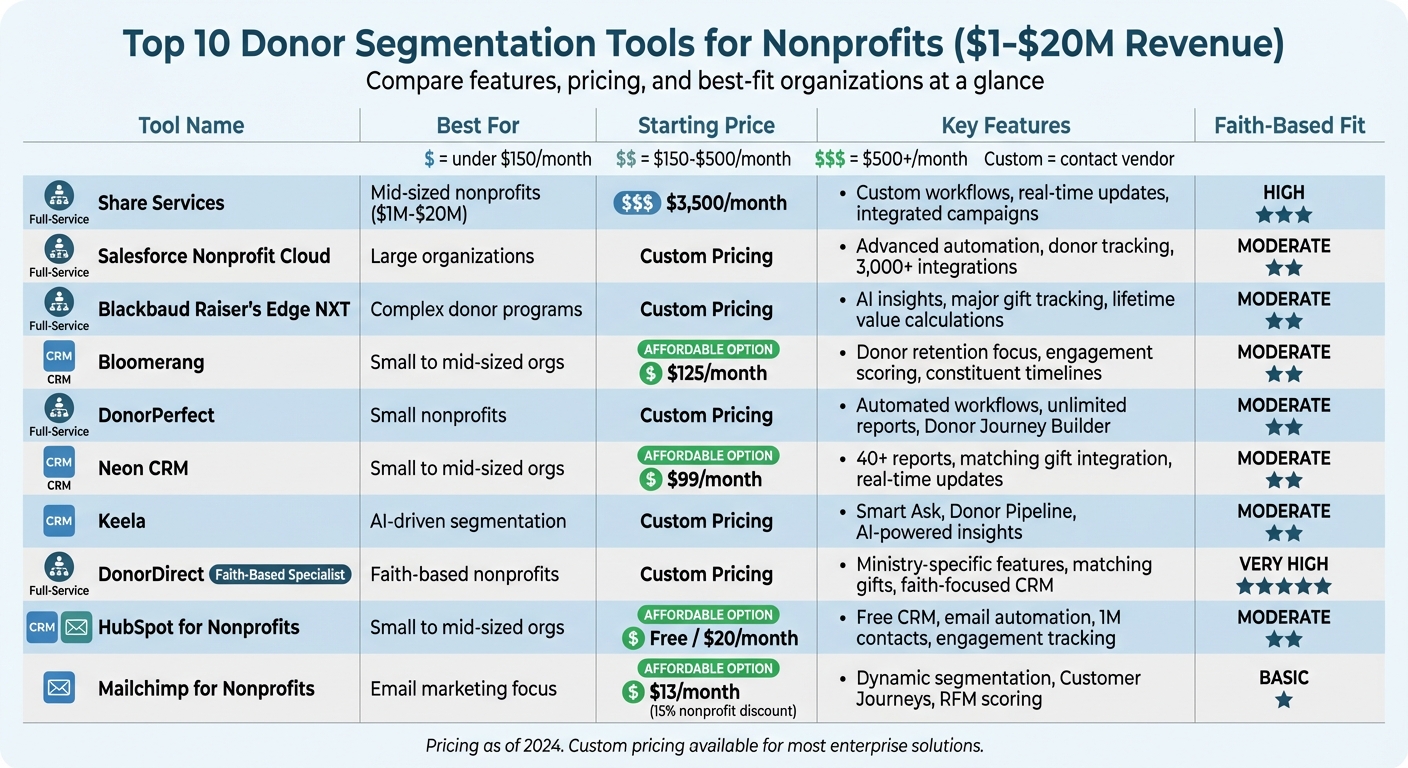
Nonprofit Donor Segmentation Tools Comparison Chart: Features, Pricing & Best Fit
Segmenting Nonprofit Donors (Fundraisers help)
1. Share Services
Share Services offers marketing and fundraising solutions tailored for nonprofits with annual revenues between $1–$20 million. Instead of replacing your current CRM or email platforms, they work alongside them, configuring and fine-tuning automated donor segmentation to achieve measurable outcomes.
Automation Capabilities
Share Services specializes in creating rules-based segmentation workflows that automatically activate based on donor behavior. For instance, if a donor contributes $100 or more on their first donation or if a monthly donor's payment method fails, these workflows spring into action. They can update donor segments, trigger personalized email sequences, set staff reminders (like calling high-value donors within 48 hours), and refresh lists in real time - all based on donor activity. Their workflows are also tailored to align with U.S. fiscal-year schedules and key fundraising events like Giving Tuesday and year-end campaigns.
Custom segments, such as new donors, monthly sustainers, mid-level donors (with cumulative gifts of $500–$4,999 over the past year), major donors, lapsed donors (no contributions in 12–24 months), LYBUNT/SYBUNT, event-only participants, and digital-only donors, are continuously updated. These lists refresh automatically as new donations or interactions are logged, eliminating manual exports and ensuring real-time accuracy. U.S.-specific giving thresholds like $250, $500, and $1,000 are built into the system to streamline donor targeting.
This level of automation enhances engagement efforts, which is especially critical for faith-based nonprofit fundraising. Better yet, it integrates seamlessly with your existing donor management tools.
Integration with Email, Online Giving, and CRM Systems
Share Services simplifies data management by automating the flow of information between platforms. For example, online donations are automatically logged in donor records, assigned campaign codes, and synced with CRM and email systems. Whether you're using Salesforce Nonprofit Cloud, Blackbaud, Bloomerang, Neon CRM, DonorPerfect, or Keela, Share Services ensures that segments like "lapsed donors 13–24 months at $100+ lifetime" sync as live audiences. This enables targeted email journeys, A/B testing, and conditional content for U.S.-specific campaigns, such as tax-deduction reminders before December 31. By aligning data standards across systems, they also reduce sync errors and ensure smooth operations.
Jasmine Morse from an Advancement Department shared: "Share helped us test simplified + focused messaging that improved our conversion rates. Additionally, paid display ad retargeting was successful, and the recurring giving pop-up brought us almost 100 new monthly gifts."
Reporting and Analytics
With integrated data flows, Share Services provides real-time analytics to shape donor strategies. They leverage metrics like donor lifetime value (LTV), recency-frequency-monetary (RFM) scores, and engagement scores to identify priority segments. For example, they might focus on reactivating donors with high RFM scores but low email engagement or target supporters with low RFM but strong engagement for upgraded monthly giving offers. Dashboards track key performance indicators (KPIs) such as average gift size, response rates, donor retention, and conversion rates. Reviews are conducted quarterly or around major U.S. campaigns to adjust segmentation rules and workflows as needed. Metrics like donor retention rates, lapsed donor reactivation, one-time-to-monthly conversion rates, and year-over-year revenue growth are closely monitored, ensuring a data-driven approach to fundraising success.
Suitability for Nonprofits with $1–$20 Million in Revenue
Share Services is particularly suited for mid-sized nonprofits that already use digital and CRM systems but lack in-house automation expertise. Their approach focuses on high-impact use cases - like automated welcome emails, lapsed donor reactivation, mid-level donor upgrades, and sustainer stewardship - without overcomplicating workflows that smaller teams might struggle to manage. Designed with U.S. mid-market realities in mind, their model addresses limited internal tech resources, board expectations for growth, and the need to show tangible revenue results within a fiscal year.
Their services start at $3,500 per month for a Strategy Retainer, with additional project budgets starting at $3,000/month and paid media services from $1,500/month. This pricing makes them a cost-effective alternative to hiring full-time specialized staff, helping nonprofits maximize their segmentation potential while maintaining a focus on sustainable growth.
2. Salesforce Nonprofit Cloud
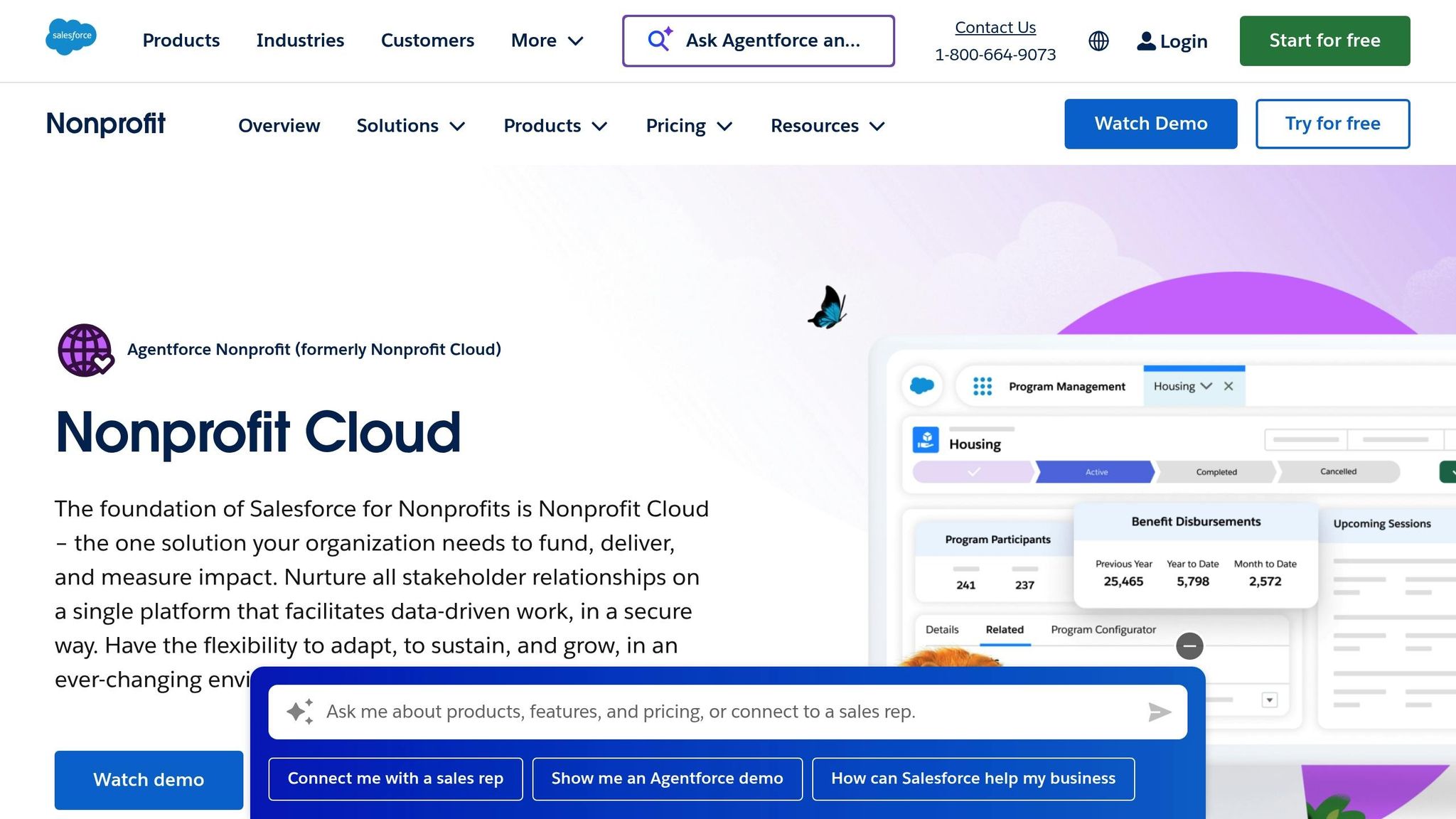
Salesforce Nonprofit Cloud, built on the Salesforce platform, provides nonprofits with powerful automation tools designed for advanced donor segmentation. It leverages features like Flow automation, Process Builder, and trigger logic to segment donors based on their giving history and behavior, helping organizations tailor their outreach effectively.
Automation Capabilities
Salesforce Nonprofit Cloud simplifies donor segmentation by using flows and trigger-based logic. It creates real-time donor segments based on important fields such as last gift date, total contributions, engagement levels, and event participation. For instance, you can set up flows to automatically move donors who contribute over $1,000 annually into a Major Donor campaign. Tasks can be triggered when certain thresholds are met, and nightly updates can generate dynamic LYBUNT (Last Year But Unfortunately Not This Year) and SYBUNT (Some Year But Unfortunately Not This Year) segments. This ensures that donors receive communication aligned with their specific giving patterns.
Integration with Email, Online Giving, and CRM Systems
Salesforce Nonprofit Cloud works seamlessly with Salesforce Marketing Cloud and Account Engagement (formerly Pardot), allowing donor segments to sync directly with email journeys, drip campaigns, and scoring models. Online giving tools automatically update donor segments - whether it's a first-time donor, a recurring contributor, or a peer-to-peer fundraiser - when new gifts, recurring donations, or event registrations are processed. Acting as the central CRM, Salesforce consolidates donor contact details, giving history, and campaign performance data, while offering access to over 3,000 AppExchange integrations for specialized fundraising tools.
Reporting and Analytics
The platform delivers robust reporting and analytics capabilities, including custom reports, dashboards, and calculated fields to track key metrics. These include total lifetime giving, last gift date, number of gifts (frequency), and cumulative donation amounts (monetary value). Nonprofits can use these insights to calculate RFM (Recency, Frequency, Monetary) scores and create targeted segments, such as "high lifetime value, high engagement" for major gift campaigns or "recent donors with low frequency" for monthly giving appeals. Engagement tracking captures email opens, event participation, and volunteer activity, consolidating this data into engagement score fields that drive automated donor journeys. For example, low-engagement donors can be reactivated through tailored campaigns.
Dashboards can also highlight metrics like donor retention rates, average gift size, donor lifetime value, and response rates at the segment level. These insights help nonprofits refine their segmentation strategies and improve donor engagement over time.
Suitability for Nonprofits with $1–$20 Million in Revenue
Salesforce Nonprofit Cloud is well-suited for organizations with annual revenue between $1 million and $20 million. As nonprofits grow closer to the upper end of this range, they often encounter more complex segmentation needs - such as organizing donors by region, program, and giving capacity. Salesforce’s adaptable schema and robust automation features make it capable of handling these demands without requiring a platform change as the organization scales.
Pricing starts at $36 per user per month for the base Nonprofit Success Pack, with enterprise-level plans available through custom quotes. While the platform offers significant flexibility compared to many donor management tools, its complexity and cost mean nonprofits should ensure they have the necessary internal expertise - or consider external help - to design effective segmentation strategies and campaigns.
3. Blackbaud Raiser's Edge NXT
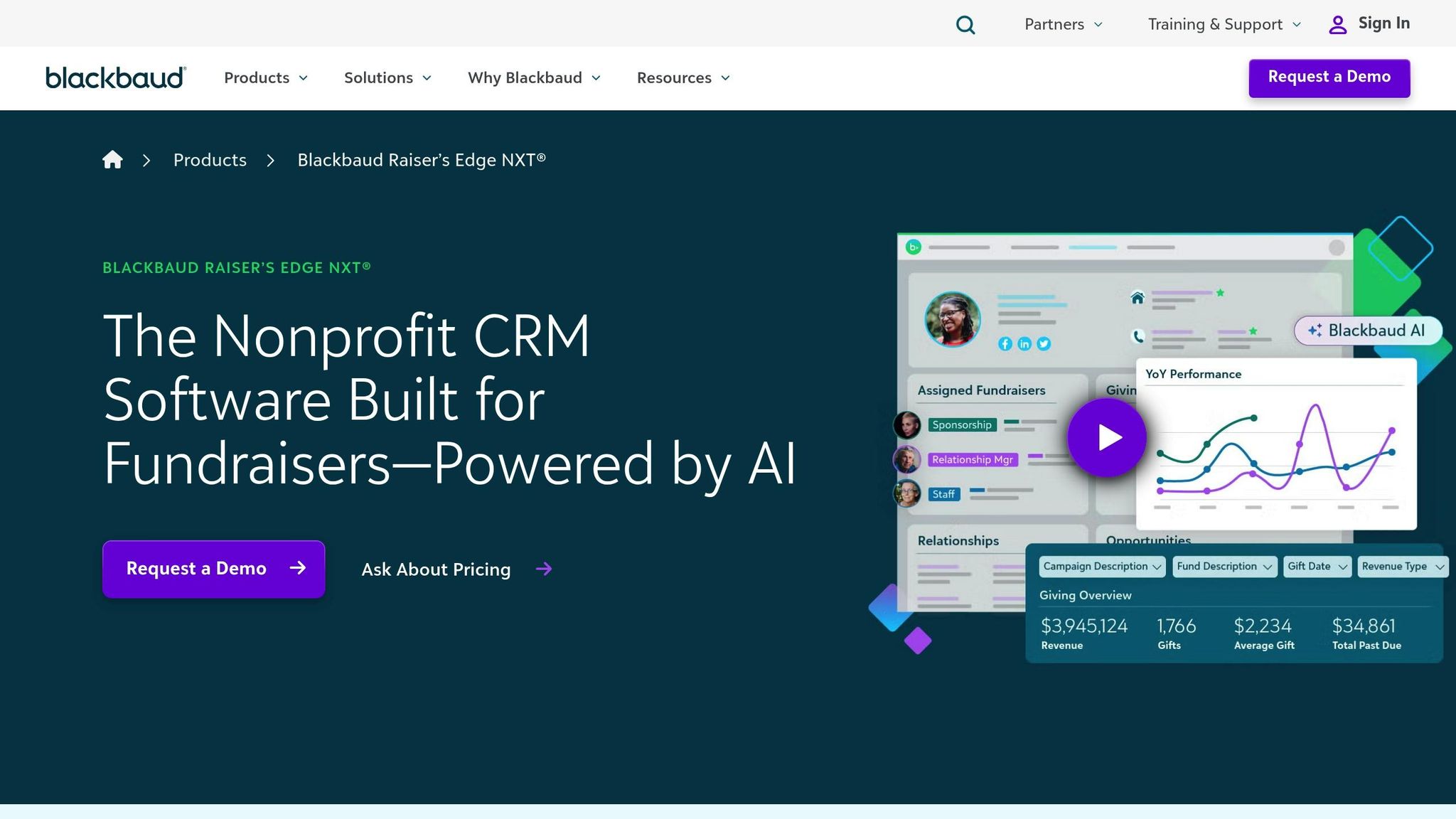
Blackbaud Raiser's Edge NXT is a cloud-based platform built to meet the needs of nonprofits that have outgrown basic CRMs. It combines tools for CRM, fundraising, marketing, and analytics into one system, offering advanced features like analytics and major-gift capabilities to support more complex donor management. This platform is particularly effective for organizations requiring precise segmentation, powered by AI technology.
Automation Capabilities
Raiser's Edge NXT uses AI to streamline workflows, making donor segmentation more efficient by analyzing engagement levels and donation histories. It can automatically initiate personalized outreach to lapsed donors or high-value prospects. The platform also recommends ideal donation amounts for annual campaigns and major gifts, creating dynamic donor lists based on metrics like RFM (Recency, Frequency, and Monetary) scores .
Integration with Email, Online Giving, and CRM Systems
This system integrates effortlessly with email marketing tools, online donation platforms, and third-party CRMs. These integrations ensure smooth data synchronization and automate follow-up communications, saving time and reducing manual effort .
Reporting and Analytics
Raiser's Edge NXT stands out with its data-driven insights, offering tools like lifetime value calculations, RFM segmentation, and engagement scoring. Through detailed dashboards and customizable reports, nonprofits can monitor donor retention, assess giving capacity, and track campaign performance . The platform also highlights high-engagement donors, helping organizations focus on targeted campaigns and manage their major-donor pipelines effectively. By leveraging these insights, nonprofits can refine their strategies to improve donor retention and maximize their return on investment over time.
Best Fit for Nonprofits with $1–$20 Million in Revenue
This platform is ideal for nonprofits generating $1–$20 million in annual revenue, particularly those managing complex fundraising programs or larger donor bases . It’s commonly used by organizations like universities, healthcare systems, and large social-service groups with significant individual giving programs . Pricing is customized based on factors such as organization size, database records, and required features, as it’s designed as an enterprise-level solution. For mid-sized nonprofits, the platform offers a strong return on investment, but success depends on proper staff training and maintaining accurate donor data .
4. Bloomerang
Bloomerang takes a fresh approach to donor segmentation, focusing on strategies designed to boost donor retention.
This donor management platform is built for small to mid-sized nonprofits looking to strengthen relationships with their supporters. With an easy-to-use interface and built-in engagement tracking, Bloomerang doesn’t just store transaction data - it calculates engagement and generosity scores based on giving habits, event attendance, and communication responses. These insights help nonprofits create targeted donor segments. For example, you can identify donors who are highly engaged but contribute small amounts, signaling potential for increased giving, or spot high-capacity donors who aren’t yet deeply involved and might benefit from a more personal touch.
Automation Capabilities
Bloomerang simplifies donor management with automated tools that group donors based on giving patterns, engagement levels, and personal interests. Its constituent timelines log every interaction and donation, triggering timely follow-ups. For instance, nonprofits can set up automated workflows for first-time donors. Imagine a donor who gives within the past 30 days - they could automatically receive a thank-you email, a follow-up impact story two weeks later, and a second-gift request six weeks after their initial contribution.
Integration with Email, Online Giving, and CRM Systems
Bloomerang integrates seamlessly with online donation forms, ensuring donor information flows directly into the CRM without manual updates. It also syncs segmented donor lists with email campaigns, tracking engagement at every stage of the donor journey. This integration ensures nonprofits can stay organized and responsive to donor behavior.
Reporting and Analytics
The platform’s dashboard provides a clear view of critical metrics like donor retention rates. Engagement and generosity scores make it easier to identify donors who are ready for major gift outreach. Customizable reports offer insights into metrics like average gift size, total revenue, and campaign response rates, helping organizations make informed decisions.
Ideal for Nonprofits with $1–$20 Million in Revenue
With its straightforward design and focus on retention, Bloomerang is a great fit for nonprofits earning between $1 million and $20 million annually. Pricing starts at $125 per month, making it an accessible option for organizations in this range.
5. DonorPerfect
DonorPerfect is a user-friendly CRM tailored for smaller nonprofits that need effective donor management without breaking the bank. Designed for organizations with limited budgets, it offers flexible contracts and affordable starting prices, making it a practical choice for those looking to maximize their resources.
Automation Capabilities
DonorPerfect simplifies donor management with rules-based workflows that automatically update records and segment contacts based on specific triggers - like a first donation, lapsed giving, or reaching a certain contribution level. For example, you can set up automation to tag donors who give more than $500 in a year, add them to a "Mid-level Donor" group, and kick off a personalized stewardship plan. This could include scheduling a personal call and sending a custom email series. The Donor Journey Builder further enhances this by creating dynamic donor pathways, using triggers to automatically group supporters like major donor prospects, monthly contributors, or first-time givers. This eliminates the need for manual list building and ensures smoother data integration across systems.
Integration with Email, Online Giving, and CRM Systems
One of DonorPerfect's strengths is its seamless integration with online giving tools and platforms like Double the Donation. This ensures that gift records and employment data are automatically synced with donor profiles. For instance, real-time online giving data can be used to create segments of match-eligible donors, triggering follow-ups to complete corporate matches. Additionally, new donors captured through web forms are automatically added to the database with relevant tags, campaigns, and segments, enabling immediate follow-up workflows.
Reporting and Analytics
DonorPerfect provides unlimited custom reports and dashboards that focus on key donor metrics like total giving, average gift size, and recency. While it doesn’t explicitly label metrics as RFM (Recency, Frequency, Monetary value) or engagement scores, you can easily filter data to approximate these models. For example, you can segment donors based on their last gift date, the number of contributions in a year, and the total amount given. These insights help nonprofits create data-driven strategies for stewardship and donor upgrades. The platform also allows staff to generate board-ready summaries showing giving trends by segment and comparing performance across fiscal or calendar years. This makes it easier to tailor strategies for organizations with diverse revenue streams.
Suitability for Nonprofits with $1–$20 Million in Revenue
DonorPerfect is an excellent fit for small nonprofits and those in the $1–$20 million revenue range. Its customizable features and robust CRM tools provide structured donor management and segmentation without the complexity of enterprise-level systems. That said, nonprofits nearing the higher end of this range may eventually need more advanced tools as their analytics needs grow.
6. Neon CRM
Neon CRM is a cloud-based system that combines donor data, online giving, email marketing, event management, and volunteer coordination into one platform. Starting at $99 per month, it’s tailored for small to mid-sized nonprofits looking for powerful automation without the complexity of enterprise-level tools. This all-in-one approach simplifies managing donor interactions and streamlines operations.
Automation Capabilities
Neon CRM takes automation to the next level by handling tasks like acknowledgment emails, pledge reminders, lapsed-donor follow-ups, and staff assignments. It also enables the creation of automated donor groups based on giving history, event participation, demographics, and engagement levels. For example, you can set up a workflow that sends a three-step welcome series to first-time donors or flags donors who haven’t contributed in 12 months, automatically enrolling them in a reactivation campaign. These segments update in real-time as donor data changes, eliminating the need for manual updates.
Integration with Email, Online Giving, and CRM Systems
Neon CRM ensures smooth data flow by linking online donation forms and event registrations directly to your CRM. This means every new contact is automatically added, tagged, and segmented appropriately. One standout feature is its integration with Double the Donation, which identifies donors eligible for corporate gift matching by passing donor and gift data seamlessly. The system then sends company-specific follow-up emails with matching instructions, turning what’s often a labor-intensive process into an automated revenue stream.
Reporting and Analytics
With over 40 pre-built reports and customizable options, Neon CRM provides insights into key fundraising metrics like donor retention, lifetime value, and engagement scores. While you’ll need to apply filters to conduct RFM (Recency, Frequency, Monetary) analyses, the platform allows segmentation based on last donation date, number of contributions, and total giving amounts. This helps nonprofits pinpoint high-value donor groups and create targeted strategies to nurture those relationships.
Ideal for Nonprofits with $1–$20 Million in Revenue
Neon CRM’s pricing tiers and comprehensive features make it a great fit for mid-sized nonprofits with annual revenues between $1–$20 million. To maximize its capabilities, organizations should prioritize training on segmentation, workflows, and reporting tools. This ensures the platform is used to its full potential, beyond just serving as a donor database.
sbb-itb-deea482
7. Keela
Keela blends donor management, fundraising, and marketing tools with AI-powered insights, making donor segmentation more efficient. Named "Best for AI-Driven Features" in 2026 donor management software reviews, it offers standout tools like the Donor Pipeline for tracking donor engagement and Smart Ask, which provides tailored donation suggestions based on data.
Automation Capabilities
Keela's AI tools dynamically segment donors using real-time engagement data. It tracks donor activity, updating segments as giving patterns evolve. For instance, nonprofits can set triggers to personalize follow-ups for lapsed donors or flag high-value prospects through the Donor Pipeline. Dynamic lists, such as monthly versus one-time donors, can automatically initiate targeted email workflows. Additionally, online donation data syncs in real time, updating RFM scores and generating Smart Ask recommendations . These automated features work seamlessly with Keela's integrations, boosting overall campaign efficiency.
Integration with Email, Online Giving, and CRM Systems
Keela integrates with platforms like Double the Donation to automate matching gift opportunities. Donation records are automatically processed to identify eligible corporate matches, triggering follow-up communications that significantly enhance matching gift revenue.
Reporting and Analytics
Keela’s analytics tools provide actionable insights, tracking donor engagement and forecasting lifetime value through its pipeline analytics. Custom RFM reports help nonprofits identify key donor segments, making it easier to focus on retention strategies. These insights highlight donors likely to increase their contributions or those who might need reactivation efforts .
Ideal for Nonprofits with $1–$20 Million in Revenue
Keela is a strong choice for mid-sized nonprofits, offering scalable AI features and flexible, quote-based pricing (U.S.-specific quotes available). While its advanced analytics are comparable to other mid-market solutions, its AI-driven approach gives it an edge. It can handle complex donor segmentation without the high costs typical of enterprise-level platforms. To get started, nonprofits should import donor data to train the AI, prioritize email and CRM integrations, and schedule demos to ease the onboarding process. Since Keela is headquartered in Canada, U.S. organizations may need to consider additional compliance requirements.
8. DonorDirect
DonorDirect is a nonprofit CRM designed specifically for faith-based organizations and ministries. Now part of Ministry Brands, it offers two main editions: Studio Enterprise for larger organizations and Studio Essentials for smaller ministries. This tiered approach makes it a flexible choice for churches and ministries of various sizes.
Built with faith-based nonprofits in mind, DonorDirect focuses on turning donor data into actionable segments. Let’s take a closer look at how it achieves this.
Automation Capabilities
DonorDirect simplifies donor management with its integration with Double the Donation. This feature automatically processes gift data, identifies donors eligible for matching gifts, and triggers follow-up messages. As a result, nonprofits can create dynamic, self-updating donor segments such as "match-eligible donors", "recurring givers", and "major gift prospects." These segments enable organizations to automate personalized reminders and thank-you messages, helping to retain donors and encourage larger contributions.
Integration with Email, Online Giving, and CRM Systems
Part of the Ministry Brands ecosystem, DonorDirect seamlessly integrates donation records, including matching gift details, with its CRM system. This integration ensures match-eligible donors are flagged, and follow-up emails are sent automatically. Churches can use DonorDirect as their central CRM to track online donations and manage all communications from a single, unified platform.
Reporting and Analytics
DonorDirect provides robust reporting tools that include detailed giving histories and campaign performance metrics. These features help identify key donor groups such as repeat contributors, lapsed donors, and those eligible for matching gifts. Additionally, its analytics tools offer insights into matching gift performance and donor segmentation, allowing nonprofits to fine-tune their campaign strategies.
Best Fit for Faith-Based Nonprofits with $1–$20 Million in Revenue
DonorDirect’s combination of automation, integration, and reporting makes it a strong option for mid-sized nonprofits in the $1–$20 million revenue range. These organizations often juggle multiple campaigns, events, and giving channels, and they need a CRM that can handle complex donor data while streamlining operations. DonorDirect allows faith-based nonprofits to segment donors based on ministry areas, campuses, or specific programs. This segmentation supports ministry-specific updates and appeals, ensuring that communications resonate with donor interests and previous engagement.
9. HubSpot for Nonprofits
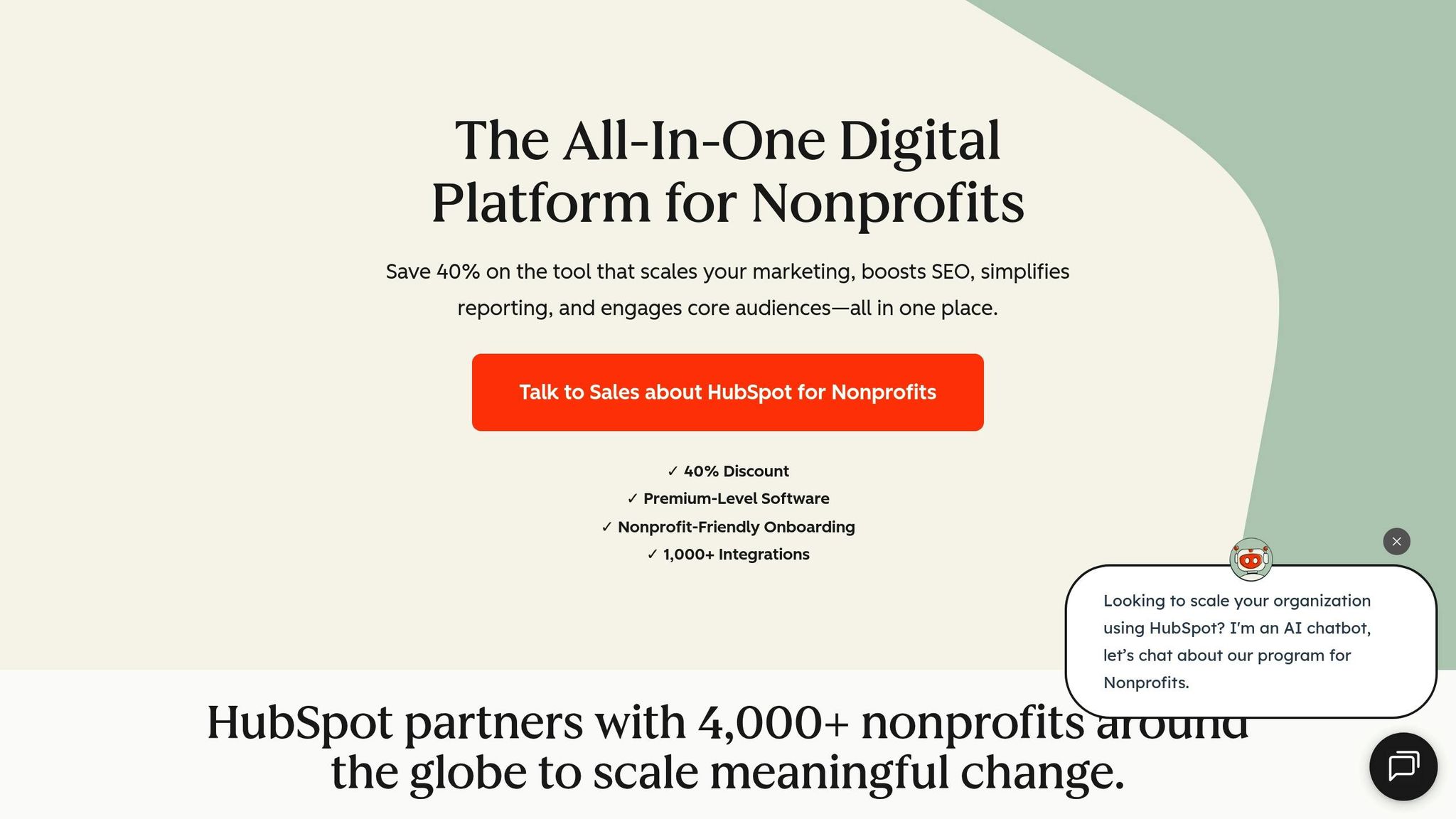
HubSpot for Nonprofits provides a free CRM packed with automation tools, making donor segmentation more efficient. It allows unlimited users, supports up to 1 million contacts on its free plan, and offers premium automation features starting at $20 per month per seat. Over 1,300 nonprofits have reported a 20% improvement in donor retention after adopting HubSpot.
Automation Capabilities
HubSpot simplifies donor management with automated workflows, similar to other advanced segmentation tools. These workflows can enroll contacts based on donation behavior (like a first gift exceeding $100), email interactions, event participation, or form submissions. Once triggered, they handle follow-ups, assign tasks, and update contact details automatically. Active lists group donors based on factors like donation frequency, total contributions, campaign source, or engagement level - helping nonprofits run targeted campaigns and generate insightful reports.
For instance, a trigger such as "last donation date > 12 months" can shift donors between segments, like moving them from "active" to "lapsed" or upgrading them from "mid-level" to "major donor." By using these tools, organizations have seen an average 55% boost in email open rates and a 30% increase in donation conversions.
Integration with Email, Online Giving, and CRM Systems
HubSpot’s email marketing tool integrates seamlessly with contact data, tracking email engagement and subscription preferences. This means actions like opens, clicks, and bounces feed directly into segmentation rules. Many nonprofits in the U.S. link their online donation tools - such as Stripe-based forms, peer-to-peer platforms, or embedded donation pages - to HubSpot. Each successful donation automatically updates or creates a contact record in HubSpot, capturing details like donation amount, campaign, and UTM parameters.
Reporting and Analytics
HubSpot’s robust reporting features allow nonprofits to calculate donor lifetime value by summing up all donation amounts or closed-won revenue tied to a contact over time. This can be further segmented by channel, campaign, or the year of the first gift. Nonprofits can also replicate RFM (Recency, Frequency, Monetary) segmentation by creating custom properties such as "Last Donation Date", "Total Gifts in 12 Months", and "Total Giving to Date." These properties can be used in filters, active lists, and dashboards to identify high-value or at-risk donors for targeted outreach.
Engagement metrics - like email open rates, click-through rates, form submissions, event registrations, and page views - can be rolled into an internal "engagement score." Dashboards then visualize this score by donor segment, helping teams test which content resonates with mid-level versus smaller donors. This insight allows nonprofits to adjust their messaging and timing for maximum impact. HubSpot’s blend of automation, detailed reporting, and intuitive segmentation tools makes it a powerful resource for mid-sized nonprofits.
Suitability for Nonprofits with $1–$20 Million in Revenue
Nonprofits in the $1–$20 million revenue range often find HubSpot’s mid-tier Marketing Hub and CRM features particularly effective. These tools support larger databases, more automation workflows, and advanced reporting capabilities compared to entry-level plans. Organizations in this category typically use HubSpot to manage segmented email campaigns for tens of thousands of contacts, nurture mid-level and major donor pipelines, and run integrated campaigns across email, landing pages, and ads.
For nonprofits closer to the $20 million mark, HubSpot often works alongside a dedicated nonprofit CRM. In this setup, the nonprofit CRM handles complex tasks like gift coding, pledges, and grants, while HubSpot focuses on front-end acquisition, donor engagement, and segmentation at scale.
10. Mailchimp for Nonprofits
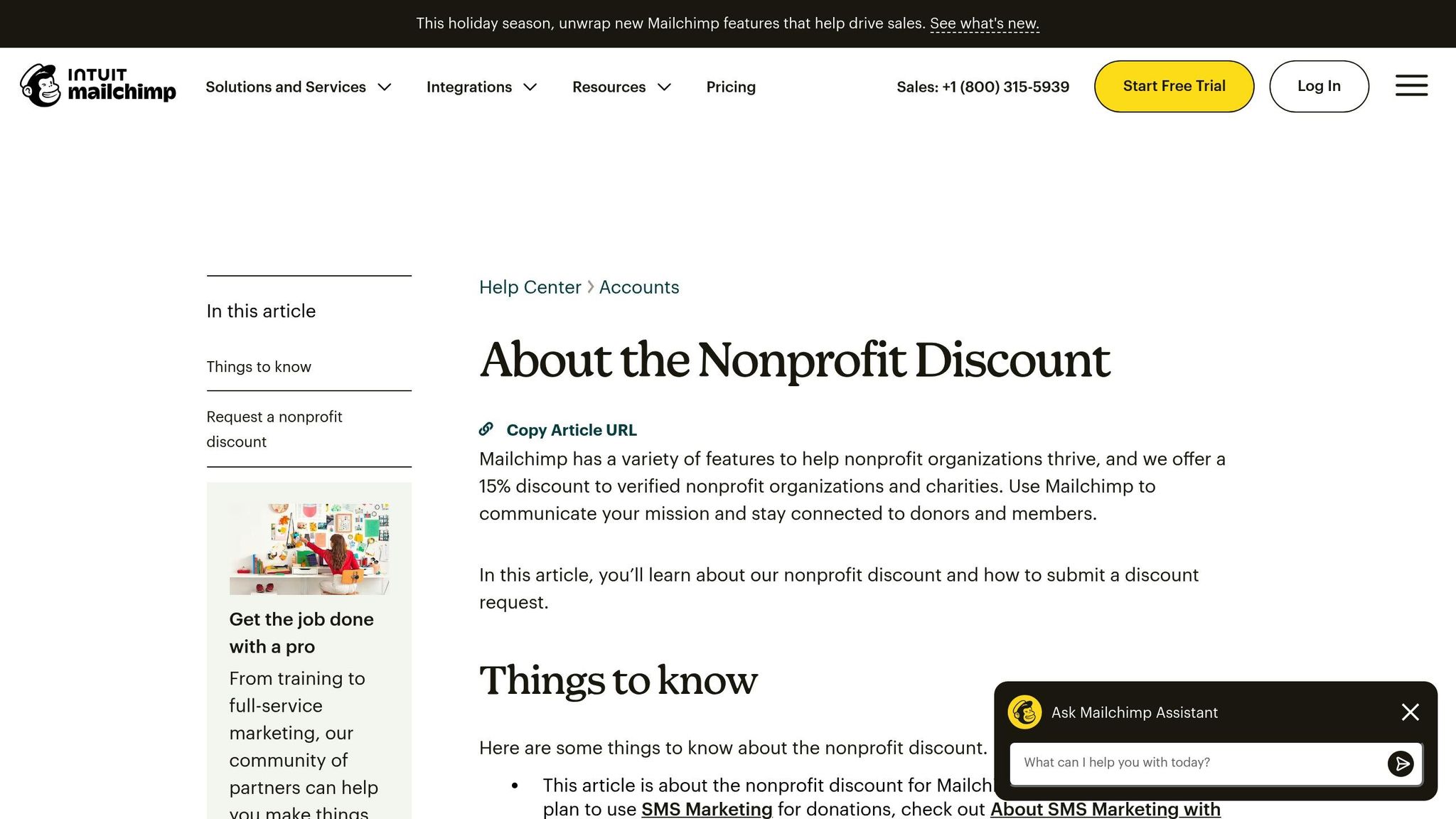
Mailchimp for Nonprofits offers a 15% discount on its services (up to 25% if enhanced account security is added) and provides powerful email automation tools designed for dynamic donor segmentation. It integrates seamlessly with existing donor databases, making it a go-to email and automation platform for nonprofits. Pricing starts at $13/month for the Essentials plan, while the Standard plan, ranging from $20–$23/month, includes features like Customer Journeys automation, dynamic content, and detailed analytics - ideal for nonprofits looking to grow their impact. Here's how Mailchimp's automation, integrations, and analytics can simplify donor engagement.
Automation Capabilities
Mailchimp's Customer Journeys feature allows nonprofits to create visual, automated workflows that adapt to donor behavior. For instance, emails can be triggered when someone makes a donation, clicks a link, opens an email, or visits your website. Dynamic segments automatically update in real time using criteria such as donation recency, total giving, or engagement level - eliminating the need for manual list updates. Tools like tags, segments, and groups make it easy to target specific donor groups, whether they’re first-time contributors, monthly supporters, or lapsed donors.
One U.S.-based animal welfare nonprofit with $5 million in annual revenue used these dynamic segments to automate workflows for 15,000 donors. By segmenting donors based on RFM (recency, frequency, monetary value), they increased donation rates by 28% within six months. Research also shows that segmented campaigns can achieve 14% higher open rates and over double the click-through rates compared to non-segmented campaigns. These automated workflows integrate seamlessly into broader donor engagement strategies.
Integration with Email, Online Giving, and CRM Systems
Mailchimp’s integration capabilities enhance its automation tools by directly connecting with donor management systems. It works with major nonprofit CRMs like Salesforce Nonprofit Cloud, Neon CRM, and DonorPerfect, as well as online giving platforms such as Classy and Donorbox. These integrations, available through direct APIs or Zapier, enable real-time updates to donor segments, triggering actions like personalized thank-you emails or follow-ups.
For example, an education nonprofit integrated Mailchimp with DonorPerfect and used automated triggers to re-engage lapsed donors, successfully recovering $150,000 in donations. Nonprofits using these integrated workflows report 15–25% higher email open rates due to the relevance and timeliness of their messaging.
Reporting and Analytics
Mailchimp’s analytics tools provide detailed insights into email performance, tracking metrics like open rates, click-through rates, and revenue attribution. Custom fields can be created for RFM scoring, helping nonprofits identify high-value donor segments and automate targeted workflows. For instance, a high-RFM donor segment might show an average lifetime value exceeding $500.
The platform also includes A/B testing features, allowing nonprofits to experiment with subject lines, send times, and calls-to-action to optimize engagement for different donor groups. These tools give nonprofits the data they need to refine their strategies and maximize donor impact.
Ideal for Mid-Sized Nonprofits
Mailchimp is particularly well-suited for nonprofits with annual revenues between $1 million and $20 million. The platform handles high-volume segmentation for donor lists exceeding 10,000 contacts without performance issues. For nonprofits in this range, the Standard plan often offers the best balance of features and cost, providing advanced automation and analytics tools at an accessible price point.
Many nonprofits in this revenue bracket use Mailchimp as their main platform for email marketing and donor engagement, pairing it with a dedicated donor CRM for tasks like gift processing, pledge tracking, and managing major donor pipelines. This approach allows organizations to take advantage of Mailchimp’s strong email design, deliverability, and automation features while maintaining robust donor management through their CRM.
Feature Comparison Table
Below is a breakdown of ten leading donor segmentation tools, evaluated across five core areas: their main purpose, the types of organizations they serve best, their automation and segmentation capabilities, pricing, and their suitability for faith-based nonprofits.
Share Services operates as a full-service marketing partner rather than traditional software, focusing on strategy and execution for nonprofits with annual revenues between $1–$20 million. DonorDirect caters directly to faith-based fundraisers, while tools like Bloomerang and DonorPerfect provide budget-friendly options for smaller organizations. For larger nonprofits with more complex needs, Salesforce Nonprofit Cloud and Blackbaud Raiser's Edge NXT deliver advanced analytics and AI-powered insights under custom pricing models.
This table offers a quick reference to help you determine which tool aligns best with your nonprofit's requirements.
| Tool | Primary Function | Organization Size Fit | Automation & Segmentation Features | Starting Price (USD) | Faith-Based Relevance |
|---|---|---|---|---|---|
| Share Services | Marketing & Fundraising Services | Mid-sized ($1M–$20M revenue) | Integrated donor journeys, automated email and media campaigns, donor retention tools | $3,500/month (Strategy Retainer) | High – tailored for ministries and faith-based nonprofits |
| Salesforce Nonprofit Cloud | CRM | Large organizations | Advanced workflow automation, donor tracking, custom integrations | Custom pricing | Moderate – customizable for mission tracking |
| Blackbaud Raiser's Edge NXT | CRM | Large nonprofits | AI-driven donation suggestions, prospect insights, advanced analytics | Custom pricing | Moderate – robust analytics for larger faith organizations |
| Bloomerang | CRM | Small to medium | Data segmentation by engagement history, constituent timelines, engagement scores | $125/month | Moderate – segments monthly givers |
| DonorPerfect | CRM | Small organizations | Donor Journey Builder, unlimited custom reports, donor profiling | Contact for pricing | Moderate – includes matching gift integration |
| Neon CRM | CRM | Small to mid-sized | Workflow automation, 40+ reports, donor data flow | $99/month | Moderate – includes matching gift integration |
| Keela | CRM | Small to mid-sized | AI-driven Donor Pipeline, Smart Ask, automated insights | Custom pricing | Moderate – tracks donor engagement |
| DonorDirect | CRM | Small to large faith-based | Matching gift automation, donor relations, faith-specific features | Custom pricing | Very High – built specifically for faith-based fundraisers |
| HubSpot for Nonprofits | Analytics & CRM | Small to mid-sized | List segmentation, automated email workflows, marketing automation | Free tier available; paid starts at $20/month | Moderate – helpful for community outreach |
| Mailchimp for Nonprofits | Email Marketing | Small organizations | Dynamic segments, Customer Journeys automation, RFM scoring | Free up to 500 contacts; $13/month for Essentials (15% nonprofit discount) | Basic – supports segmented campaigns for faith-based outreach |
Conclusion
Selecting the best donor segmentation tool for your nonprofit comes down to aligning your organization's size, budget, and technical know-how with the platform's features. For smaller teams, options like Bloomerang and DonorPerfect (ranging from $99 to $125 per month) provide an affordable starting point. Larger organizations, on the other hand, might turn to Salesforce Nonprofit Cloud or Blackbaud Raiser's Edge NXT, which offer customized pricing and robust administrative support.
Start by focusing on the basics: segmenting donors into key groups like first-time contributors, monthly supporters, and lapsed donors (those who haven’t given in 12–24 months). Once you’ve established these foundational segments, you can expand your strategy with more advanced techniques.
Incorporating behavioral data can take your segmentation to the next level. Consider factors like event participation, email interactions, and volunteer involvement to create more precise donor groups. Tools such as Neon CRM or Keela make it easier to automate tasks like welcome email series or win-back campaigns for lapsed donors. Eddie Laing, a Paid Media Specialist, underscores the importance of a diverse outreach strategy:
"It costs less to reactivate a lapsed donor than to acquire a new one. Email can be effective, but multi-channel approaches are even better. We did this with Focus and saw great results for them."
For mid-sized U.S. nonprofits with annual revenue between $1 million and $20 million - and without in-house digital expertise - working with Share Services can be a game-changer. They help design segmentation strategies, implement campaigns, and build donor retention programs tailored to your needs. By pairing these services with the automation and segmentation strategies outlined here, you can maximize your marketing budget and make a greater impact.
FAQs
What are the benefits of using automated donor segmentation tools for nonprofits with $1–$20 million in revenue?
Automated donor segmentation tools bring valuable benefits to nonprofits operating within the $1–$20 million revenue range. By enabling precise targeting and personalized communication, these tools allow organizations to engage with their supporters on a deeper level. The result? Stronger donor connections, increased engagement, and better retention rates.
Beyond improving relationships, these tools simplify donor management by automating labor-intensive tasks. They also help cut costs tied to acquiring new donors and support multi-channel outreach efforts, ensuring nonprofits can reach their audience effectively across various platforms. With these tools in place, organizations can dedicate more energy to advancing their mission and nurturing long-term donor relationships.
What should nonprofits look for in a donor segmentation tool?
When selecting a donor segmentation tool, nonprofits should focus on features that streamline their efforts and enhance outreach. Automation is a must-have to reduce manual work and save valuable time. Tools with customizable criteria allow you to create donor groups that align with your specific goals, while real-time analytics help you monitor and adjust your strategies as needed. It's also important to choose a tool that integrates smoothly with your current systems and offers multi-channel capabilities, enabling you to connect with donors via email, social media, and other platforms. Lastly, a user-friendly interface ensures your team can quickly get up to speed and fully utilize the tool’s features.
How can nonprofits use automation to boost donor retention?
Nonprofits can use automation to boost donor retention by simplifying communication and offering more personalized interactions. For instance, automated email campaigns and text messages can help reconnect with donors who may have drifted away, while targeted ads and retargeting strategies keep your mission front and center for supporters.
By automating outreach across multiple channels and delivering timely, customized messages, nonprofits can cut costs, work more efficiently, and deepen their connection with donors. This steady and intentional engagement not only fosters loyalty but also increases the chances of repeat donations.
Related Blog Posts
Get helpful resources, straight to your inbox
We love sharing tools, ideas, and stories that make nonprofit work a little lighter and a lot more effective. Sign up below and we’ll send you practical tips, free resources, and a bit of encouragement—because the work you’re doing matters.
No spam. Just good stuff for good people.