

Jan 14, 2026
Mission Stories vs. Data: What Donors Value
When it comes to faith-based nonprofits, there’s a key question: should you lead with emotional stories or hard data? Both play a role, but the best results come from combining them. Here’s why:
- Stories evoke emotion: Over 70% of donors are more likely to give when moved by a personal narrative. Stories trigger empathy and help donors connect with the mission on a personal level.
- Data builds trust: 90% of donors want to see measurable results. Numbers answer critical questions like, “How is my gift making a difference?”
- Together, they deliver impact: Nonprofits using both approaches see up to a 50% increase in donations and a 67% boost in donor retention.
The key? Start with a story to spark emotion, back it up with data to show impact, and close by reinforcing the transformation. This balance ensures donors feel both inspired and confident in their decision to give.
What Is Data-Driven Impact Storytelling For Nonprofits?
sbb-itb-deea482
How Mission Stories Connect with Donors
Mission stories have a unique way of bypassing logic to tap directly into emotion. For example, when faith-based donors read about a single mother finding hope through a church's food pantry, their brains release oxytocin - a chemical that fosters empathy. This biological response helps explain why over 70% of donors are more inclined to support nonprofits that use storytelling effectively. It’s this emotional spark that makes narratives so powerful among faith-based donors.
Stories also create a lasting connection. Through what researchers call the "transportation" effect, donors are able to imagine themselves in the lives of those they’re helping, experiencing their struggles and victories firsthand. This emotional journey turns a simple financial transaction into something much deeper - a partnership. As Deborah Small, a Marketing Professor at Wharton, explains:
The more vivid the story – through narrative or through imagery – the more emotionally arousing. And emotions are what triggers the impetus to help.
Why Stories Appeal to Donors
Faith-based donors are drawn to stories that reflect their core beliefs - values like compassion, redemption, and transformation. When they read about someone overcoming hardship with the support of ministry programs, they see their faith in action. This alignment fosters a sense of shared mission that numbers and statistics simply can’t match.
The "identifiable victim effect" sheds light on why people are more generous when they connect with a single, named individual rather than abstract data. For instance, a story about "Maria", a refugee who rebuilt her life with the help of a church resettlement program, will resonate far more than a statement like, "We served 3,500 refugees last year." Research also shows that donors respond more strongly to changes in condition - like someone losing their home - than to ongoing issues such as homelessness.
This emotional connection isn’t just about the initial gift - it impacts future giving, too. When donors remember the specific person they helped, they’re more likely to give again. In fact, more than 80% of donors continue supporting a nonprofit when they receive regular updates featuring stories about the people or causes they’ve impacted. These stories don’t just build emotional bridges; they lay the groundwork for a balanced persuasion strategy we’ll explore further.
Examples of Storytelling That Works
Real-world examples show how storytelling can transform donor engagement.
In August 2019, Ohio University shared the story of alumnus Kyle Michalek, who turned personal loss into a $100,000 gift to the College of Nursing. This heartfelt narrative connected alumni and students, showing how tragedy could inspire meaningful change.
Similarly, in 2018, the Peddie School commemorated Walter Annenberg's $100 million donation by focusing on five students whose lives were transformed by the gift. Instead of emphasizing the amount, they highlighted personal stories: one graduate launched a venture capital firm in Africa, while another became the first in her family to attend college. These relatable, specific examples demonstrated the long-term human impact of philanthropy.
What makes these stories effective is their structure. They introduce a real person, outline the challenges they faced, show how donors played a role in their transformation, and highlight the results. These narratives aren’t generic - they’re authentic, specific, and invite donors to see themselves as active participants in an ongoing mission, not just financial contributors.
Why Donors Need Data and Proof
While emotional stories create a connection, data provides the evidence donors need to feel confident about their impact. In fact, 90% of donors say they value data and statistics alongside the stories nonprofits share. Emotional appeal may draw donors in, but it’s the measurable outcomes that answer their most pressing questions: How many people have been helped? How is my gift making a difference?
By sharing tangible results and transparent financial information, nonprofits reassure donors that their contributions are being put to good use. This is especially critical for donors who prioritize evidence-based decisions, such as major gift prospects or those with an analytical mindset.
How Transparency Builds Trust
Transparency is the foundation of trust, and trust is at the core of donor relationships. John Mark Vanderpool, Co-founder of Social Impact Solutions, sums it up perfectly:
Trust. It's at the heart of donor giving and the key element nonprofits need to acquire and retain donors.
When nonprofits openly share metrics - like financial efficiency and program outcomes - they demonstrate accountability. This openness reassures donors that the organization has nothing to hide.
Consider this: nearly 60% of donors believe nonprofits that combine storytelling with data are more transparent. Even more compelling, nonprofits that pair personal success stories with overall impact statistics can see donations increase by as much as 50%. For example, in 2022, St. Jude Children’s Research Hospital earned the title of most trusted nonprofit by clearly presenting its financial details and strategic plan on its website. Tailoring these practices to specific donor groups can further enhance clarity and trust.
Ways to Share Data with Donors
Not all donors want information presented in the same way. For major donors and grant foundations, detailed analytics and financial breakdowns are essential. These might include metrics like $50 per student enrolled in tutoring programs. Annual impact reports, complete with comprehensive program results and audit trails, are ideal for these audiences.
For general donors, simpler formats work better. Infographics are a great tool, offering a visual way to present problems, actions, and outcomes. They make complex data easier to understand and more engaging. Some nonprofits even use real-time dashboards to show daily progress toward goals, giving donors immediate insight into how their gifts are being used.
The secret lies in tailoring the depth and format of data to fit the preferences of each donor group. Whether it’s a detailed Theory of Change model for analytical donors or a straightforward chart summarizing program results, this balance of storytelling and analytics strengthens the connection to the mission and reinforces donor confidence.
Storytelling vs. Data: What Works Best
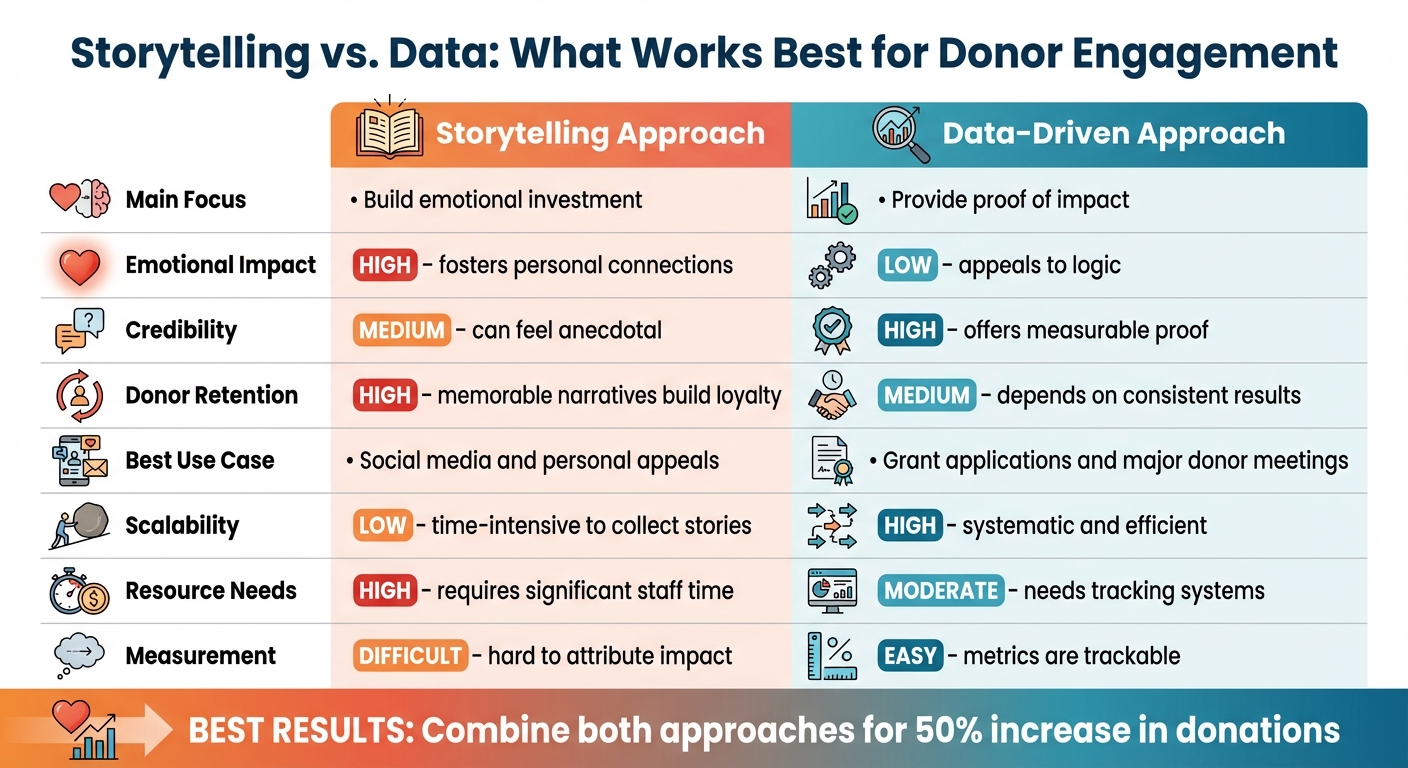
Storytelling vs Data-Driven Approach for Nonprofit Donor Engagement
When it comes to donor communications, finding the right balance between emotional storytelling and solid data is key. These two approaches serve different purposes: stories forge emotional bonds, while data builds trust through tangible evidence.
Imagine a donor reading about a child receiving life-saving meals. This kind of personal story tugs at the heartstrings, sparking an urge to help. This phenomenon, often referred to as the "identifiable victim effect", is why story-driven campaigns often see a surge in donations.
On the other hand, data answers the practical questions donors ask: Is this organization effective? How will my money be used? For major donors and grant-making organizations, measurable results are essential before making large commitments. However, as Wharton Marketing Professor Deborah Small points out:
Statistics can actually blunt this emotional response by causing people to think in a more calculative, albeit uncaring, manner.
The truth is, different donors respond to different appeals. Major donors often seek detailed metrics, while recurring givers are moved by personal, heartfelt stories. The table below highlights the strengths and limitations of both approaches to help you decide which fits your strategy best.
Comparison Table: Storytelling vs. Data
| Factor | Storytelling Approach | Data-Driven Approach |
|---|---|---|
| Main Focus | Build emotional investment | Provide proof of impact |
| Emotional Impact | High – fosters personal connections | Low – appeals to logic |
| Credibility | Medium – can feel anecdotal | High – offers measurable proof |
| Donor Retention | High – memorable narratives build loyalty | Medium – depends on consistent results |
| Best Use Case | Social media and personal appeals | Grant applications and major donor meetings |
| Scalability | Low – time-intensive to collect stories | High – systematic and efficient |
| Resource Needs | High – requires significant staff time | Moderate – needs tracking systems |
| Measurement | Difficult – hard to attribute impact | Easy – metrics are trackable |
Using Stories and Data Together
When it comes to donor communications, blending stories with data is a winning strategy. Stories tap into emotions, while data builds trust by showing tangible results. Together, they create a powerful combination that gives donors both a reason to care and proof that their contributions matter.
How to Blend Data with Stories
To create a seamless connection between storytelling and data, consider using the "Heart-Head-Heart" approach. Start with a personal story to engage emotions, back it up with impactful data to highlight results, and close by reinforcing the emotional impact with evidence of meaningful change.
Here’s a tip: make data relatable by framing it around people. For instance, instead of saying, "We distributed 50,000 pounds of food", say, "We put 50,000 pounds of food on family tables." This small shift connects cold numbers to real human experiences. Jessica England from Asemio sums it up well:
Data provides the evidence and credibility, while stories add the emotional pull. Together, they create a powerful narrative that appeals to both reason and emotion.
To keep donors engaged, focus on the most compelling data and use visuals like graphs to highlight key points. This approach ensures clarity without overwhelming your audience.
Results from Combined Approaches
The results of merging stories with data speak for themselves. Nonprofits that pair personal success stories with program statistics can see donation increases of up to 50% compared to using either method alone. Research also shows that people remember facts 22 times better when they’re part of a story.
Donation pages that feature a story alongside measurable impact metrics tend to see a 20% boost in average gift size. This demonstrates that donors are more generous when they connect emotionally and see clear evidence of their impact. Additionally, organizations using this method often experience a significant increase in donor retention rates - up to 67% - as supporters feel both emotionally invested and confident in the organization’s effectiveness.
A great example of this approach in action comes from the World Wildlife Fund’s 2023 Annual Report. They highlighted Namibia’s rhino conservation efforts by combining a compelling narrative with hard-hitting data. WWF shared how they built 86 conservancies over 30 years, leading to the world’s largest population of black rhinos and achieving zero rhino poaching in 2022. This blend of storytelling and data showcased both the emotional stakes and the measurable success of their work.
This combined strategy not only strengthens donor relationships but also lays the groundwork for actionable steps, as detailed in the next section of our guide.
How to Implement This Approach
Combining stories with data doesn’t require a massive budget or complex systems. Even faith-based nonprofits with limited resources can create a simple yet effective setup to capture both the numbers and the human experiences behind them. Here’s how you can bring together the emotional power of stories and the credibility of data to strengthen donor engagement.
Step 1: Gather Stories and Data
Start by setting up a system that collects data in real time. Assign unique IDs to participants to track their progress over time. It’s worth noting that 80% of analysis time is often spent cleaning fragmented data before reporting even begins. A structured approach can save time and effort.
Your data collection should focus on four key components:
- Baseline context: Understand where participants started.
- Intervention evidence: Document what your program did.
- Outcome measurement: Provide measurable proof of change.
- Participant voice: Include quotes or testimonials to explain the "why" behind the numbers.
This combination ties personal stories to measurable outcomes, giving donors a clear picture of your impact. When gathering stories, consider asking donors to rate their confidence and follow up on what influenced their change in perspective.
To manage these stories effectively, create a Story Bank. This will help you catalog and retrieve stories for various purposes, from reports to social media posts. As Unmesh Sheth, Founder & CEO of Sopact, puts it:
The goal isn't just to create pretty reports. It's to build a continuous learning system where stakeholder feedback becomes actionable insight, where data turns into decisions, and where impact stories emerge naturally.
Step 2: Create and Share Your Message
Once you’ve gathered the data and stories, it’s time to craft your message. Use the Story → Ask → Proof structure. Start with a personal story to form an emotional connection, follow it with a direct call to action, and back it up with data to demonstrate your organization’s effectiveness.
For example, instead of saying, “We distributed 50,000 pounds of food,” say, “We put 50,000 pounds of food on family tables.” This approach connects the numbers to real people, making your message more relatable.
Personalize your content by using donor data to highlight program-specific stories and relevant statistics. Keep visuals simple - stick to one or two impactful graphs rather than overwhelming your audience with too many charts.
Step 3: Track Results and Improve
Set up basic tracking tools to measure the effectiveness of your efforts. Google Analytics 4 is free and can show you which stories on your website attract the most attention. Installing the Facebook Pixel on your donation page can help you link social media engagement to actual donations. Focus on three key metrics: donor retention rates, average gift size, and campaign conversion rates.
Experiment with A/B testing to compare appeals that include the story-data approach with those that don’t. Survey your donors to see if the stories and data you share increase their trust and willingness to give. Nonprofits that regularly review and adjust their strategies often see a 34% boost in donor retention.
Conclusion
Donors need more than just an emotional connection - they also want the reassurance that their contributions are making a measurable difference. By combining heartfelt storytelling with solid data, you create a complete narrative that builds trust and motivates action.
The numbers back this up: nonprofits that merge stories with data experience a 50% increase in donations and achieve 22 times higher retention of facts by their audience. Additionally, 70% of donors are more likely to give when storytelling is used effectively, and 90% emphasize the importance of seeing data integrated into those stories.
Take a moment to review your donor communications. Are you striking the right balance between emotional stories and clear evidence of impact? As Rob Burke wisely puts it:
The story makes donors care; the numbers assure them their care is effective.
In your next appeal, try using the Story → Ask → Proof structure. Share a compelling story of transformation, make your ask, and then back it up with measurable results. Faith-based donors, in particular, want to see both the lives being changed and the evidence that their support is driving real, tangible outcomes.
FAQs
How can nonprofits combine storytelling and data to connect with donors effectively?
To effectively engage with donors, nonprofits should combine emotional storytelling with powerful data. Begin by sharing a heartfelt story - perhaps about an individual whose life was transformed, a community uplifted, or a milestone achieved through your mission. These stories create a personal connection that resonates emotionally. Then, reinforce that connection with meaningful data, like program success rates, donor retention figures, or growth in engagement. For instance, pairing a story with a statistic such as "87% of participants reached their goals in 2022" builds both trust and credibility.
When shaping your communications, think of it as crafting an "impact story." Incorporate visuals like charts or infographics to make your results stand out, ensuring the data enhances the narrative rather than overshadowing it. Highlight the metrics that matter most to your donors, showing clearly how their support translates into real-world change. Tools like Share Services can simplify this process by helping you personalize donor messages, automate updates, and create reports grounded in data - all while keeping your mission front and center.
Why do faith-based donors connect more deeply with personal stories?
Faith-based donors tend to connect deeply with personal stories, as these narratives stir emotions and create a strong sense of empathy. Stories about people facing challenges or experiencing life-changing transformations often align with their core values and their desire to make a meaningful impact.
While data appeals to logic, stories touch the heart, making the results of their generosity feel more immediate and relatable. This emotional bond drives action and strengthens their faith-centered commitment to helping others.
Why is combining stories and data effective for retaining donors?
Blending heartfelt stories with clear, factual data creates a message that resonates on two levels: it touches the heart and satisfies the mind. Stories forge an emotional bond, making donors feel personally connected to the mission. At the same time, data provides proof of impact, giving them confidence that their contributions truly matter.
This powerful combination does more than just inspire - it builds trust and deepens donor commitment. For example, sharing a moving success story alongside program-wide statistics allows nonprofits to highlight the personal and measurable impact of their work. It reassures donors that their support isn’t just symbolic; it’s making a real, tangible difference. This thoughtful approach can turn one-time donors into long-term supporters, invested in the mission for years to come.
Related Blog Posts
Get helpful resources, straight to your inbox
We love sharing tools, ideas, and stories that make nonprofit work a little lighter and a lot more effective. Sign up below and we’ll send you practical tips, free resources, and a bit of encouragement—because the work you’re doing matters.
No spam. Just good stuff for good people.