

Jul 1, 2026
Improving Faith Outreach with Paid Ads
Faith-based nonprofits often struggle to reach new supporters due to limited budgets, restricted social media visibility (5–10% of followers see unpaid posts), and unclear messaging. Paid advertising can solve these challenges by targeting the right audience with measurable results. Platforms like Google Ad Grants, Meta Ads (Facebook and Instagram), and Performance Max (PMax) offer tools to expand outreach effectively:
- Google Ad Grants: Provides eligible nonprofits with up to $10,000/month in free ads, ideal for high-intent searches (e.g., "churches near me"). Requires compliance with specific rules like maintaining a 5% click-through rate.
- Meta and Instagram Ads: Great for interest-based targeting, starting at budgets as low as $5/day. Perfect for building awareness and promoting events.
- Performance Max (PMax): Leverages AI to distribute ads across YouTube, Gmail, and Google Maps, enhancing campaign reach.
Key steps for success:
- Set SMART goals (Specific, Measurable, Achievable, Relevant, Time-Bound).
- Use geo-targeting and audience segmentation (e.g., families, young adults).
- Track metrics like click-through rates (3–5% is healthy) and conversions (event signups, donations).
- Regularly test and update ad creatives to maintain engagement.
Faith-based organizations can also partner with services like Share Services to manage campaigns, optimize ad spend, and analyze results. For example, a Texas church used Google Ad Grants to boost website visits from 5 to 47 per day, leading to 30+ new visitors in six months.
Paid ads aren't just about visibility - they're a way to connect with your community and grow your mission. By combining targeted messaging, strategic platforms, and consistent tracking, nonprofits can maximize their impact while staying within budget.
Google Gives Churches $10K in Free Ads: No Catch?
sbb-itb-deea482
Paid Advertising Basics for Faith-Based Nonprofits

Paid Advertising Platforms Comparison for Faith-Based Nonprofits
Best Platforms for Faith Outreach
If you're looking to expand your faith-based nonprofit's reach, platforms like Google Ad Grants, Meta Ads (Facebook), Instagram Ads, and Performance Max (PMax) can be game-changers.
Google Ad Grants is a standout for nonprofits, offering eligible 501(c)(3) organizations up to $10,000 per month in free advertising - a total of $120,000 annually. This program uses intent-based targeting, meaning your ads show up when people actively search for terms like "churches near me" or "spiritual guidance". Since its launch in 2003, Google has given out over $10 billion in grants. On average, churches with professionally managed accounts can attract approximately 1,400 free website visits per month.
Meta and Instagram Ads take a different approach, leveraging interest-based targeting to engage users as they scroll. This is perfect for reaching families in your area or individuals passionate about community service. While Google thrives on capturing high-intent searches, Meta Ads are ideal for raising awareness and telling your story visually. You can start seeing results with a budget as low as $5–$10 per day.
Performance Max (PMax) is an exciting update expected by 2025–2026 for Google Ad Grants. This feature will expand beyond traditional text ads, using AI to distribute your message across platforms like YouTube, Gmail, Display, and Google Maps. With PMax, you’ll be able to showcase videos and images from your events and services, amplifying your outreach efforts.
"Facebook ads are great for broad, interest-based outreach, while Google ads excel in capturing high-intent traffic."
– Andrew Spikes, Faithworks Marketing
If you're new to paid advertising, start with the free Google Ad Grant. Once you’ve mastered that, consider adding Meta Ads to diversify your campaigns. Just make sure your organization meets the eligibility requirements for these platforms.
Eligibility Requirements for Nonprofits
Each platform comes with its own set of rules. For Google Ad Grants, your nonprofit must have 501(c)(3) status and be validated by Goodstack (formerly TechSoup) or Percent. Validation typically takes 7–14 business days, so plan ahead. Additionally, your website must be secure (using HTTPS) and hosted on your own domain - subdomains from hosting providers won’t qualify.
Some organizations, like government entities, hospitals, and schools, are not eligible for the Google Ad Grant. You’ll also need to adhere to Google’s non-discrimination policies.
Keeping your grant active requires ongoing compliance. Google enforces a minimum monthly click-through rate (CTR) of 5% - fall below this for two consecutive months, and your account could be suspended. Campaigns must include at least two ad groups, each with two unique sitelink assets, and use geo-targeting. Single-word keywords are generally prohibited (except for brand names or medical terms), and all keywords must have a Quality Score above 2.
Pro Tip: Never input credit card details into a Google Ad Grant account. Doing so converts it into a paid account and voids your grant eligibility. Always check that the billing section says, "We don't bill you". Keep in mind the daily spending cap of $329 and a maximum cost-per-click bid of $2.00 (with some exceptions).
For Meta and Instagram Ads, the process is simpler. You’ll need to set up a business account and link a payment method. Unlike Google, Meta doesn’t offer free ad credits for nonprofits, so you’ll need to budget accordingly. To match the traffic generated by a fully utilized Google Ad Grant, many faith-based nonprofits spend between $500 and $2,000 per month on Meta Ads.
Setting Goals and Identifying Your Audience
How to Set SMART Goals
Before diving into ad campaigns, it’s crucial to know exactly what you want to achieve. The SMART framework is a handy tool to keep your goals clear and measurable. Here’s how it works: your goals should be Specific (clearly defined), Measurable (trackable using data), Achievable (realistic for your team’s resources), Relevant (aligned with your mission), and Time-Bound (set with a deadline).
For instance, instead of a vague goal like "grow our church", aim for something specific, such as, "Increase Sunday attendance by 15% by December 2026, tracked via church management software." If you’re promoting an event, you might say, "Register 75 new families for Vacation Bible School by June 15, 2026." Keep each campaign focused on one main objective - whether it’s raising awareness, boosting engagement, or driving conversions.
"S.M.A.R.T. goals don't limit the work of the Holy Spirit. They simply help you steward your communication efforts well so more people in your community can hear the message."
– Rohn Gibson, ChurchSpring
Choosing the right platform is equally important. For high-intent searches like "churches near me", Google Ads is a strong choice. On the other hand, platforms like Facebook or Instagram are ideal for promoting community events. Your budget should also align with your goals. For example:
- $50–$150/month: Basic event promotion.
- $200–$500/month: Regular boosted posts and testing custom audiences.
- $1,000+/month: Multi-campus strategies or ambitious growth plans.
Once your goals are set, the next step is figuring out who you need to reach.
How to Target the Right Audience
After defining your SMART goals, it’s time to identify your audience. Knowing who they are and where they spend their time online is key to connecting effectively. Start with geo-targeting, focusing on a 5- to 10-mile radius around your church to engage local community members.
To expand your reach, try lookalike audiences. Platforms like Meta allow you to upload your email list or donor database, and their Audiences tool can find users with similar traits. For the best precision, use a 1% lookalike audience.
Another powerful tactic is retargeting. This involves showing ads to people who’ve already interacted with your website or content. Tools like the Meta Pixel or Conversions API allow you to track these visitors and re-engage them with personalized follow-ups.
Instead of trying to appeal to everyone, segment your audience into groups based on life stages - like families, young adults, seniors, or newcomers. Tailor your messaging to their specific needs. For example, if you’re targeting parents for a summer program, use comforting phrases like "worry-free" or "safe."
"If your ad doesn't speak directly to the person it's meant for, it ends up missing the mark. A lot of campaigns stumble right here by trying to reach everyone and ending up reaching no one."
– Andrew Spikes, Faithworks Marketing
How to Launch Your First Paid Ad Campaign
How to Set Up Google Ad Grants
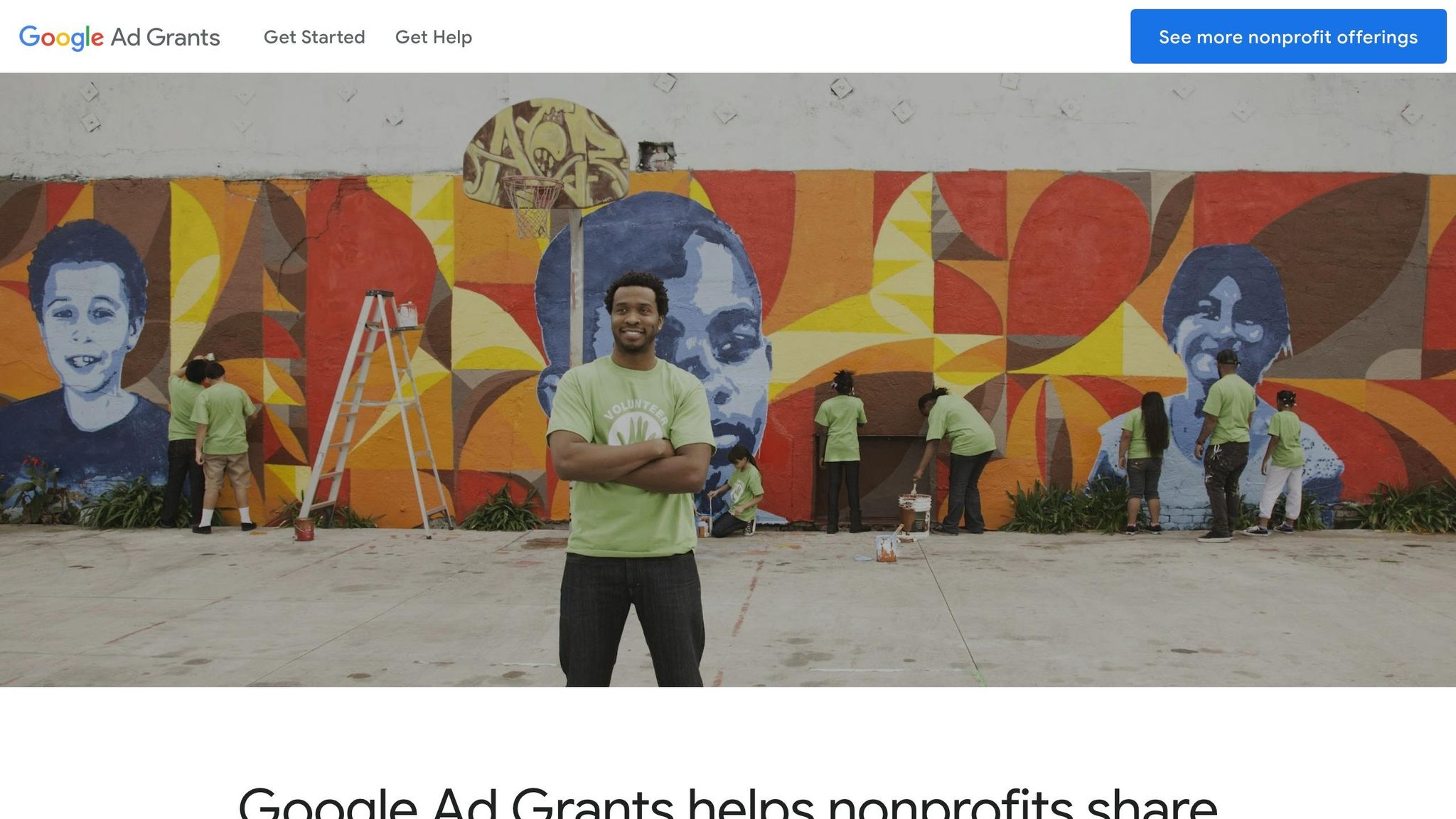
The Google Ad Grant gives eligible nonprofits up to $10,000 per month in free search ads - equivalent to $120,000 annually. Since its launch in 2003, Google has allocated over $10 billion through this program.
Getting started involves three main steps: First, register with TechSoup (now called Goodstack) to get a validation token. Next, use that token to apply for a Google for Nonprofits account. Finally, activate your Ad Grant through the designated portal. Critical tip: Avoid entering any credit card or billing details during setup. Doing so converts your account to a paid one and disqualifies you from the grant.
To maintain eligibility, your account must meet certain requirements, including a 5% minimum monthly click-through rate (CTR). Make sure each campaign has at least two active ad groups, with two responsive search ads per group. Use at least 10 keywords per ad group but steer clear of single-word keywords unless they're brand names or medical terms. During weekly maintenance, pause any keywords with a CTR below 1%.
"Google's ad system rewards relevancy, not size. Local churches using location‑specific keywords often show up before national organizations."
– Brady Sticker, Founder, ChurchCandy
Direct your traffic to specific landing pages instead of your homepage. For example, if someone searches for "churches near me", link them to a "Plan Your Visit" page with service times and directions. If the search is for "help with anxiety", guide them to a dedicated counseling page. Tailored landing pages boost user engagement and improve your campaign's effectiveness. Use negative keywords like "lyrics", "shoes", or "Scientology" to block irrelevant searches that waste impressions. On average, churches using the grant gain over 1,400 free website visits each month.
Here’s a success story: In 2025, a 200-member church in Texas activated their Google Ad Grant. Within three weeks, their daily website visitors jumped from 5 to 47. Over six months, their campaigns brought in over 30 first-time in-person visitors - all without spending a dime on ads.
Once you’ve mastered Google Ad Grants, consider expanding your reach by tapping into Meta and Instagram ads.
How to Create Meta and Instagram Ads
While Google Ad Grants focus on intent-based searches, Meta and Instagram ads let you connect with people based on their interests - ideal for catching attention as they scroll through photos and videos. You can start small with budgets as low as $5 to $10 per day. Begin by setting up a Meta Business Manager account and linking it to your church's Facebook Page and Instagram profile.
When creating your campaign, choose an objective that aligns with your goals. For example:
- Awareness: Promote events or services.
- Engagement: Share updates and encourage interaction.
- Conversions: Drive signups for events or programs.
Next, define your audience by location (usually a 5- to 10-mile radius), demographics, and interests like "faith and spirituality" or "community service."
Meta offers several ad formats, including single images, carousels, and videos. Use real, high-quality visuals from your events or services. Keep the copy conversational and approachable - skip the church-specific jargon in favor of clear, friendly messaging. Always include a compelling call-to-action like "Plan Your Visit" or "Register Now."
Once your campaign is live, experiment with different elements to see what resonates most. A/B test headlines, visuals, and audience segments to find the winning combination. Start with a small budget ($10–$15 per day) for the first week to collect data, then scale up on what performs best. Monitor key metrics like reach, engagement rate, and cost per result to measure your campaign’s success.
"Google's AI is like a smart intern - it can help analyze data and automate tasks, but you still need to oversee and guide the process."
– Andrew Spikes, Faithworks Marketing
One example of success: A mid-size church in the Southeast used their Google Ad Grant to promote community counseling and food distribution. Over 12 months, their campaigns led to over 800 event registrations and 200+ volunteer signups - equivalent to more than $14,000 in paid advertising.
Tracking and Improving Ad Performance
Which Metrics to Track
Once your paid ad campaign is live, keeping an eye on its performance is essential to make the most of your investment. Start with Click-Through Rate (CTR), which measures the percentage of people clicking your ad after seeing it. For faith-based campaigns, a healthy CTR typically falls between 3% to 5%, though highly targeted ads in low-competition areas can hit 10% or more. Another key metric is Cost Per Click (CPC), which tells you how much each click is costing. Staying below $3.00 per click ensures you're spending efficiently.
While clicks are important, conversions - like event registrations, newsletter signups, donations, or volunteer applications - are what truly matter. Pay attention to your frequency metric, too. If the same person sees your ad more than five times, their engagement is likely to drop off. To confirm your digital campaigns are making an impact, track conversions tied to real-world outcomes, such as event attendance or community involvement.
"Understanding how to measure the success of your paid Google Ads campaigns is crucial for ensuring that your church's resources are being used effectively."
– Michael Kimanzi, Founder, Africads Consultants
Use tools like Google Analytics to dig deeper into user behavior. You can see how long visitors stay on your site, which pages they explore, and whether they leave immediately. Adding conversion tracking tags to specific pages - like those for signups or donations - helps you measure the effectiveness of your ads and tweak your approach to better engage your audience.
How to Improve Results Over Time
Whether your campaign is designed for the long haul or a short-term push, regular reviews are key. For long-term ads, check performance every 2–4 weeks; for shorter campaigns, review results every few days. If your CTR starts to dip or your CPC climbs above $3.00, it’s time to refresh your visuals and headlines to recapture attention. Updating your ad creative monthly can help keep your audience engaged.
Testing is another powerful tool. Run A/B tests to compare different headlines, images, or calls-to-action and see which combinations drive the most conversions. Timing also matters - schedule ads to appear during peak activity times, like lunch breaks, evenings, or weekends, rather than spreading them evenly throughout the day. Regularly refine your keyword lists in Google Ads to ensure your content aligns with what people are searching for.
Take Brookstone Church in Asheville, North Carolina, as an example. In early 2024, they partnered with Vers Creative to rebuild their attendance after the pandemic. By running ads with a CPC as low as $0.09 and achieving a CTR that doubled the industry average, they saw steady growth in weekly attendance.
"No matter how good your ads are performing, if your attendance isn't going up, there may be a deeper problem to address."
– Vers Creative
To connect your digital campaigns to physical results, track how many first-time visitors mention discovering you through an ad. If your online metrics look great but in-person attendance isn’t improving, the issue might be with your welcome experience or follow-up process rather than your advertising strategy. By consistently monitoring and refining your efforts, you can ensure your outreach continues to make an impact.
Growing Your Outreach with Share Services
Share Services builds on the foundation of launching and refining paid ad strategies by offering expert-managed campaigns that amplify your reach.
Share Services Paid Media Options
For $1,500 per month, Share Services provides a Paid Media Spend plan that includes professional management of Meta Ads, Google Ad Grants, and detailed analytics tailored for faith-based outreach. This plan helps nonprofits make the most of Google's $10,000 monthly advertising credit - equivalent to $120,000 annually - while also running focused Facebook and Instagram campaigns to engage local families and seekers.
A great example of this in action comes from The Journey Church in Avon, Indiana. In June 2024, they teamed up with Missional Marketing to enhance their Google Ad Grant strategy. By creating targeted landing pages addressing key spiritual questions, they achieved a 12.54% click-through rate - almost three times the industry average - and doubled their website traffic. Lead Pastor Tim shared:
"A guy came to us just a few weeks ago on Easter Sunday... He literally just pulled out his phone and looked up 'church,' and our church popped up first thing. So he came, and he's continued coming since".
This approach combines the power of Google Ads to connect with active seekers and Meta Ads to boost community awareness. By directing traffic to customized landing pages with clear calls-to-action, nonprofits can simplify lead capture and engagement.
To determine which service best suits your nonprofit's goals, explore the plan comparison below.
Share Services Plan Comparison
Share Services offers three tailored plans to meet a variety of outreach and marketing needs:
| Plan Name | Monthly Cost | Best For | Key Features |
|---|---|---|---|
| Paid Media Spend | $1,500 | High-growth donor and visitor acquisition | Meta Ads management, Google Ad Grant oversight, analytics, donor acquisition |
| Monthly Project Budget | $3,000 | Ongoing marketing needs and seasonal events | Email marketing, branding, graphic design, web design, copywriting, donation pages |
| Strategy Retainer | $3,500 | Long-term growth planning and consulting | Dedicated strategist, weekly strategy sessions, project management, KPI reporting |
The Paid Media Spend plan is ideal for faith organizations looking to expand their reach through targeted advertising. For nonprofits needing broader marketing support - like branding, email campaigns, and website updates - the Monthly Project Budget is perfect for handling seasonal events such as Easter or vacation Bible school. Meanwhile, the Strategy Retainer offers long-term guidance with a dedicated strategist, weekly planning sessions, and in-depth KPI tracking.
These plans are designed to help faith-based nonprofits connect with their communities, engage supporters, and maximize the impact of their advertising budgets. Starting with paid media often delivers a return on investment of three times or more as new visitors become regular attendees and supporters.
"Paid ads aren't just a cost in your budget; they're a catalyst for connection".
Conclusion
Paid advertising has become a powerful tool for growth for faith-based nonprofits, helping organizations connect with seekers and supporters who might otherwise be out of reach through traditional methods. With over 1.3 million new social media accounts created daily, the potential to expand your community outreach is enormous.
The strategies outlined earlier emphasize making intentional decisions: taking advantage of the $10,000 monthly Google Ad Grants credit, using genuine visuals featuring real individuals from your ministry, and focusing on local families within a few miles of your location. Each campaign should center on a single compelling story and one clear call-to-action - whether that’s inviting someone to a Sunday service or encouraging donations toward a specific cause.
As Don Dodds, Chief Marketing Strategist at M16 Marketing, explains:
"For nonprofits and religious organizations, digital marketing isn't just a channel - it's a mission multiplier".
This mindset shifts advertising from being just another expense to a modern way of extending hospitality, inviting people to engage where they already spend their time.
Viewing paid ads as the starting point of a broader journey is key. The digital discipleship funnel helps guide individuals from initial awareness to meaningful, long-term involvement. By combining strategic targeting, authentic storytelling, and mobile-friendly landing pages, organizations can create deeper connections with new supporters.
When all these elements come together, the mission remains clear: offering people a sense of community, hope, and purpose through your organization. Whether you’re launching a small event ad or a large-scale campaign, start with manageable steps, track what’s working, and let your faith inform every decision.
FAQs
How do I know if my nonprofit qualifies for Google Ad Grants?
To participate in Google Ad Grants, your nonprofit must hold a valid 501(c)(3) status and fulfill specific requirements. These include maintaining an active website with sufficient content and following Google’s rules, such as not using credit card details in your account. Staying compliant with all eligibility guidelines is essential to retain access to the program.
What should I advertise first: events, donations, or visits?
To kick things off, focus on promoting donations through paid ads. These ads work well for reconnecting with previous donors and motivating them to contribute again. The funds raised can then be used to support initiatives like event promotions and boosting attendance. Starting with donations lays the groundwork for expanding your outreach efforts.
How can I track if ads lead to real in-person engagement?
To find out if your ads are encouraging in-person engagement, tools like Facebook Pixel or Google Analytics can be incredibly helpful. These tools let you monitor user actions, such as event registrations, check-ins, or attendance directly tied to your ads.
Make sure your ads include clear calls-to-action - like prompts to RSVP or visit a location - and use analytics to track the responses. This approach helps you measure how well your campaigns are turning online interest into real-world participation.
Related Blog Posts
Get helpful resources, straight to your inbox
We love sharing tools, ideas, and stories that make nonprofit work a little lighter and a lot more effective. Sign up below and we’ll send you practical tips, free resources, and a bit of encouragement—because the work you’re doing matters.
No spam. Just good stuff for good people.