
Mar 15, 2026
Boost Conversions with Trust Signals
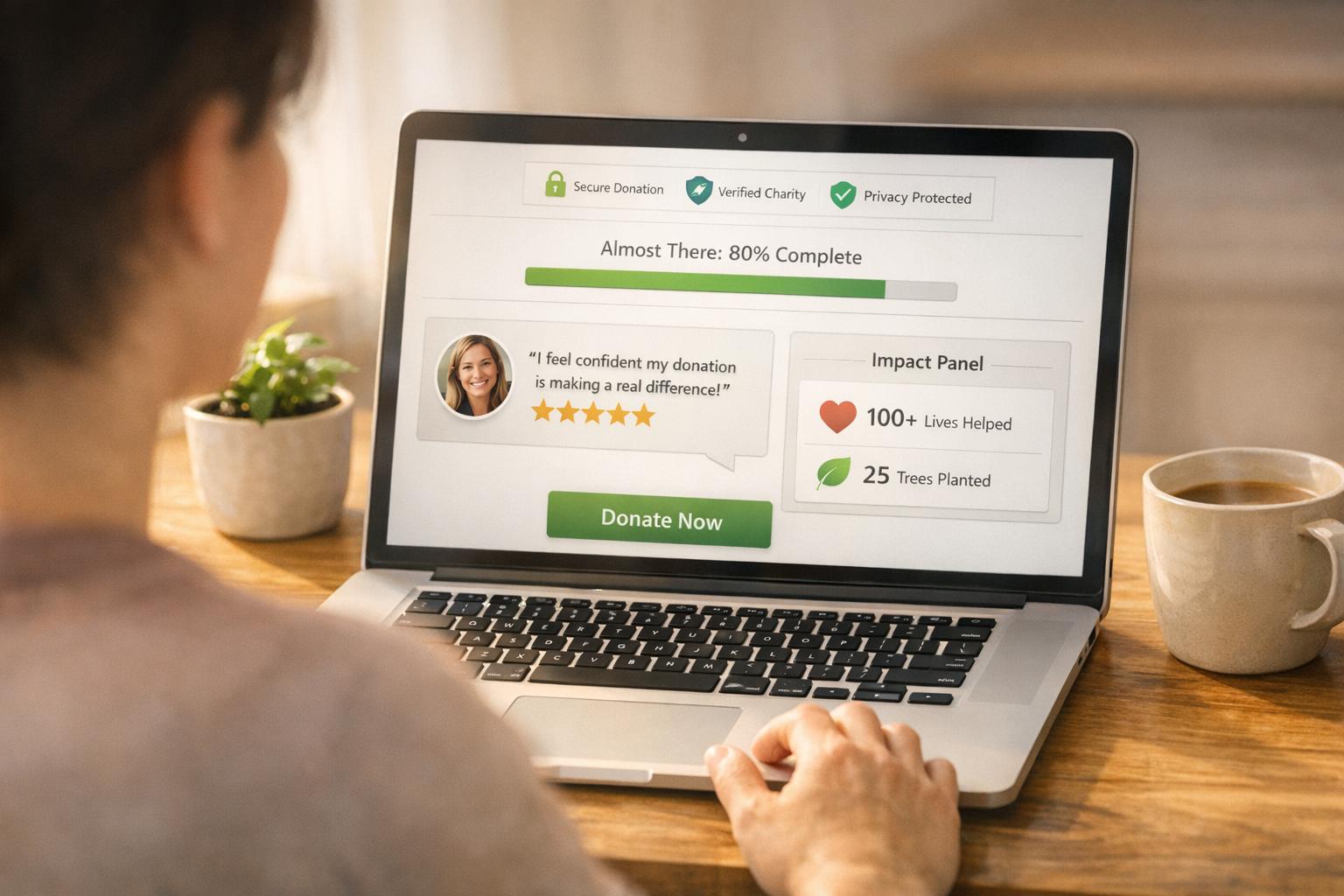
Boosting conversions on donation pages is all about building trust. Donors often hesitate due to concerns about security, transparency, or the legitimacy of an organization. Adding trust signals - like badges, testimonials, and progress bars - can help reassure visitors and drive action. Research shows these elements can increase conversion rates by 15% to 42% while reducing abandonment caused by security fears.
Key trust signals that work:
- Third-Party Ratings Badges: Show credibility through trusted organizations like Charity Navigator or BBB.
- Security Icons: Reassure donors their payment information is safe.
- Progress Bars: Display campaign momentum to encourage participation.
- Financial Transparency Sections: Prove donations are used effectively with clear breakdowns.
- Social Proof Testimonials: Highlight real stories from donors and beneficiaries.
- Impact Metrics: Tie donations to measurable outcomes like meals provided or projects funded.
Quick Tips for Implementation:
- Place trust signals near donation buttons or payment fields.
- Use familiar icons and badges to avoid confusion.
- Keep trust signals concise - too many can overwhelm users.
- Ensure all elements are mobile-friendly since most traffic comes from mobile devices.
These trust signals not only reduce hesitation but also strengthen confidence in your organization, especially for faith-based nonprofits where mission alignment is key. By addressing donor concerns with the right tools, you can turn more visitors into supporters.

6 Trust Signals That Boost Nonprofit Donation Conversions: Impact & Implementation Guide
Best Donation Page Optimizations For Nonprofits | Webinar Video
sbb-itb-deea482
1. Third-Party Ratings Badges
Third-party ratings badges - such as Charity Navigator, BBB Accredited Charity, or GuideStar - help establish trust by associating your organization with credible, independent authorities. For faith-based organizations, these badges serve as a safeguard against skepticism, showing donors that their contributions are being managed responsibly and ethically. When potential donors see that your ministry has been vetted by a trusted source, it answers a crucial question: "Can I trust this organization with my donation?"
These badges are just one of several tools designed to build donor confidence and boost conversions.
Conversion Rate Impact
For lesser-known nonprofits, adding trust badges can lead to significant improvements, while larger, more established organizations may see a modest lift of 0–3% in conversion rates. For example, during November and December 2020, Dallas Theological Seminary tested placing a Charity Navigator badge (with a 75% score) beneath their donation button. The results showed measurable increases in both the number of gifts and the average gift size.
Another experiment in 2025 by Home Plans Marketplace demonstrated the power of trust signals. By adding a Norton trust badge next to an existing "100% secure" label, they achieved a 12.2% boost in conversion rates and a 16.6% increase in total revenue, based on data from 3,480 users with 95% confidence.
Donor Psychology Triggers
Trust badges tap into the concept of social proof - the idea that people look to others' actions or endorsements to guide their decisions. For donors, seeing a respected authority validate your organization helps reduce three common concerns:
- Security risk: Fear of fraud or misuse of personal information.
- Mission risk: Doubts about whether their donation will make a real impact.
- Financial risk: Concerns about whether their money is being used wisely.
Placement matters. Websites have just 50 milliseconds to make an impression, and familiar trust icons can immediately ease donor hesitation.
Ease of Implementation
Where you place badges is key. Position your most trusted badge directly beneath the "Donate" button to address last-minute doubts. Always link the badge to your rating profile for transparency. Limit the number of badges to 3–4 per page, as overcrowding can backfire. Too many badges can overwhelm visitors and even reduce trust, with studies showing a 5–8% drop in conversions when excessive signals are used. Stick to well-known badges, as unfamiliar icons can decrease trust by 12%, even compared to having no badge at all.
Faith-Based Relevance
"Careful placement of trust elements and imagery can still move the needle in 2025, but don't rely on 5 year old 'best practices' to guide you." - Devon Cox, President, ConversionTeam
Today’s donors expect badges to be interactive, linking directly to verification pages for added reassurance. While mobile users tend to engage less with trust signals, they place a higher value on their presence. To adapt, make sure your most recognizable badges are prominently displayed and mobile-friendly. By understanding these behaviors, nonprofits can fine-tune their strategies to maximize the impact of trust signals across all platforms.
2. Security Icons
Security icons - like SSL badges, padlock symbols, and encryption seals - tackle a specific concern: "Is my credit card information safe right now?" While third-party ratings establish your organization's credibility, these icons directly address security fears. And those fears are real - 18% of online donors abandon transactions due to security concerns. For nonprofits, that translates to nearly one out of every five potential donations lost.
Let’s dive into how these icons can make a measurable difference on donation pages.
Conversion Rate Impact
Security icons aren’t just decorative - they reassure donors that their payment information is safe. When used strategically, they can lead to noticeable improvements in conversion rates.
Take this example: In September 2023, Marlin Communications and NextAfter tested a small tweak on a local nonprofit’s donation page. By adding padlock icons near payment fields, they saw an 11.5% increase in donations and a 22% boost among desktop users. Studies also show that placing security badges near payment forms can increase completion rates by an average of 23%. Despite these numbers, only 15% of the 2,000 largest nonprofits in the U.S. currently display security seals on their donation pages.
Donor Psychology Triggers
Security icons work because they act as mental shortcuts. Familiar symbols - like Norton or McAfee - immediately signal safety to donors. This recognition can increase transaction completion rates by 85%. On the flip side, 25% of donors will abandon checkout if they don’t see visible security indicators when it matters most.
"Anxiety about giving does not live on the page - it lives in the mind of the donor."
– Tim Brack, Marlin Communications
Ease of Implementation
Adding security icons to your donation page is surprisingly simple and delivers results. A few best practices include:
- Use a light gray background around credit card fields to create a "secure zone."
- Place padlock icons near field labels and the "Donate" button to reassure donors at the critical moment of decision.
- Choose well-known brands like Norton, McAfee, or DigiCert - 35.6% of respondents trust Norton, for example.
- Avoid unfamiliar or generic icons, as they can undermine trust.
For mobile users, ensure security icons are at least 60 pixels wide and tappable, linking to verification pages. Mobile donors, while spending less time analyzing pages, weigh trust signals 25% more heavily when deciding to give.
Nonprofits can also use digital fundraising platforms like Share Services to integrate these trust signals seamlessly, creating a secure experience that builds donor confidence.
Faith-Based Relevance
For faith-based organizations, security icons play a particularly important role. They help remove the "barrier of doubt" that might stop donors from fulfilling what they see as a moral responsibility. By displaying familiar payment logos (Visa, PayPal, Mastercard) alongside SSL certificates, you’re not just protecting sensitive data - you’re empowering donors to act on their convictions without hesitation.
Position these trust signals where they matter most: at the point where 70% of cart abandonment usually occurs. This is the moment when donors decide whether to follow through, and visible security icons can make all the difference in turning intention into action.
3. Progress Bars
Progress bars answer a crucial question many donors have: "Will my gift actually make a difference?" Unlike security icons, which address safety concerns, progress bars focus on transparency and momentum. For nonprofits, this visual display of progress can mean the difference between a completed donation and one that’s abandoned. By showcasing campaign advancements, they build donor confidence and reinforce the idea that their contributions matter.
Conversion Rate Impact
Progress bars deliver measurable results by leveraging a simple truth: people are more likely to give when they see a campaign gaining traction. Studies show that donations increase significantly once a campaign reaches 66% of its goal. Campaigns that hit 85% funding often experience a surge in conversion rates compared to those stuck at 15%, as donors feel compelled to "help finish the job". For example, one nonprofit boosted its conversion rates by 28% by clearly displaying optimized donation amounts and their potential impact. Using specific figures - like "Raised $8,500 of $10,000" - helps donors see exactly where their contribution fits into the bigger picture.
Donor Psychology Triggers
Progress bars tap into several psychological principles that motivate giving. The Goal-Gradient Effect explains why people feel more driven as a campaign nears its goal. The Endowed Progress Effect encourages donations when there’s visible progress, and the Zeigarnik Effect pushes donors to help "complete the task".
"The closer we get to our goal, the more motivated we are to finish. That last stretch? It's where the magic happens." – Sandra Davis, CEO & Founder, Donorly
Even a modest $50 donation can feel impactful, as it visibly moves the needle closer to the goal. This sense of collective progress resonates strongly, especially within faith-based communities.
Ease of Implementation
Setting up progress bars is straightforward with automated tools that ensure real-time updates as donations come in. This prevents outdated numbers, which can make a campaign seem stagnant. Tools like Charitable Lite or Pro make real-time tracking simple. To maximize impact, don’t start the bar at zero - secure leadership gifts to cover at least 60% of the goal before launching publicly. For larger campaigns, wait until you’re two-thirds of the way there before displaying the bar, and break goals into smaller milestones to keep them achievable (e.g., "Help us reach the halfway point") . This approach not only ensures accuracy but also aligns with the values of faith-based donors, who often prioritize transparency and progress.
Faith-Based Relevance
When paired with other trust signals like badges and security icons, progress bars create a well-rounded strategy that reassures donors throughout the giving process. Faith-based donors, in particular, value honesty and transparency. Progress bars provide clear, real-time evidence of a campaign’s success, turning fundraising into a shared journey rather than a plea for help.
"Fundraising should never feel like desperation. It should feel like shared success." – Sandra Davis, CEO & Founder, Donorly
Linking progress bar milestones to tangible outcomes - like "We’ve funded 100 meals" or "The roof of our community center is complete" - helps donors feel like active participants in meaningful change . This approach taps into the IKEA Effect, where people value something more when they’ve contributed to its creation.
Share Services specializes in helping nonprofits integrate progress bars and other trust signals seamlessly into their digital fundraising strategies. With real-time updates and clear messaging, these tools connect donors directly to the impact of their gifts, fostering a deeper sense of involvement and purpose.
4. Financial Transparency Sections
Financial transparency sections tackle a key question on every donor's mind: "Is my money being used as I intended?" While progress bars can effectively showcase campaign momentum, transparency sections go a step further by addressing trust concerns. They help bridge the "credibility gap" between a potential donor and an unfamiliar organization.
Conversion Rate Impact
Transparency pays off - literally. Organizations that earn a Candid Seal of Transparency see an average 62% increase in donor contributions compared to those without one. Small nonprofits, with annual revenues under $1 million, experience nearly identical results, with donations increasing by 61%. Transparency sections, when paired with trust-building elements like security badges, can also raise conversion rates by 15% to 42%. Showing donors exactly what their money accomplishes - like breaking down how a $50 gift provides 10 meals - removes hesitation and builds confidence in the impact of their generosity. These measurable improvements are backed by psychological factors that influence donor behavior.
Donor Psychology Triggers
Financial transparency taps into deep psychological motivators. It addresses loss aversion - the fear of wasting money - by showing donors their contributions are safe and impactful. Donors often rely on transparency indicators as mental shortcuts to gauge an organization's trustworthiness. Specific, tangible claims like "$50 provides 10 meals" resonate strongly because they allow donors to visualize the direct results of their support.
"Data confirms that nonprofit transparency boosts contributions - in fact, funders give 62% more on average to organizations that devote the time and effort to earn a Candid Seal of Transparency." – Grace Sato, Director of Research, Candid
Interestingly, absolute perfection in transparency can sometimes have the opposite effect. For example, perfect 5-star ratings may reduce conversions by 12% compared to slightly lower ratings (4.2–4.5), as donors may view perfection as unrealistic or staged.
Ease of Implementation
Incorporating financial transparency is surprisingly simple. Earning a Candid Bronze Seal of Transparency, for instance, takes just 15 minutes and is completely free. For added credibility, organizations can invest in third-party security seals from providers like Norton or McAfee, which typically cost between $200 and $400 annually. Placement matters - transparency signals should be positioned near high-friction areas like the "Donate" button or payment fields to maximize their impact. Tools like Charitable can even automate real-time updates for donor counts and financial progress, avoiding the risk of outdated data eroding donor trust. These straightforward steps align well with the expectations of faith-based donors.
Faith-Based Relevance
For faith-based donors, transparency isn't just a nice extra - it’s a reflection of core values like stewardship and accountability. Organizations such as Dallas Theological Seminary have tested trust marks to understand how rankings influence donor confidence and average gift size. When transparency sections include clear breakdowns of how donations translate into ministry outcomes, they build a compelling case for trust and accountability. Share Services specializes in helping nonprofits integrate transparency into their fundraising strategies, ensuring that every dollar is clearly linked to meaningful, measurable results.
5. Social Proof Testimonials
Conversion Rate Impact
Research reveals that detailed social proof testimonials - complete with photos, full names, and specific results - can increase conversions by up to 90%, with an average improvement of 34%. In contrast, generic testimonials only result in a modest 2–5% lift. Video testimonials perform even better, outperforming text by 25–35% because they convey emotional authenticity. Additionally, 88% of consumers trust online reviews as much as personal recommendations, highlighting the influence of digital word-of-mouth during critical decision-making moments. These impressive results are rooted in psychological principles, which are explored further below.
Donor Psychology Triggers
Social proof addresses donor uncertainty by showing that others have already supported the cause, which reinforces the organization’s credibility and fosters an emotional connection through shared goals . This behavior - where people mimic the actions of others in uncertain situations - is a well-documented psychological phenomenon.
"In a skeptical culture, especially online, social proof works as a buffer against doubt. When visitors see that others - especially peers or respected Christian leaders - are giving, they are more likely to believe the organization is legitimate." – Joel Rishel, Client Success Manager, Infinity Concepts
The "warm glow" effect also plays a role, as donors feel a sense of positive self-worth when their contributions align with those of their peers. On the flip side, 49% of consumers interpret a lack of trust signals as a red flag for potential fraud, making testimonials a critical component of building credibility.
Ease of Implementation
Start by identifying loyal donors with a strong connection to your mission. Use their testimonials, including their names, photos, and specific quotes about the impact of their contributions . To enhance credibility, combine donor testimonials - which highlight peer support - with beneficiary testimonials that showcase tangible outcomes . Place these testimonials near the "Donate" button to reduce decision anxiety at the moment of giving. Be mindful of mobile users, as 75% of traffic comes from mobile devices, and ensure testimonials don’t interfere with buttons or navigation. These practical steps help testimonials fulfill their role in building trust and driving action.
Faith-Based Relevance
Testimonials, much like security seals or progress indicators, reinforce your organization’s legitimacy and align with its faith-driven mission. For Christian nonprofits, social proof is more than just a marketing tactic - it reflects faithful stewardship of the mission. Endorsements from respected pastors, ministry leaders, or community figures lend authority and inspire confidence. These endorsements create a sense of belonging to a community with shared values. Share Services specializes in helping nonprofits identify and present the most impactful testimonials, ensuring they remain genuine while boosting donor trust and conversion rates.
6. Impact Metrics
Conversion Rate Impact
Impact metrics turn general appeals into specific, measurable outcomes, which can boost conversions by 10–20%. For instance, replacing broad statements like "helping families" with precise examples such as "$50 provides 10 meals" reduces donor hesitation and builds trust instantly. Similarly, displaying review counts and ratings prominently can improve conversions by 12–18%. Trust blocks featuring impact statistics can further increase conversion rates by 15% to 42%, particularly for smaller or less-recognized nonprofits. For these organizations, trust signals can lead to a 32% lift in conversions, compared to more established brands where trust is already inherent. These figures highlight the power of using impact metrics effectively to connect with donors.
Donor Psychology Triggers
Impact metrics leverage the goal-gradient effect, a psychological principle where people feel more motivated to act as a goal approaches completion. Think of a campaign that’s 85% funded - it inspires more donations than one stuck at 15%, as donors want to support what feels like a winning cause. Showing metrics like the total number of donors adds social proof, answering the unspoken question, "Is this organization trustworthy?". Real-time updates, such as "Sarah from Austin just donated", create urgency and show that your mission is actively gaining momentum.
"A campaign at 85% funded gets more donations than one at 15% because people want to be part of the winning team." – Alvin Collin
Ease of Implementation
To build trust, clearly tie donations to measurable outcomes. For example, statements like "$25 = 5 meals" or "$100 = 3 children's school supplies" help donors see the tangible impact of their contributions. Automated systems that provide live updates reinforce transparency, while outdated metrics can undermine confidence. Displaying donor totals can also create urgency and encourage action. Since about 18% of users specifically look for trust indicators before completing a donation, ensure these metrics are easy to read on mobile devices without requiring zooming.
Faith-Based Relevance
For faith-based nonprofits, impact metrics act as modern-day testimonies - concrete evidence that your mission delivers meaningful results. Dallas Theological Seminary, for example, tested the addition of a Charity Navigator "Give with Confidence" banner on their donation page from November 5, 2020, to December 10, 2020. This banner, which showcased a 75% score, was placed directly beneath the donate button to measure its effect on both the number of gifts and the average gift size. Organizations like Share Services help faith-based groups identify the most resonant metrics for their audience, ensuring transparency aligns with their values while increasing donor engagement and contributions.
Pros and Cons of Each Trust Signal
This breakdown highlights the strengths and challenges of the trust signals mentioned earlier. Each has its own role to play, and finding the right combination is key to improving donor conversions.
Third-party ratings badges can increase conversions by 15–25% for smaller or lesser-known nonprofits. These badges are especially important for faith-based organizations looking to establish credibility. However, they often require lengthy accreditation processes, which can be a hurdle for some organizations.
Security icons directly tackle the issue of lost donations caused by security concerns. For first-time visitors, they can boost conversions by 15–42%. Implementing these icons is relatively straightforward, often involving SSL certificates and trusted payment logos. However, using unfamiliar or generic badges can backfire, reducing trust by 12%. To avoid this, stick with well-recognized seals like Norton or McAfee.
Social proof testimonials are incredibly effective, with the potential to increase conversions by as much as 270%. Video testimonials, in particular, can outperform text by 25–35%. The challenge lies in maintaining authenticity, as overly perfect ratings (like 5 stars) can come across as fake. Ratings in the 4.2 to 4.5 range tend to feel more genuine. For faith-based nonprofits, testimonials also act as modern "witness statements", aligning well with their community-driven values.
Financial transparency sections and impact metrics are powerful tools for building trust. Transparency can boost trust scores by 31% and increase purchase intent by 19%, while impact metrics can lift conversions by 10–20%. However, these features require significant effort, including detailed data reporting and real-time tracking. Organizations like Share Services can help nonprofits identify the most meaningful metrics for their audience, ensuring the work pays off.
Progress bars are effective at using commitment bias to encourage donors to complete multi-step forms. However, they need careful UX design to avoid overwhelming users. Overloading a page with too many trust signals can also create doubt.
"If they need this many badges to convince me they're safe, maybe they're not actually safe."
Conclusion
From the insights above, it’s clear that some trust signals outperform others in driving conversions for faith-based nonprofits. The standout combination? Impact metrics paired with social proof. When donors can see the tangible result of their contribution - like how a $50 donation provides meals for five families - it answers the critical question: "Why should I give?" Add testimonials or real-time donor counts, and you tap into the sense of community that deeply resonates with faith-driven audiences.
For first-time visitors, security icons and third-party ratings are essential to easing concerns at the payment stage. Recognized badges, such as those from Charity Navigator, are far more effective than generic seals, which can sometimes have the opposite effect. The key is to reduce risk without overwhelming the page - limit these signals to 1–3 strategically placed elements.
Placement matters just as much as the signals themselves. Position security badges near the "Donate" button, include specific impact statements, and showcase real-time activity to build trust at every step. As Brimar Online Marketing puts it:
"Trust signals make what's invisible visible. They show your site is safe, real, and worth engaging with."
If implementing these strategies feels daunting, Share Services offers a Monthly Project Budget plan at $3,000 per month. Their team can handle everything from technical setup and A/B testing to the strategic placement of trust signals. They specialize in optimizing donation pages, crafting compelling messaging, and turning cautious visitors into loyal donors.
FAQs
Which trust signals should I add first to a donation page?
Including social proof on your donation page can make a big difference in gaining trust and encouraging contributions. For instance, you could highlight recent donations, showing visitors that others are actively supporting your cause. Another effective approach is featuring testimonials from past donors or beneficiaries. These personal stories and endorsements reassure potential contributors that their money will make an impact, making them more likely to donate.
How many trust signals are too many on one page?
Using an excessive number of trust signals on one page can backfire. Instead of building confidence, it might overwhelm visitors and lead to what's called "defensive design anxiety." This feeling can make users hesitant and even reduce conversions. To avoid this, focus on placing trust signals strategically. Keep their number manageable so they enhance credibility without distracting or confusing your audience.
How do I A/B test trust signals without hurting donations?
To run A/B tests on trust signals effectively, stick to elements that have a track record of building confidence, such as security badges, impact statistics, and transparency indicators. Experiment with their placement and design to see what resonates most, but make sure these signals are genuine and directly relevant to your audience.
Keep the page clean and avoid overwhelming visitors with too many elements. Focus on trust signals that are supported by research. Use careful A/B testing methods to measure even minor improvements, and pay close attention to how these changes affect your donation conversion rates. The goal is to enhance trust without disrupting the donor's experience.
Related Blog Posts
Get helpful resources, straight to your inbox
We love sharing tools, ideas, and stories that make nonprofit work a little lighter and a lot more effective. Sign up below and we’ll send you practical tips, free resources, and a bit of encouragement—because the work you’re doing matters.
No spam. Just good stuff for good people.