

Mar 14, 2026
Top AI Tools for Donor Behavior Prediction
AI tools are transforming how nonprofits predict donor behavior. They help organizations analyze data, forecast donations, and personalize outreach. If you're looking to boost fundraising efficiency, here are six tools worth exploring:
- DonorSearch AI: Predicts donor likelihood with machine learning, offering insights into major gift opportunities.
- Salesforce Einstein AI: Integrates with Salesforce CRM to predict donor actions and optimize engagement.
- Fundraise Up: Suggests real-time donation amounts and identifies recurring donor opportunities.
- ChatGPT for Nonprofits: Assists with donor segmentation and personalized content creation.
- Virtuous: Combines CRM and predictive AI to forecast donor behavior and recommend actions.
- Share Services: Tracks donor activity and adjusts campaigns dynamically for nonprofits with $1M–$20M annual revenue.
Each tool offers unique features, from predictive analytics to real-time donor insights. Choosing the right one depends on your organization's size, budget, and fundraising goals.
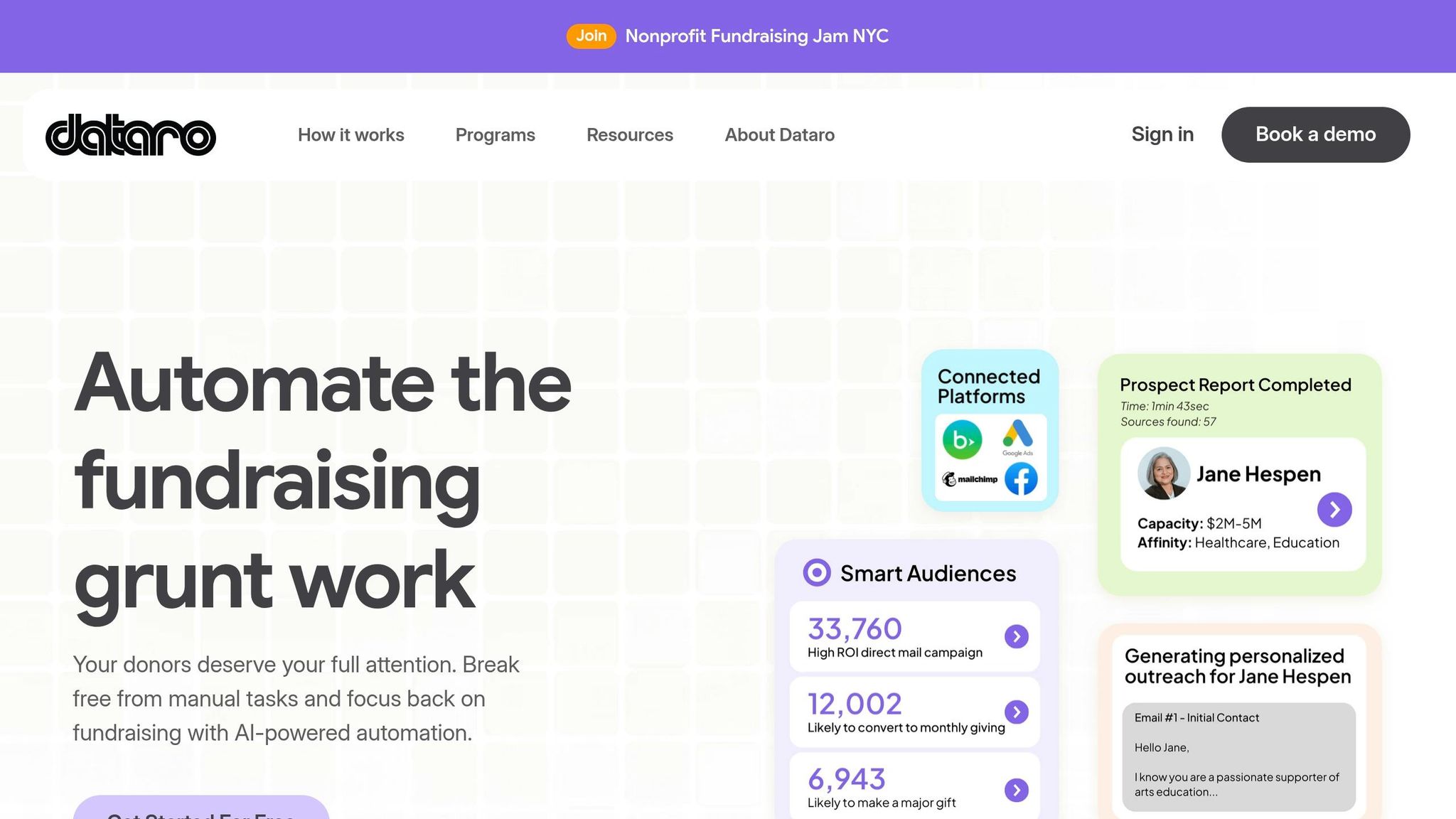
Dataro Predict - Fundraising AI Software that Turns Your Donor Data into Donor Predictions
sbb-itb-deea482
1. DonorSearch AI
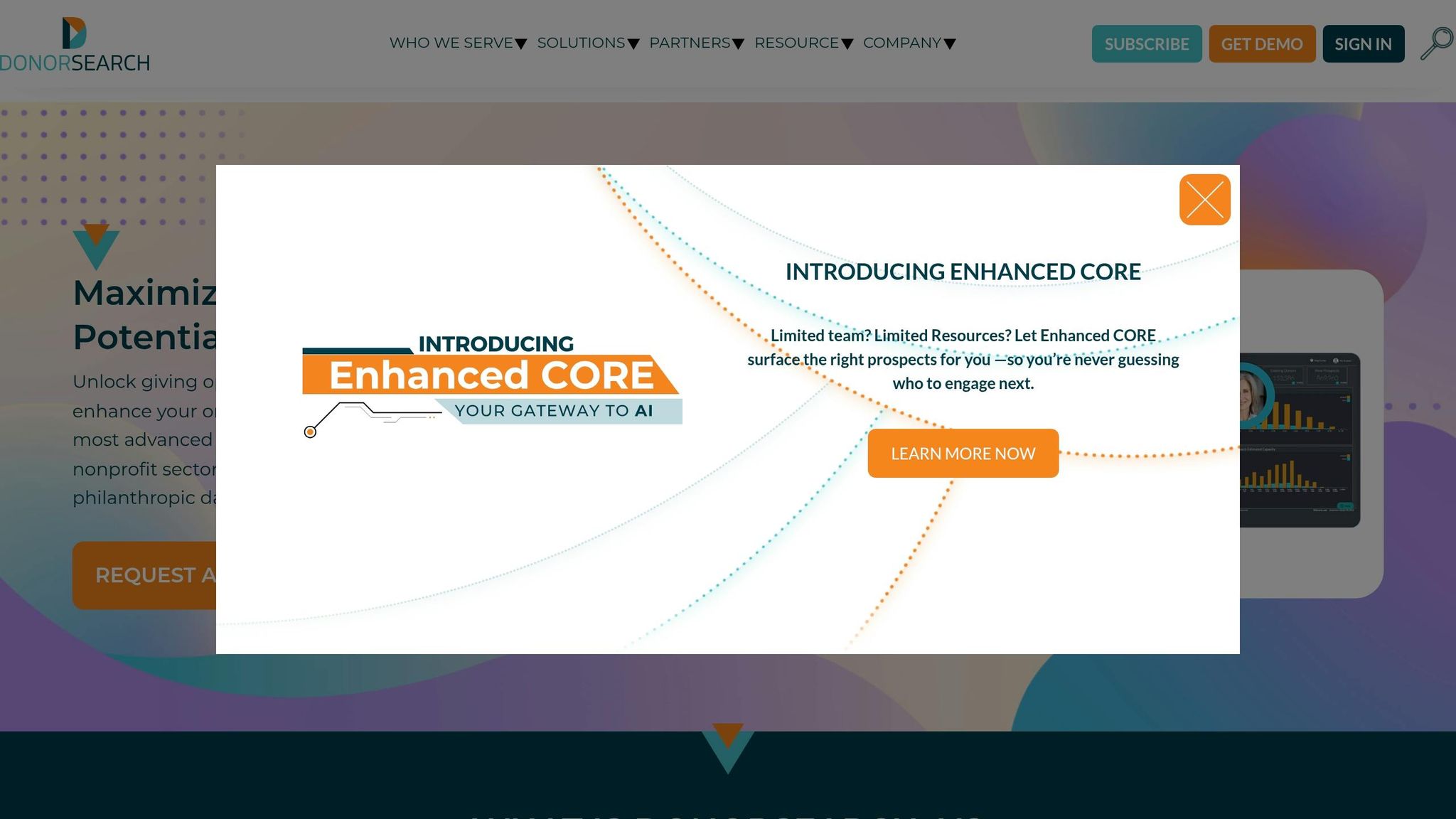
DonorSearch AI (DSAi) leverages machine learning to dive deep into your internal data and a massive philanthropic database. Its Most Likely to Respond (MLR) Score pinpoints donors who are most likely to contribute within the next 12 months. By analyzing over 800 data points - like email engagement, event attendance, and real-time donation activity - it uncovers complex donor behaviors at lightning speed. This goes far beyond just tracking giving history; it predicts patterns like repeat donations, retention rates, and even the potential for larger gifts. These insights set the stage for more advanced analytics, which we’ll explore further.
Predictive analytics capabilities
DSAi transforms traditionally time-consuming tasks into quick, automated processes. For instance, portfolio analysis that once took hours can now be completed in minutes. Nonprofits using the platform have reported impressive results, including 85% increases in response rates and 81% accuracy in identifying repeat donors. Custom AI models developed through DSAi have also uncovered repeat donors who contribute gifts averaging ten times higher than those found through standard prospecting methods.
The impact doesn’t stop there. One development director slashed their mailing volume by 75%, saving $50,000 in costs while boosting annual fund revenue by 10%. Blue 13 Dance Company tapped into the MLR Score to identify high-affinity donors, raising over $100,000 and achieving a 20% increase in overall contributions. Similarly, the Children's Healthcare of Atlanta Foundation unearthed major gift prospects within their existing database, securing donations they would have otherwise missed.
DSAi doesn’t just predict outcomes - it integrates seamlessly with your existing tools to keep everything running smoothly.
Integration with nonprofit tools
With over 40 platform integrations, DonorSearch AI works effortlessly with popular nonprofit CRMs and fundraising software. It enhances your internal donor data by adding external philanthropic insights, giving you a more comprehensive understanding of your donors. The platform adheres to strict security standards, including SOC 2 Type 1, CCPA, and HIPAA, ensuring donor information remains protected. These integrations make DSAi a versatile solution for nonprofits across various sectors, from healthcare and education to arts, culture, and faith-based organizations.
On top of its technical features, DSAi offers flexible pricing options to accommodate nonprofits at different levels of AI adoption.
Pricing and scalability for nonprofits
For organizations just starting with AI, DonorSearch provides the Enhanced CORE version. This entry-level option includes pre-built predictive models and user-friendly visualizations. For those seeking more advanced capabilities, the full DonorSearch AI suite offers enterprise-grade customization with tailored AI models.
Matthew Cook, Executive Director of Blue13 Dance Company, shared: "You will make your money back. It will easily give you a return on investment in your first year".
The platform has the power to identify prospects with 20 times higher lifetime values than traditional methods and speeds up the movement of major donors through the pipeline by about 17%.
2. Salesforce Nonprofit Cloud (Einstein AI)
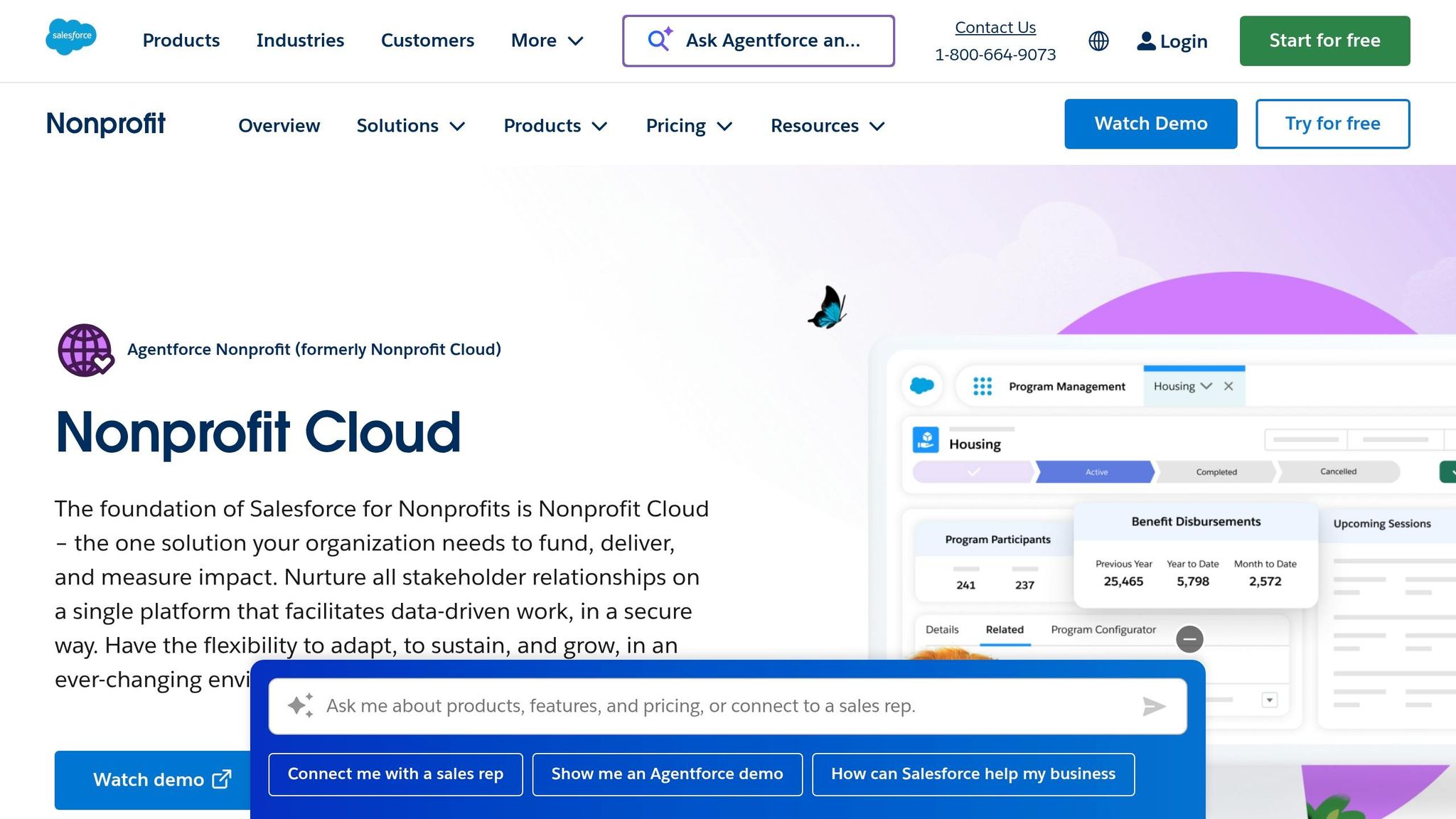
Salesforce has taken donor outreach to the next level by incorporating AI into its Nonprofit Cloud. With Einstein AI, nonprofits can move beyond guesswork and focus on data-driven strategies. The Einstein Prediction Builder analyzes past donor behavior and similarities, assigning probability scores to predict actions like becoming a first-time, recurring, or major donor. These insights are added directly to donor profiles, helping fundraisers prioritize outreach efforts effectively. For smaller datasets, Salesforce provides "Backup Models" that offer broader predictive insights.
Predictive analytics capabilities
Einstein Discovery is a powerful tool for nonprofits, helping them set realistic fundraising goals and identify the factors that drive high-value donations. But it doesn’t stop at fundraising - this AI system also predicts potential membership churn and program registration likelihood, giving organizations the chance to act before issues arise. As Aldo Jiménez explains:
"The best person to create a prediction is not a data scientist but someone who knows the data and day-to-day operations of the business".
The system refines its predictions over time, typically requiring about a month after activation to deliver more accurate results. Nonprofits can start with the free "Einstein for Nonprofits" package, which includes pre-configured models for predicting first-time, top, and recurring donors.
Personalization features
Salesforce also focuses on personalization to enhance donor engagement. The Fundraising Gift Proposals tool uses generative AI to create tailored proposals based on donor history and interests. Meanwhile, Einstein Send Time Optimization ensures email campaigns reach donors at the most effective times by analyzing individual patterns, such as time zones and past engagement. The system also generates Major Donor Engagement Summaries, offering fundraisers quick, detailed briefs before important interactions.
For organizations already using Marketing Cloud Engagement, tools like Send Time Optimization and Engagement Scoring can be activated through the platform’s setup menu at no extra cost. Data privacy is a priority, with the Einstein Trust Layer ensuring sensitive donor information is masked and not retained by large language models.
Integration with nonprofit tools
The Data Cloud for Nonprofits consolidates data from various sources - like spreadsheets, donor databases, and volunteer logs - into unified profiles, providing a complete view of stakeholders. This eliminates the inefficiencies of siloed systems and enables seamless collaboration. The platform integrates smoothly with tools like Slack, Marketing Cloud Engagement, Experience Cloud, and CRM Analytics.
Kathryn McCarthy, President and CEO of Pacific Clinics, highlights the benefits:
"Nonprofit Cloud is a game changer for nonprofits like us since it provides a single location for all of our stakeholders to see and work from the same information and make program and funding adjustments in real time".
Post-implementation, 82% of users reported faster decision-making, and 95% experienced a positive return on investment.
Pricing and scalability for nonprofits
Salesforce offers flexible pricing to suit a variety of nonprofit needs. Through the Power of Us Program, eligible nonprofits receive 10 free subscriptions. Beyond that, pricing depends on the edition selected:
- Enterprise Edition: $175 per user/month, includes basic AI features.
- Unlimited Edition: $350 per user/month, offers Predictive AI.
- Agentforce 1 Sales Edition: $550 per user/month, includes the full AI suite.
Some AI agent features may involve additional consumption-based costs, starting at around $2 per conversation. For those just testing the waters, the free "Einstein for Nonprofits" app allows one active prediction at a time.
3. Fundraise Up
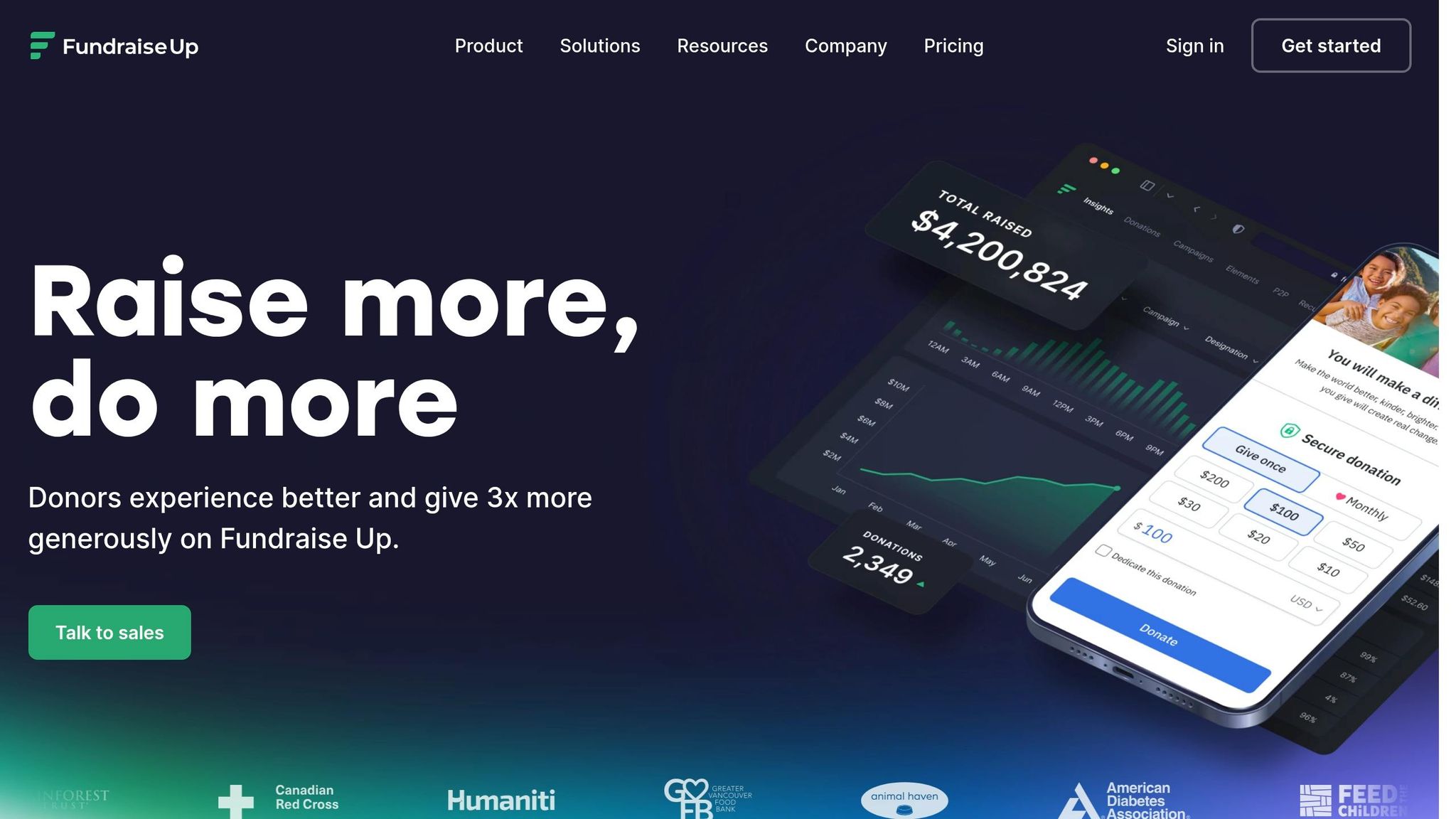
Fundraise Up uses machine learning to analyze over 200 data points, such as device type, location, time of day, cell carrier, and donor behavior, to suggest the most suitable donation amounts in real-time. This method has delivered impressive results: nonprofits using these AI-generated suggestions report a 30% rise in average gift size and a 10-15% boost in overall revenue. By combining data insights with predictive analytics, the platform enhances both donor conversion and retention.
Predictive analytics capabilities
Fundraise Up doesn’t just suggest donation amounts - it also identifies the best opportunities to encourage one-time donors to become recurring contributors. In fact, 26% of recurring plans on the platform are the result of these AI-driven upsell prompts. The system also excels at retaining donors by anticipating when they might cancel their recurring gifts. By offering options like pausing or reducing their contributions, the platform retains 27% of donors who were about to cancel.
The Salvation Army UK shared remarkable results in November 2025, reporting that 49% of donors converted using AI, and 70% of donations were made through AI-suggested amounts.
Fraud detection is another strength, with the platform identifying 1.3% of transactions as fraudulent and blocking 98.8% of these before they are processed. This proactive approach builds donor trust while maintaining high reliability.
Personalization features
Unlike standard donation forms, Fundraise Up customizes gift options based on each donor's capacity. Its AI-powered donor portal includes "Give More" buttons and upgrade prompts tailored to individual giving histories. These personalized touches align with broader strategies to engage donors more effectively. Matthew Mills, Communication Director at China Partnership, highlighted:
"We really appreciate the innovative features in Fundraise Up, such as using AI to populate suggested donation amounts".
To ensure privacy, Fundraise Up uses anonymized data for personalization, eliminating the need for names or email addresses upfront. The platform also offers an adaptive cost coverage feature, and 87% of donors opt to cover transaction fees when this option is enabled.
Integration with nonprofit tools
Fundraise Up seamlessly integrates with over 100 major CRMs, including Salesforce, HubSpot, DonorPerfect, Bonterra EveryAction, and Neon CRM. Through Zapier, it connects with more than 8,000 additional apps, enabling automated workflows based on donor behavior predictions. Its infrastructure is built to handle high-traffic events like #GivingTuesday and year-end campaigns, ensuring peak performance. Even minor delays - like a 100-millisecond lag - can affect conversion rates, so the platform is designed for speed.
Pricing and scalability for nonprofits
Fundraise Up is designed to scale for nonprofits of all sizes, especially those requiring fast and reliable performance during high-demand periods. Pricing details are available upon request. The platform’s results speak volumes: users achieve an average click-to-donate conversion rate of 29%, far surpassing the industry average of 12%. For example, Greater Good Charities saw a 161% increase in online revenue and a 230% growth in recurring giving revenue, effectively doubling their monthly giving income.
4. ChatGPT for Nonprofits
ChatGPT serves as a versatile tool for nonprofits, especially in analyzing donor behavior. While it’s not a dedicated predictive analytics platform, it can process internal data - like survey results and program participation records - to uncover trends that might indicate future donation patterns. It’s particularly effective at segmenting donors by demographics, giving history, or even geographic factors, such as targeting high-income zip codes, to estimate their responsiveness. This functionality makes ChatGPT a valuable companion to more specialized analytics tools.
Predictive Analytics Capabilities
Although ChatGPT doesn’t replace advanced predictive platforms, it can identify key characteristics of engaged donors, helping nonprofits build detailed donor personas. These personas can then be used to predict how donors might respond to mission-related messages. By analyzing anonymized metadata, organizations can maintain donor privacy while still gaining insights into behavioral trends. Additionally, ChatGPT can summarize external research and statistics, offering nonprofits a clearer picture of economic or social factors that could influence donor capacity and willingness to contribute. For larger-scale needs, it can be paired with specialized analytics tools to process extensive datasets and create highly personalized donor engagement strategies.
Personalization Features
ChatGPT is adept at creating tailored content, such as personalized email subject lines or fundraising letters, designed for specific donor segments. It also ensures consistency across multiple platforms, including social media, SMS, blogs, and direct mail. According to a survey conducted in the "GPT for Nonprofits" LinkedIn group, 73% of fundraisers have used ChatGPT for their work, with nearly half using it weekly. Kara Schmid, Communications Manager, highlights its role:
"ChatGPT is not a replacement for human-to-human engagement. Rather, it is a tool that can augment and enhance your interactions and outreach".
Integration with Nonprofit Tools
Several nonprofit platforms, like Funraise and CharityEngine, have integrated ChatGPT into their CRMs. This allows users to generate content directly within the application, eliminating the need to switch between tools. CharityEngine, for instance, enables staff to use simple commands like "show me my longest-lapsed donors", and the system responds with detailed reports. For even broader connectivity, nonprofits can use Zapier to link ChatGPT with over 8,000 other apps, automating workflows and streamlining operations. ChatGPT can also be embedded into website chatbots, providing 24/7 support for donor questions and inquiries. CharityEngine expressed enthusiasm about this integration:
"We're so excited about this technology, we're making it available to all CharityEngine customers for free…at least for now!".
Pricing and Scalability for Nonprofits
OpenAI offers nonprofits a 20% discount on ChatGPT Business plans and a 50% discount on Enterprise plans. While there’s a free version available, it doesn’t include advanced features or robust data analysis capabilities. Nonprofits can also create customized "fundraising assistants" by uploading their own knowledge base to a Custom GPT, ensuring outputs align with their specific needs. The platform’s "Projects" feature further helps organize data for initiatives like annual giving or capital campaigns. With 82% of nonprofit professionals expressing confidence in using AI for donor outreach and 69% believing it reduces manual tasks, thereby improving job satisfaction, ChatGPT provides an accessible way for nonprofits to refine their donor engagement strategies.
5. Virtuous
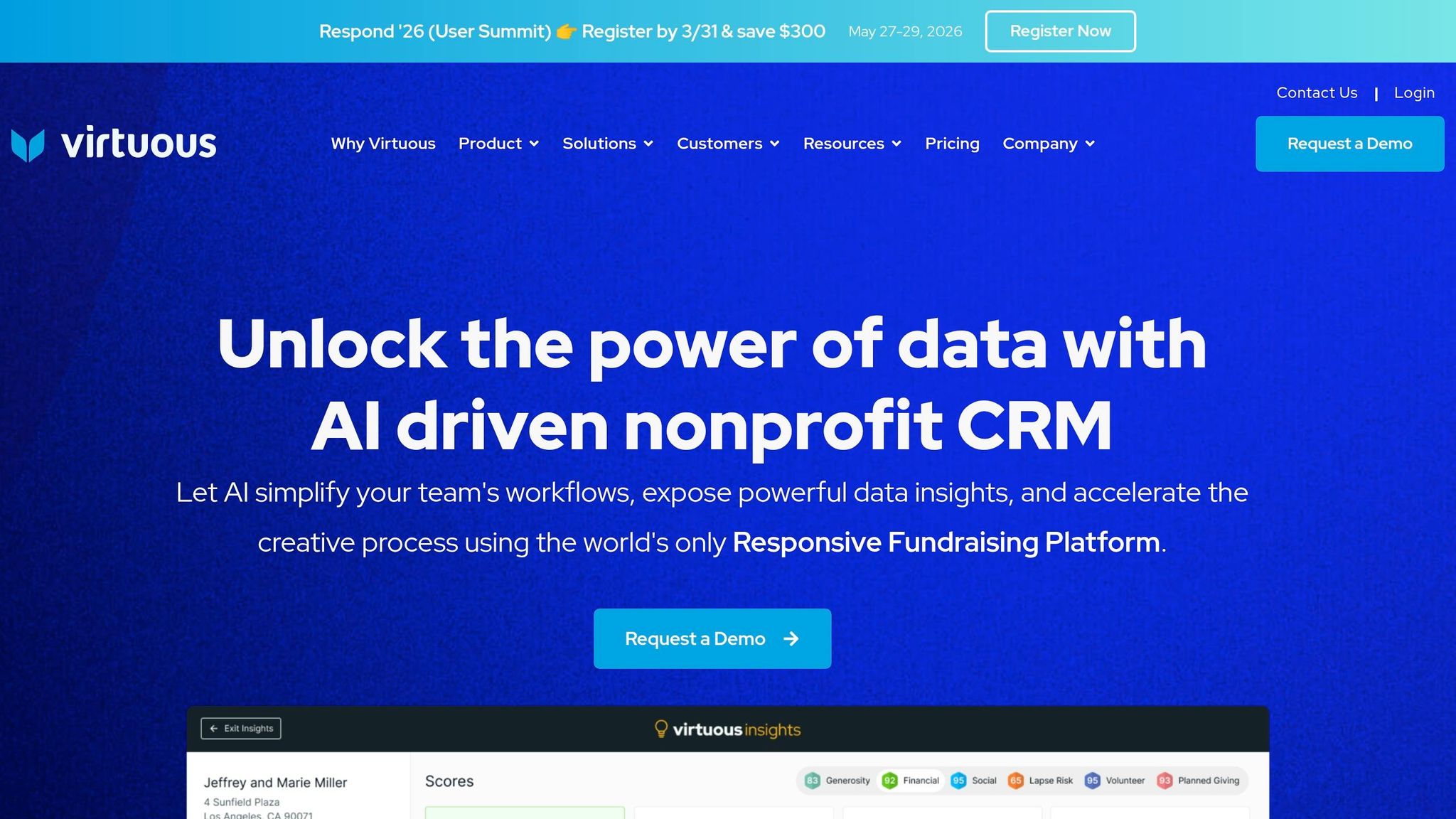
Virtuous combines CRM tools with predictive AI, enabling nonprofits to anticipate donor behaviors. Its Virtuous Insights engine applies machine learning to analyze donor activity, assigning predictive scores for factors like giving likelihood, churn risk, and potential for planned gifts or upgrades. By integrating donor engagement history, gift records, and third-party data (such as wealth, demographics, and social media), it provides a comprehensive donor profile that sets it apart from other platforms. This data-driven approach forms the foundation for predictive analytics that deliver actionable insights.
Predictive Analytics Capabilities
Virtuous tracks real-time signals - like website visits, email opens, and social media interactions - to recommend the "next best action" for each donor. The platform can automatically trigger personalized emails, such as a donor welcome series, or tasks when donors show signs of disengagement or readiness for increased contributions. It also suggests AI-recommended gift amounts tailored to each donor's giving history and financial capacity. Samantha Mellon, Director of Development at A Kid's Place Tampa Bay, highlighted the platform's proactive approach:
"Virtuous Insights predictive capabilities are a game-changer - we're no longer reacting to data, we're acting on it before it happens".
Nonprofits using Virtuous have reported an 8% to 12% boost in donor retention and a 10% to 15% increase in average gift size. Verland, for example, achieved a staggering 345% year-over-year increase in funds raised under the leadership of VP of Philanthropy Abigayle Tobia.
Personalization Features
The Virtuous Momentum AI agent helps gift officers prioritize their inboxes and automates the drafting of personalized emails based on donor data and fundraising strategies. Pam Colbert, Mid-Level Gift Officer at Metropolitan State University in Denver, shared how it simplifies her daily tasks:
"When I open up Momentum, I know I've got a plan. It keeps me going in the morning... it's picking up the work for me!".
Organizations leveraging Virtuous Momentum have seen impressive results, including a 66% increase in major gift size and a 400% expansion in mid-level portfolio capacity. Victory Mission, for instance, experienced a 75% rise in monthly recurring donors over two years by utilizing these features.
Integration with Nonprofit Tools
Virtuous enhances nonprofit operations through seamless integrations. Its App Marketplace and Open API connect with tools like Dataro (for advanced AI modeling) and DonorSearch (for prospect research). Built on Microsoft Azure as a Tier 1 Partner, the platform ensures enterprise-grade security, HIPAA compliance, and robust data encryption. Unlike other CRMs, Virtuous not only predicts donor behaviors but also centralizes data from multiple sources, providing clear next-step recommendations. As Brad D. noted:
"Virtuous ties together different systems and is our main repository for donor data. It is the data silo killer for our organization".
By automating processes, teams using Virtuous report saving an average of 520 hours annually and reducing administrative time by 20%.
Pricing and Scalability for Nonprofits
Virtuous offers two main pricing tiers: the Platform Tier for nonprofits with annual fundraising revenue up to $5 million, and the Enterprise Tier for organizations exceeding that amount. Additional modular features include Virtuous Raise (for online giving), Virtuous Insights (for AI-driven predictions), and Virtuous Volunteer, with pricing tailored to each tier. The platform's reputation is further bolstered by its recognition as the #1 Momentum Leader in the nonprofit CRM category in G2's Spring 2024 Report, where it earned 15 badges, including "High Performer" and "Most Likely to Recommend".
6. Share Services
Share Services takes AI-powered donor insights to the next level by combining predictive analytics with hands-on campaign execution. Designed for mid-sized nonprofits with annual fundraising between $1M and $20M, this platform doesn't just provide software - it actively monitors donor behavior and adjusts strategies as campaigns unfold. With its real-time adaptability, Share Services offers a comprehensive approach that goes beyond data analysis to deliver actionable results.
Predictive Analytics Capabilities
Share Services uses tools like Donation Tracking and KPI Reporting to monitor donor engagement across various channels. It fine-tunes conversion rates by testing targeted messaging on donation pages and emphasizes reactivating lapsed donors - a more cost-effective approach than acquiring new ones. By leveraging data-driven, multi-channel strategies, it ensures nonprofits can reconnect with past donors effectively.
Integration with Nonprofit Tools
The platform consolidates donor activity from sources like websites, email campaigns, donation platforms, and CRMs to create unified donor profiles. With over 700 pre-built integrations, it connects seamlessly to a nonprofit's existing tech stack. Using Identity Resolution technology, Share Services links anonymous website visitors to known donor records across devices and channels, ensuring all systems stay updated in real time.
Pricing and Scalability for Nonprofits
Share Services offers a tailored pricing model with three main components:
- Strategy Retainer: For $3,500/month, nonprofits gain access to a dedicated strategist who provides weekly sessions, project management support, and detailed KPI reporting.
- Monthly Project Budget: At $3,000/month, this covers essential donor programs, email marketing, branding, graphic design, web design, copywriting, donation pages, and conversion optimization.
- Paid Media Spend: Starting at $1,500/month, this budget supports targeted campaigns across Meta ads, OTT advertising, Google Ad Grants, and other analytics-driven donor acquisition efforts.
This structure ensures nonprofits can scale their efforts while maintaining a strategic and data-driven approach to fundraising.
Tool Comparison Table

AI Tools for Donor Prediction: Features, Pricing & Best Use Cases Comparison
This table brings together the essential details of each tool to help you quickly weigh your options and choose the best fit for your nonprofit. The choice largely depends on your organization's size, budget, and technical needs. Each platform offers distinct approaches to predictive analysis, integration, and pricing.
Predictive accuracy varies by tool. DonorSearch AI utilizes wealth screening and philanthropic data, while Einstein AI leverages your existing CRM data for engagement insights. Fundraise Up focuses on real-time donation behavior to optimize ask amounts and timing. ChatGPT for Nonprofits is geared toward content personalization rather than predictive modeling. Virtuous users have reported an impressive 345% increase in year-over-year fundraising through AI-driven donor conversations. Share Services combines predictive analytics with active campaign monitoring, adapting strategies as donor behavior evolves in real time.
Integration capabilities also differ significantly. DonorSearch AI and Einstein AI are designed to work within their respective platforms, making them ideal for organizations already using those systems. Fundraise Up connects seamlessly with donation platforms and CRMs via APIs. ChatGPT operates independently without database connections. Virtuous includes a native CRM with built-in AI, eliminating the need for third-party integrations. Share Services stands out with over 700 pre-built integrations and Identity Resolution technology, which links donor activity across multiple channels and devices.
Pricing models range widely. DonorSearch AI follows an annual subscription model based on database size. Salesforce Nonprofit Cloud requires a CRM license plus additional costs for Einstein AI features. Fundraise Up uses a transaction-based pricing system, with 84% of donors covering fees through Adaptive Cost Coverage. ChatGPT for Nonprofits offers a free tier and a $20/month premium plan. Virtuous pricing depends on tiered packages and requires consultation. Share Services uses a three-part pricing structure: $3,500/month for a Strategy Retainer, $3,000/month for a Project Budget, and a $1,500/month Paid Media Spend minimum.
| Tool | Predictive Focus | Best For | Starting Price | Key Integration |
|---|---|---|---|---|
| DonorSearch AI | Wealth screening, major gift identification | Nonprofits seeking major donors | Custom pricing | Native platform |
| Salesforce Einstein AI | CRM data analysis, engagement scoring | Organizations using Salesforce | Add-on to NPSP license | Salesforce ecosystem |
| Fundraise Up | Real-time donation optimization | Online fundraising campaigns | Transaction-based | Donation platforms, CRMs |
| ChatGPT for Nonprofits | Content personalization, communication | Small teams needing writing support | Free–$20/month | Independent tool |
| Virtuous | Donor churn prediction, upgrade opportunities | Mid-sized nonprofits wanting an all-in-one CRM | Custom pricing | Native CRM |
| Share Services | Multi-channel behavior tracking, campaign execution | Nonprofits with $1M–$20M revenue | $8,000/month total | 700+ integrations |
This overview highlights the tools' predictive strengths, integration options, and pricing structures to help you align them with your organization's goals. For nonprofits on a limited budget, ChatGPT offers an affordable way to enhance content creation. Meanwhile, organizations aiming to scale should consider platforms that combine predictive insights with active donor engagement tools.
Conclusion
AI tools are reshaping how nonprofits connect with and understand their donors. The shift from reactive to predictive modeling gives organizations the power to anticipate donor behavior - spotting potential churn, fine-tuning ask amounts in real-time, and personalizing outreach on a large scale. By 2024, 58% of nonprofits have already adopted AI, particularly in fundraising and marketing efforts. Early adopters have seen 35% higher donor retention rates compared to those relying on traditional methods.
Selecting the right AI tool depends on factors like organization size, budget, and technical capabilities. For smaller nonprofits with limited resources, no-code platforms or ready-to-use tools requiring minimal setup are ideal. Mid-sized organizations using CRMs like Salesforce can enhance their workflows with tools like Einstein AI for predictive scoring. Nonprofits focused on major gifts might consider wealth screening solutions such as DonorSearch AI, while those prioritizing online donations could explore real-time optimization tools like Fundraise Up.
A smart way to start is by testing an AI tool on a single campaign - like an automated thank-you email sequence or a targeted social media fundraiser - to gauge ROI before scaling up. This cautious approach minimizes risk and helps teams build confidence in the technology.
AI strategies work best when they automate data-heavy tasks, allowing teams to focus on building meaningful relationships with major donors or re-engaging lapsed supporters. As Ruzida Badrutdinova from Fundraise Up puts it:
"AI, especially as implemented by Fundraise Up, is designed to work with your team, not replace it. It enhances your ability to connect with donors by taking care of the technical, data-driven tasks".
For nonprofits ready to translate these insights into action, tailored solutions can drive results. Share Services is a standout example, offering a blend of predictive analytics and adaptive campaign management for organizations with annual revenue between $1 million and $20 million. Their pricing model - $3,500/month for strategy, $3,000/month for project work, and a $1,500/month paid media minimum - comes with over 700 pre-built integrations and Identity Resolution technology. This system tracks donor activity across multiple channels and adjusts campaigns in real time based on donor behavior, making it a comprehensive option for nonprofits looking to scale their fundraising efforts effectively.
FAQs
What data is needed to predict donor behavior with AI?
To effectively predict donor behavior with AI, you'll need access to data that paints a clear picture of your donors. This includes details like donor interactions, giving history, engagement patterns, and demographic information. By analyzing these elements, AI tools can uncover patterns and trends, helping you fine-tune your campaigns for better results.
How can nonprofits validate AI predictions without risking donor relationships?
To ensure the safe validation of AI predictions, nonprofits should treat AI as a decision-support tool rather than relying on it for automated actions. For example, when AI identifies at-risk donors, staff should carefully review these suggestions before taking any steps.
Testing is key. Nonprofits can use methods like A/B testing or small-scale pilot programs to confirm the accuracy of AI-generated insights. This approach minimizes risks and helps refine strategies.
Above all, focus on personalized, human-centered communication. AI can guide efforts, but it’s the human touch that builds trust and strengthens donor relationships. By blending AI insights with thoughtful engagement, nonprofits can enhance connections without compromising the integrity of those relationships.
What’s the fastest low-risk way to pilot an AI tool and measure ROI?
To test an AI tool with minimal risk, start small with a controlled rollout. Use your existing donor data and basic automation to keep things manageable. Opt for a no-code or low-code platform that offers predictive scores and actionable insights. For the pilot, focus on a specific objective - like pinpointing high-potential donors - and measure key metrics such as response rates or donor retention. This approach helps you gauge ROI effectively without overcomplicating the process.
Related Blog Posts
Get helpful resources, straight to your inbox
We love sharing tools, ideas, and stories that make nonprofit work a little lighter and a lot more effective. Sign up below and we’ll send you practical tips, free resources, and a bit of encouragement—because the work you’re doing matters.
No spam. Just good stuff for good people.